

What Is Bookkeeping and Why It Matters for Profitability
For many Kansas City small business owners, bookkeeping feels like a confusing chore you can put off until tax time. Yet overlooking this process can quickly lead to missed payments, tangled expenses, or trouble with tax compliance. Learning the basics of accurate financial record-keeping pays off by giving you the facts and control needed to run your business with confidence. Discover how bookkeeping clears up financial uncertainty and brings real value to home service companies with fewer than 20 employees.
Table of Contents
- Bookkeeping Defined And Common Misconceptions
- Types Of Bookkeeping Systems Explained
- How Bookkeeping Supports Small Business Success
- Essential Bookkeeping Tasks And Tools
- Mistakes To Avoid In Small Business Bookkeeping
Key Takeaways
| Point | Details |
|---|---|
| Importance of Bookkeeping | Accurate bookkeeping is crucial for informed decision-making and financial health in small businesses. |
| Bookkeeping Methods | Choose between single-entry for simplicity or double-entry for detailed insights based on business size and complexity. |
| Essential Tasks | Regularly record transactions, reconcile statements, and generate reports to maintain financial clarity. |
| Common Mistakes | Avoid mixing personal and business finances and ensure timely record-keeping to prevent costly errors. |
Bookkeeping Defined and Common Misconceptions
Bookkeeping is the systematic process of recording, tracking, and organizing a business’s financial transactions. Unlike what many small business owners might assume, it’s far more than just keeping receipts in a shoebox or logging numbers into a spreadsheet.
At its core, bookkeeping involves recording financial transactions with precision and consistency. This means documenting every financial event that impacts your business, including:
- Purchases and sales
- Receipts and payments
- Employee wages
- Vendor invoices
- Tax-related transactions
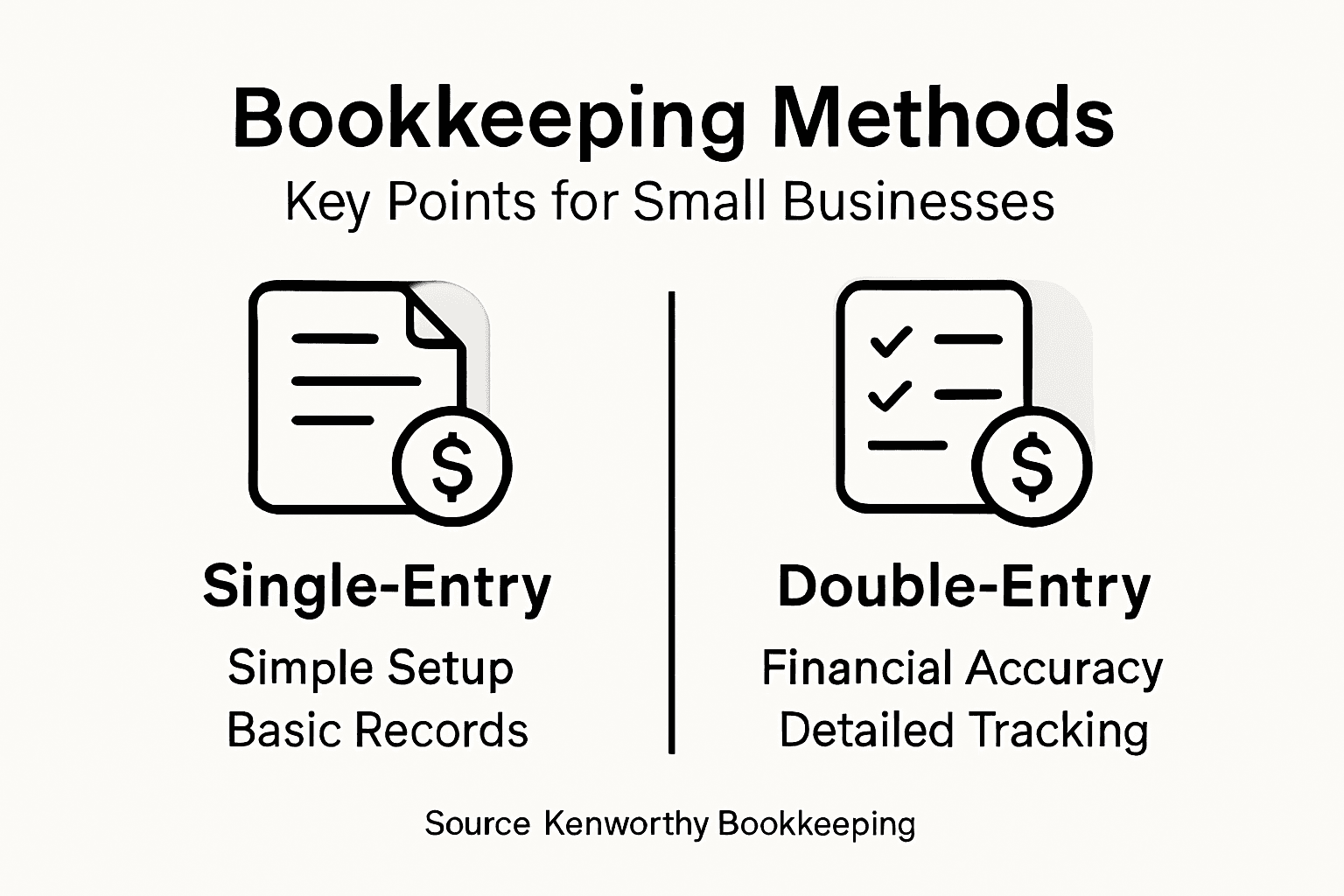
There are multiple bookkeeping methods, with two primary systems dominating the landscape: single-entry and double-entry bookkeeping. Single-entry is simpler, recording transactions in one account, while double-entry requires recording each transaction in two separate accounts to ensure mathematical accuracy.
Common misconceptions about bookkeeping can seriously harm a small business’s financial health. Many entrepreneurs mistakenly believe bookkeeping is optional or something they can handle casually. In reality, maintaining accurate financial records is critical for making informed business decisions, preparing tax returns, and understanding your company’s financial performance.
Pro tip: Treat your bookkeeping like a monthly health checkup for your business—consistent, thorough, and non-negotiable.
Types of Bookkeeping Systems Explained
For small business owners, understanding the different bookkeeping system types is crucial for maintaining accurate financial records. Essentially, there are two primary bookkeeping methods: single-entry and double-entry systems, each with unique characteristics and applications.
Single-Entry Bookkeeping is the simplest method, ideal for small businesses with minimal financial complexity. In this system, each transaction is recorded only once, typically in a cash book or spreadsheet. Key features include:
- Minimal accounting knowledge required
- Lower administrative overhead
- Suitable for businesses with few transactions
- Less expensive to maintain
- Simple tracking of cash inflows and outflows
Double-Entry Bookkeeping offers a more comprehensive approach, recording each financial transaction in two separate accounts. This method ensures mathematical accuracy and provides deeper financial insights. Characteristics include:
- Recording transactions as debits and credits
- Provides built-in error checking mechanism
- Generates more detailed financial reports
- Recommended for medium to large businesses
- Enables complex financial analysis
The choice between single-entry and double-entry bookkeeping depends on your business size, transaction volume, and financial reporting requirements.
While single-entry systems work well for very small businesses or sole proprietorships, growing companies typically transition to double-entry bookkeeping to maintain more precise financial records and support strategic decision-making.
Here’s a quick comparison of the two leading bookkeeping systems and their impacts on small businesses:
| Aspect | Single-Entry System | Double-Entry System |
|---|---|---|
| Complexity | Simple for beginners | Requires accounting knowledge |
| Error Detection | Limited error visibility | Built-in error checks |
| Reporting Detail | Basic cash flow overview | In-depth financial analyses |
| Scalability | Best for sole proprietors | Suits growing or complex businesses |
Pro tip: Regularly reassess your bookkeeping system as your business grows to ensure it continues meeting your financial management needs.
How Bookkeeping Supports Small Business Success
Bookkeeping is more than just recording numbers—it’s a critical strategic tool that supports small business financial health. By systematically tracking financial transactions, small business owners gain unprecedented visibility into their company’s economic performance and potential growth opportunities.
Key ways bookkeeping supports business success include:
- Tracking cash flow and income sources
- Identifying potential cost-saving opportunities
- Preparing accurate financial statements
- Ensuring tax regulation compliance
- Supporting strategic decision-making
- Providing transparent financial records
Financial Tracking and Analysis enables business owners to understand their revenue streams and expense patterns. By meticulously documenting every financial transaction, entrepreneurs can make informed financial decisions that directly impact profitability.
Consistent and accurate bookkeeping transforms financial data into actionable business intelligence.
Professional bookkeeping goes beyond simple record-keeping. It serves as a comprehensive financial dashboard, helping small business owners anticipate challenges, recognize growth opportunities, and maintain a clear understanding of their company’s financial trajectory.

Pro tip: Schedule monthly reviews of your financial records to catch potential issues early and maintain consistent financial health.
Essential Bookkeeping Tasks and Tools
For small business owners in the Kansas City area, understanding essential bookkeeping tasks is crucial for maintaining financial health and driving business growth. Effective bookkeeping involves more than simply tracking numbers—it’s about creating a comprehensive financial management system.
Core Bookkeeping Tasks include:
- Recording all financial transactions
- Categorizing expenses and income
- Reconciling bank statements
- Generating financial reports
- Tracking accounts receivable and payable
- Maintaining accurate tax documentation
- Monitoring cash flow
Financial Documentation and Reporting requires systematic approach. Small businesses must consistently document every financial interaction, from client invoices to vendor payments. This ensures transparency and provides critical insights into business performance.
Accurate bookkeeping is the foundation of financial intelligence for small businesses.
Modern bookkeeping leverages technology to streamline processes. Digital tools can automate many time-consuming tasks, reducing human error and providing real-time financial insights. Small business owners should seek solutions that integrate seamlessly with their existing workflows and provide user-friendly reporting capabilities.
Pro tip: Invest in cloud-based bookkeeping software that offers automatic transaction categorization and real-time financial reporting.
Below is a summary of bookkeeping’s business benefits and related tools:
| Benefit | Description | Recommended Tool Type |
|---|---|---|
| Cash Flow Monitoring | Tracks money entering and leaving | Cloud-based dashboards |
| Expense Categorization | Groups expenses for clarity | Automated transaction apps |
| Financial Reporting | Generates statements and summaries | Report generation software |
| Tax Document Management | Organizes paperwork for tax season | Secure digital storage |
Mistakes to Avoid in Small Business Bookkeeping
Kansas City small business owners often encounter critical bookkeeping challenges that can derail their financial success. Common bookkeeping mistakes can create significant financial risks that compromise business profitability and operational efficiency.
Critical Bookkeeping Errors include:
- Mixing personal and business finances
- Neglecting to save small receipts
- Failing to track reimbursable expenses
- Misclassifying employees or contractors
- Inconsistent record-keeping
- Avoiding regular financial reconciliation
- Poor communication with financial professionals
Financial Documentation Challenges require vigilant attention. Small businesses frequently struggle with maintaining organized and accurate financial records, which can lead to unexpected tax complications and missed opportunities for deductions.
Consistent and meticulous bookkeeping is your first line of defense against financial mismanagement.
Professional bookkeeping demands more than just recording transactions. Maintaining timely and accurate records helps prevent costly errors and provides a clear picture of your business’s financial health. By implementing systematic documentation practices, entrepreneurs can avoid common pitfalls that plague small business financial management.
Pro tip: Schedule weekly financial review sessions to catch and correct potential bookkeeping discrepancies before they become significant problems.
Take Control of Your Small Business Finances with Expert Bookkeeping
Understanding the importance of accurate bookkeeping is the first step toward boosting your business profitability and avoiding common financial pitfalls like inconsistent record-keeping and poor cash flow tracking. If you are overwhelmed by tasks like categorizing expenses, reconciling bank statements, or preparing for tax season, you are not alone. Small business owners in Kansas City face these challenges daily but you do not have to manage them on your own.

Kenworthy Bookkeeping specializes in providing effortless and reliable bookkeeping solutions tailored for small businesses. By leveraging QuickBooks Online, our team ensures every financial transaction is properly recorded and categorized, giving you clear financial reports such as P&L statements and helping you stay tax ready. Gain the peace of mind that comes with having a trusted partner focused on your financial health. Discover how easy it can be to maintain accurate books and make confident business decisions by visiting Kenworthy Bookkeeping. Act now and start transforming your bookkeeping into a powerful tool for your business success.
Frequently Asked Questions
What is bookkeeping?
Bookkeeping is the systematic process of recording, tracking, and organizing a business’s financial transactions, including purchases, sales, employee wages, and tax-related activities.
Why is bookkeeping important for small businesses?
Bookkeeping is critical for small businesses as it helps maintain accurate financial records, supports informed decision-making, ensures tax compliance, and provides insights into the company’s financial performance.
What are the main types of bookkeeping systems?
The two main types of bookkeeping systems are single-entry and double-entry bookkeeping. Single-entry is simpler, suitable for small businesses with fewer transactions, while double-entry offers a more comprehensive approach suitable for larger businesses, ensuring mathematical accuracy and detailed reporting.
What are common mistakes to avoid in bookkeeping?
Common bookkeeping mistakes include mixing personal and business finances, neglecting small receipts, inconsistent record-keeping, and failing to reconcile bank statements regularly.
Recommended
- Bookkeeping and Profitability: Strategies for Small Businesses
- Role of Bookkeeping in Growth for Home Services
- Role of Bookkeeping for Small Business Success – Kenworthy Bookkeeping Blog
- Why Small Businesses Need Bookkeeping Services
- Understanding The Role Of Consulting Services In Accounting – Stratgetic IT Consultants For Accountants