

Why keep receipts: essential guide for Kansas City 2026
Many small business owners think keeping receipts is just busywork, something to worry about only when tax season arrives. This misconception costs Kansas City businesses thousands in lost deductions and penalties every year. Receipts aren’t just paper trails. They’re your financial defense system, protecting every dollar you’ve earned and spent. This guide reveals why keeping receipts is critical for IRS compliance, how proper documentation shields you from audits, and practical strategies to organize receipts efficiently in 2026.
Table of Contents
- Why Keeping Receipts Matters For Kansas City Small Businesses
- What Receipts The IRS Requires And How To Keep Them Properly
- Benefits Of Digital Receipts Versus Paper Receipts For Small Businesses
- How Keeping Accurate Receipts Supports Expense Management And Audit Defense
- Optimize Your Bookkeeping And Receipt Management With Expert Help
- Frequently Asked Questions
Key takeaways
| Point | Details |
|---|---|
| Maximize tax deductions | Keeping receipts substantiates business expenses and prevents disallowed deductions during IRS audits. |
| Meet IRS requirements | Receipts must include amount, date, place, business purpose, and vendor details to satisfy federal documentation rules. |
| Digital saves time and money | Digital receipt systems cut storage costs by 80% and reduce processing time from 15 minutes to 5 minutes per expense. |
| Protect against audits | Poor documentation triggers IRS scrutiny and can result in penalties, interest charges, and lost deductions. |
| Support smart decisions | Organized receipts enable accurate expense tracking, better budgeting, and informed pricing strategies. |
Why keeping receipts matters for Kansas City small businesses
The IRS doesn’t accept your word when you claim business expenses. You need proof. Accurate record keeping is crucial for maximizing tax deductions and avoiding penalties. Without receipts, you can’t substantiate expenses, which means the IRS can disallow deductions and hit you with penalties and interest charges.
Kansas City adds another layer. If you operate here, you must comply with the city’s 1% earnings tax. Proper bookkeeping helps avoid penalties from both federal and local tax authorities. Missing receipts create gaps in your financial records, making it nearly impossible to prove compliance when questions arise.
Here’s what happens when you skip receipt keeping:
- The IRS disallows deductions you legitimately earned
- You pay higher taxes than necessary
- Audit risk increases dramatically
- You lose the ability to defend your tax return
- Penalties and interest compound your losses
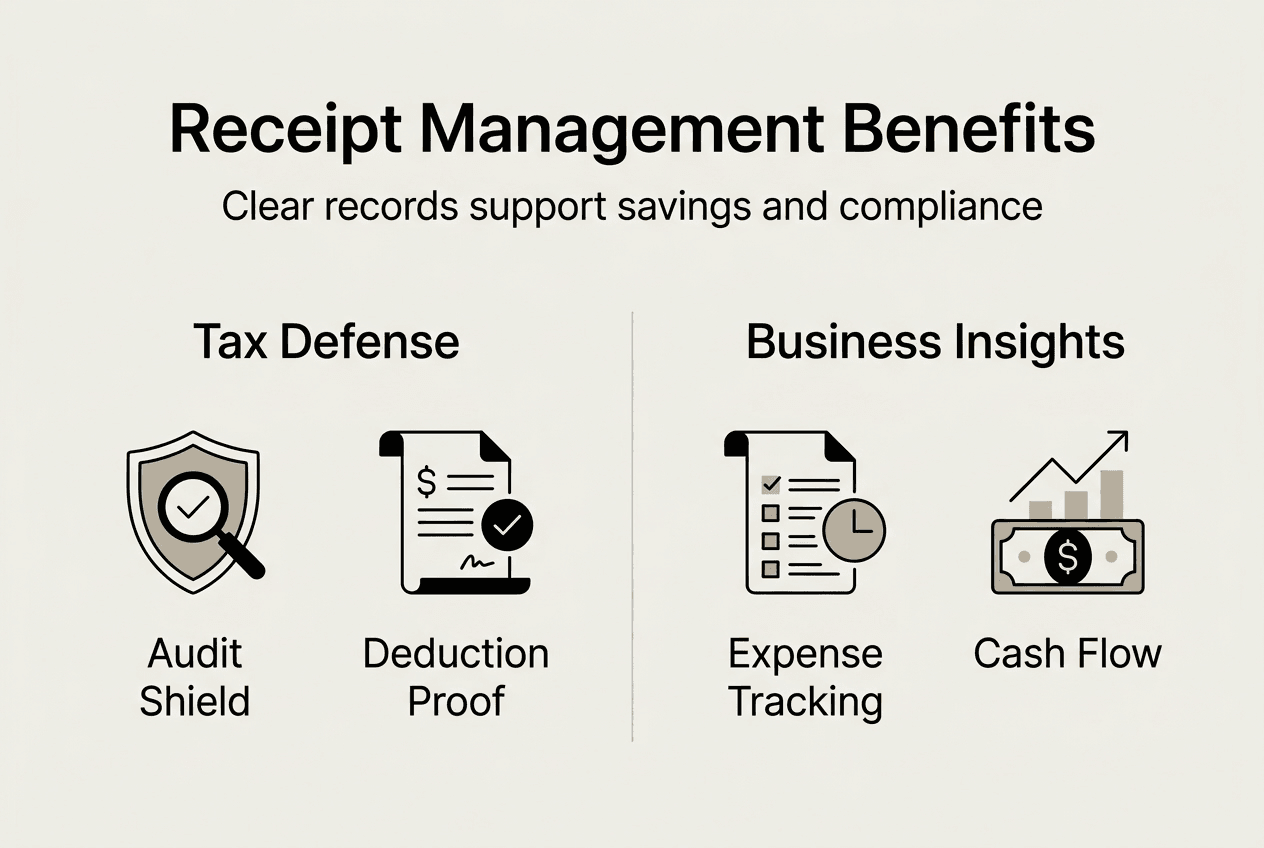
Receipts do more than satisfy tax collectors. They create a clear picture of where your money goes. You can identify spending patterns, negotiate better vendor rates, and make smarter purchasing decisions. Every receipt tells a story about your business operations.
Pro Tip: Set up a simple system today, even if it’s just a shoebox. Collecting receipts now beats scrambling during tax season or facing an audit with empty hands.
Think of receipts as your business insurance policy. Failure to maintain adequate records leads to disallowed deductions and financial penalties. The small effort of keeping receipts protects you from massive headaches later. Your small business accounting depends on this foundation.
“The burden of proof is on you, the taxpayer. Without receipts, you have no proof.”
What receipts the IRS requires and how to keep them properly
The IRS has clear rules about what makes a valid receipt. You can’t just save random scraps of paper and hope for the best. Every receipt you keep must include five essential elements: the amount paid, the date of purchase, the place or vendor name, the business purpose, and the relationship to your business operations.
Here’s what the IRS demands:
- Purchase description: What you bought and why it relates to business
- Date: When the transaction occurred
- Proof of payment: Receipt, invoice, or bank record showing you paid
- Amount: Total cost including tax
- Payee details: Vendor name and contact information
IRS documentation requirements specify these elements for valid expense substantiation. Missing even one element can weaken your documentation during an audit.
The $75 rule creates confusion. Receipts are required for expenses of $75 or more per transaction. Below that threshold, you still need documentation, just not necessarily a formal receipt. Bank statements, credit card records, or invoices can work for smaller purchases. Don’t interpret this as permission to skip documentation entirely.
| Receipt Type | IRS Acceptance | Best Use Case |
|---|---|---|
| Paper receipts | Accepted if legible and complete | Traditional record keeping |
| Digital receipts | Accepted if accurate with required details | Modern businesses seeking efficiency |
| Credit card statements | Accepted as supplementary proof | Supporting documentation |
| Bank records | Accepted with additional context | Backup when receipts are lost |
| Invoices | Accepted if payment proof included | Service based transactions |
Retention periods matter. Keep receipts at least three years from when you filed your return. If the IRS suspects fraud or you underreported income by 25% or more, that extends to six or seven years. Employment tax records need four years of retention.
Pro Tip: Create a simple filing system by month and category. When tax time arrives, you’ll have everything organized and ready. Digital tools make this even easier, automatically categorizing expenses as you scan receipts.
Acceptable documentation goes beyond traditional receipts. Credit card statements work as backup proof. Bank records showing electronic payments count. Invoices paired with payment confirmation satisfy IRS requirements. The key is maintaining complete, organized, and accessible financial records that tell the full story of your business expenses. Your bookkeeping best practices should include a clear system for capturing and storing all these documents.
Benefits of digital receipts versus paper receipts for small businesses
Paper receipts fade, tear, and disappear at the worst possible moments. Digital receipts solve these problems while saving you time and money. Businesses save up to 80% on receipt storage costs when they go digital. That’s real money back in your pocket.

The time savings are equally impressive. Processing expenses drops from 15 minutes to just 5 minutes on average with digital systems. Multiply that across dozens or hundreds of transactions monthly, and you’ve reclaimed hours for productive work.
| Factor | Paper Receipts | Digital Receipts |
|---|---|---|
| Storage cost | High, requires physical space | Minimal, cloud based storage |
| Processing time | 15 minutes per expense | 5 minutes per expense |
| Risk of loss | High, fading and damage common | Low, backed up automatically |
| Search and retrieval | Slow, manual sorting required | Instant, keyword searchable |
| IRS compliance | Accepted if legible | Accepted if complete and accurate |
| Environmental impact | Paper waste and storage | Minimal physical footprint |
The IRS fully accepts digital receipts. Digital copies meet IRS requirements if they’re accurate and include all required details. You don’t need to keep paper originals once you’ve created reliable digital copies. This gives you flexibility in how you manage records.
Here’s how to implement digital receipt management:
- Use your smartphone camera to capture receipts immediately after purchase
- Choose receipt scanning apps that automatically extract key data
- Store digital files in cloud services with automatic backup
- Organize by month, category, or vendor for easy retrieval
- Review and categorize receipts weekly to stay current
Digital systems offer benefits beyond compliance. You can access receipts anywhere, anytime. Need to check a vendor charge while traveling? Pull it up on your phone. Preparing for a meeting with your accountant? Email all receipts instantly. This accessibility transforms how you manage business finances.
Pro Tip: Take photos of receipts the moment you receive them. Thermal paper receipts fade within months, making them useless for tax purposes. A quick photo preserves the information permanently.
Environmental and operational benefits add up. Less paper means reduced office clutter and easier organization. Digital receipts eliminate physical storage needs entirely. Your small business accounting becomes cleaner and more efficient. You’ll wonder why you ever dealt with paper receipts once you experience the simplicity of digital systems. Understanding why tracking expenses matters helps you appreciate the power of digital organization.
How keeping accurate receipts supports expense management and audit defense
Receipts reveal patterns you’d otherwise miss. When you review spending over time, you spot trends in vendor costs, seasonal fluctuations, and unnecessary expenses. Proper record keeping allows accurate expense management to control costs and make informed business decisions. This isn’t just about taxes. It’s about running a smarter operation.
Expense tracking with receipts helps you:
- Identify your biggest cost categories and find reduction opportunities
- Compare vendor pricing and negotiate better rates with data
- Spot unusual charges or billing errors before they multiply
- Set realistic budgets based on actual spending history
- Make pricing decisions that reflect true costs and maintain profitability
Audit defense is where receipts become your shield. The IRS examines your tax return and questions deductions. Without receipts, you have no proof. The IRS relies heavily on documentation to verify tax return items. Missing documentation means disallowed deductions, period.
Poor documentation triggers audits and costly penalties. The IRS looks for red flags like unusually high deductions, missing receipts, or inconsistent records. When they find these issues, they dig deeper. Your entire return comes under scrutiny. What started as one missing receipt can snowball into a full audit.
Common audit triggers you can prevent:
- Claiming large deductions without supporting receipts
- Mixing personal and business expenses in the same accounts
- Round numbers suggesting estimates rather than actual expenses
- Inconsistent record keeping across different expense categories
- Missing documentation for cash transactions
Separating personal and business finances is critical. Use dedicated business bank accounts and credit cards. This creates a clear paper trail and eliminates confusion about which expenses are legitimate business costs. When everything is mixed together, proving business use becomes nearly impossible.
“Documentation is your first line of defense in an audit. Without it, you’re fighting a battle you can’t win.”
Receipts also support strategic planning. You can analyze which products or services generate the best returns relative to their costs. You identify seasonal patterns that affect cash flow. You make data driven decisions instead of guessing. Your business budgeting becomes precise and actionable.
Pro Tip: Review your receipts monthly, not just annually. This regular habit catches errors early, keeps your records current, and gives you real time insights into business performance. Monthly reviews take 30 minutes but save hours during tax preparation.
The peace of mind is invaluable. When you know your receipts are organized and complete, you sleep better. Tax season becomes routine instead of stressful. Audits become manageable instead of terrifying. Understanding why bookkeeping matters helps you appreciate how receipts form the foundation of financial confidence.
Optimize your bookkeeping and receipt management with expert help
Keeping receipts organized takes discipline and time. Many Kansas City small business owners struggle to maintain consistent records while running their operations. Professional bookkeeping services eliminate this burden and ensure your financial records meet IRS standards.

Expert bookkeepers categorize expenses correctly, reconcile accounts regularly, and maintain receipt records that withstand scrutiny. They know exactly what documentation the IRS requires and how to organize it for maximum protection. This expertise reduces audit risk significantly while freeing you to focus on growing your business.
Kenworthy Bookkeeping specializes in helping Kansas City small businesses maintain accurate, compliant financial records. Their services include receipt organization, expense categorization, and preparation for tax season. You get peace of mind knowing professionals handle the details while you concentrate on serving customers and increasing revenue. Schedule a consultation to discover how expert bookkeeping transforms your financial management. Learn more about bookkeeping best practices and explore comprehensive small business accounting services tailored for Kansas City entrepreneurs.
Frequently asked questions
What types of receipts should small business owners keep?
Keep receipts for all business expenses including supplies, equipment, travel, meals, utilities, rent, professional services, and vehicle costs. Any expense you plan to deduct on your tax return needs supporting documentation. This includes both large purchases and small daily expenses.
How long do I need to keep business receipts?
The IRS requires keeping receipts for at least three years from when you filed your tax return. If you underreported income by 25% or more, extend that to six years. Employment tax records need four years of retention. When in doubt, keep receipts longer rather than discarding them too soon.
Are digital receipts as valid as paper receipts for the IRS?
Yes, the IRS accepts digital receipts if they contain all required information: amount, date, vendor, business purpose, and proof of payment. Digital copies must be clear, complete, and accessible. You can safely discard paper receipts once you’ve created reliable digital versions with proper backup.
What happens if I lose a receipt the IRS requests during an audit?
Without receipts, the IRS may disallow the related deduction, resulting in higher taxes, penalties, and interest. You can try to reconstruct records using bank statements, credit card records, or vendor invoices, but this is much harder than keeping original receipts. Missing documentation significantly weakens your audit defense.
Do I need receipts for expenses under $75?
The IRS requires formal receipts for any single expense of $75 or more. For expenses under $75, you still need documentation but can use bank statements, credit card records, or other proof of payment. Don’t skip documentation entirely just because an expense is small. Consistent record keeping protects all your deductions.
Recommended
- 7 Bookkeeping Best Practices 2025 for Kansas City Owners
- Why Bookkeeping Matters for Kansas City Businesses
- 7 Essential Business Budgeting Tips for Kansas City Owners
- Why Track Expenses – Boost Profitability in Kansas City
- Why choose Cape Town for events: 2026 prestige guide – Winelands Function – For Every Occasion, Your Celebration
- Sustainable Floor Care in Colorado 2026: Cut Costs 25%