

Business Expenses: Key Tax Deductions for 2026
Sorting through what counts as a business expense often frustrates home service owners in Kansas City. Clear definitions set by the IRS mark a line between personal and business spending, but common myths and misunderstandings trip up even seasoned professionals. Properly categorizing ordinary and necessary business expenses helps keep your records clean, lowers audit risk, and gives you a true picture of your profitability.
Table of Contents
- Defining Business Expenses and Common Myths
- Major Categories of Deductible Expenses
- IRS Rules for 2026: What Qualifies?
- Best Practices for Categorizing and Recording Expenses
- Common Mistakes That Trigger Audits
Key Takeaways
| Point | Details |
|---|---|
| Understanding Business Expenses | Expenses must be ordinary, necessary, and reasonable to qualify for deductions. Personal purchases cannot be disguised as business costs. |
| Common Expense Categories | Key categories include vehicle costs, equipment, wages, marketing, and office supplies. Proper organization of these may simplify tax preparation. |
| Documentation is Crucial | Keep detailed records for all deductions, including receipts and mileage logs, as lacking documentation can result in disallowed expenses during an audit. |
| Avoid Audit Triggers | Round numbers, disproportionate deductions, and missing documentation can increase audit risk. Record expenses accurately to maintain credibility with the IRS. |
Defining Business Expenses and Common Myths
What counts as a business expense? The IRS has a clear answer. Ordinary and necessary expenditures directly connected to your trade or business qualify for deduction. For home service business owners in Kansas City, this means expenses tied to running your operation—not personal purchases disguised as business costs.
The key word here is ordinary. Your expense should be common in your industry. If you’re an HVAC contractor, a new furnace diagnostic tool is ordinary. A personal vacation? Not ordinary, even if you meet one client there.
The second requirement is necessary. The expense must be helpful and appropriate for your business. Necessary doesn’t mean essential or unavoidable. It simply means the expense makes sense for how you operate.
Breaking Down What Qualifies
Business expenses fall into several categories that home service owners regularly encounter:
- Vehicle and equipment costs directly tied to jobs
- Tools, parts, and materials for service delivery
- Fuel, maintenance, and vehicle insurance
- Office supplies and communication systems
- Licensing, permits, and professional memberships
- Training and education to improve your skills
- Marketing, advertising, and customer outreach
- Wages paid to employees or subcontractors
Your expense must connect directly to earning income. Personal groceries don’t qualify, but supplies for a job site do.
Many home service owners wonder about vehicle deductions. Here’s the reality: only the business-use portion counts. If you drive your truck 60% for jobs and 40% for personal use, only 60% of maintenance and fuel is deductible.
Common Myths That Trip Up Business Owners
Myth one: “I can deduct anything as long as I bought it for my business.” False. Personal expenses labeled as business expenses are still personal. The IRS looks at the actual use and purpose.
Myth two: “Cash purchases don’t need documentation.” Wrong. You need records for every deduction. Without receipts or invoices, the IRS won’t accept the expense.
Myth three: “I can deduct my home office at full square footage.” Not quite. You can deduct only the portion of your home actually used for business. A dedicated office space in your basement works. Your kitchen where you happen to do paperwork doesn’t.
Myth four: “Meals with friends count if we talk about work.” No. Business meals must be with clients, customers, or employees to discuss business. Fifty percent of those costs are deductible. Personal meals are never deductible.
Myth five: “I don’t need to track anything until tax time.” This approach creates problems. When you track expenses consistently, you catch deductions you’d otherwise miss and avoid last-minute scrambling for receipts.
The Bottom Line
Ask yourself two questions for every expense: Is it ordinary for my business type? Is it necessary for earning income? If both answers are yes, you likely have a deductible business expense.
Proper categorization matters more than you might think. Mixing personal and business expenses clouds your financial picture and invites audit risk.
Pro tip: Set up a simple expense log now—even a spreadsheet organized by category—and record purchases immediately. Future-you at tax time will thank present-you immensely.
Major Categories of Deductible Expenses
Home service business owners can deduct dozens of expense types, but organizing them into clear categories makes tax preparation and financial management dramatically easier. The IRS recognizes core deductible expense categories that directly apply to your Kansas City operations. Understanding where each expense belongs prevents missed deductions and simplifies record-keeping.
Vehicle and Transportation Costs
Your service vehicle is likely one of your biggest business assets. Track everything related to it:
- Fuel and gasoline for job travel
- Oil changes, tire replacements, and routine maintenance
- Vehicle insurance premiums
- Registration and licensing fees
- Major repairs and parts replacement
- Depreciation or lease payments
Keep a simple mileage log showing the date, destination, purpose, and miles driven. Only business mileage counts. Your commute to the first job and back home from the last job qualify as business miles.
Document your vehicle use consistently. The IRS scrutinizes vehicle deductions more than most categories.
Equipment, Tools, and Supplies
Anything you buy to deliver services qualifies. HVAC contractors deduct diagnostic equipment. Plumbers deduct pipe fittings and wrenches. Electricians deduct wire and breakers.

You can deduct tools under $2,500 immediately. Larger equipment gets depreciated over several years. Keep receipts organized by vendor or by job so you can reference them quickly.
Employee Wages and Benefits
If you have team members on payroll, all compensation is deductible:
- Salaries and hourly wages
- Payroll taxes you pay as the employer
- Health insurance premiums
- Retirement plan contributions
- Workers compensation insurance
This applies whether you have 2 employees or 19. The cost of having reliable help directly reduces your taxable income.
Rent and Office Space
Deduce the full cost of renting office space, a warehouse, or storage area. If you operate from home, calculate your home office deduction carefully. The IRS allows either the simplified method (number of dedicated business square feet times a set rate) or actual expense method (your share of utilities, mortgage interest, property taxes, and insurance).
Advertising and Marketing
Local advertising drives business. These costs are fully deductible:
- Website hosting and maintenance
- Google Ads and social media advertising
- Local directory listings
- Vehicle wraps and signage
- Printed business cards and flyers
- Sponsorships and community marketing
Marketing is how you fill your schedule. Every dollar spent here reduces your taxes.
Professional Services
You don’t do everything yourself, and you shouldn’t. Deduct fees for:
- Accounting and bookkeeping services
- Legal consultations
- Licensing and permit applications
- Subcontractors on specific projects
This category includes services like the ones Kenworthy Bookkeeping provides. When you invest in professional help organizing your books, that investment itself reduces your taxable income.
Insurance Beyond Vehicle Coverage
Business liability insurance is essential and fully deductible. So is workers compensation, commercial general liability, and tools and equipment coverage.
Travel and Meals
If you travel overnight for business, lodging and reasonable meal costs are deductible. Day trips covering meals with clients or employees are 50% deductible. Personal meals never qualify.
Pro tip: Create separate folders—digital or physical—for each category and drop receipts in as you go. When you organize expenses by type throughout the year, tax time becomes a simple sorting task, not a panic search.
IRS Rules for 2026: What Qualifies?
The IRS updates rules annually, and 2026 brings specific standards for what qualifies as a deductible business expense. These rules are stricter than most business owners realize. Understanding the fine details keeps you compliant and maximizes your deductions without audit risk.
The Three Tests Every Expense Must Pass
Every business expense must meet three criteria simultaneously. If it fails any one, the IRS can disallow it.
First, the expense must be ordinary. This means it’s common and accepted in your industry. An HVAC company buying a furnace is ordinary. A plumbing company buying diagnostic equipment is ordinary. But neither can deduct a personal vacation as ordinary.
Second, the expense must be necessary. It must be helpful and appropriate for your business operations. Necessary doesn’t mean required or unavoidable. It simply means the expense makes logical sense for how you operate.
Third, the expense must be reasonable in amount. You can’t deduct inflated costs. If market rates for a service run $100 per hour, claiming $500 per hour fails this test.
All three tests must be satisfied. Meeting two out of three won’t work with the IRS.
Vehicle Deduction Rules for 2026
Vehicle deductions generate more audits than almost any other category. The IRS watches closely. You have two options: the standard mileage method or actual expense method.
The standard mileage method uses an IRS-set rate per business mile. Track your business miles carefully. Personal miles don’t count. Your morning commute is personal. Your drive from home to the first job and from the last job home is personal. Only driving between job sites qualifies.
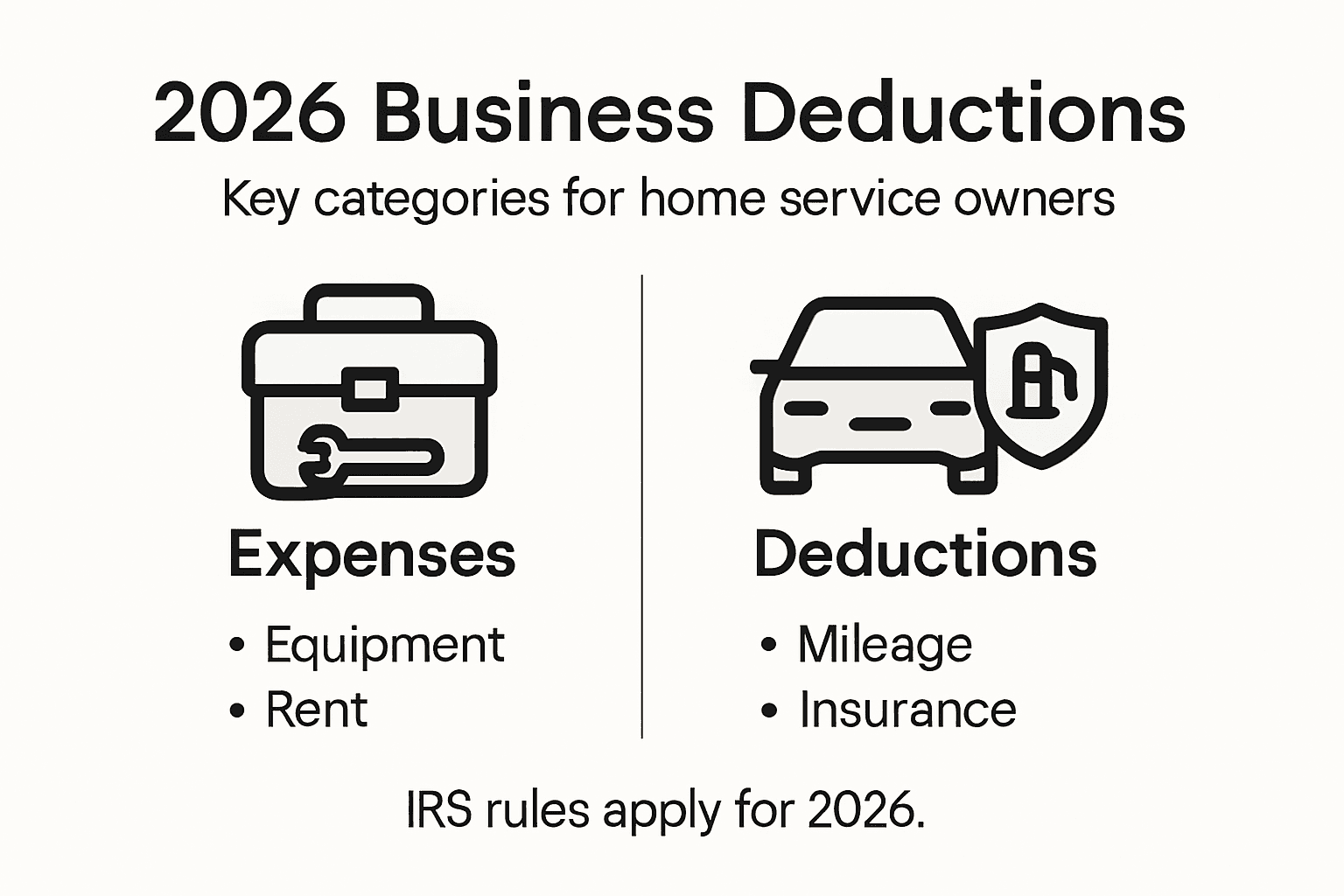
The actual expense method lets you deduct your actual vehicle costs proportional to business use. Keep detailed records of fuel, maintenance, insurance, and depreciation.
Here’s a quick summary of expense deduction methods for service vehicles in 2026:
| Method | How It Works | Strengths | Common Pitfalls |
|---|---|---|---|
| Standard Mileage | Deduct set rate per mile | Easy tracking, predictable | Personal miles accidentally included |
| Actual Expense | Deduct vehicle costs by business use | Captures real costs, flexible | Complex records, mixing methods forbidden |
| Lease Deduction | Deduct lease payments proportionally | Simple for leased vehicles | Must track business use percentage |
| Depreciation | Write off purchase price over years | Large asset deduction | Requires IRS depreciation schedules |
Choose one method for a vehicle and stick with it. Switching between methods in future years can trigger IRS questions.
Meal and Entertainment Expenses
Meals and entertainment rules changed significantly in recent years. For 2026, understand these limits:
- Business meals with clients, customers, or employees are 50% deductible
- The meal must be directly related to business discussion
- Meals eaten alone are never deductible, even if you discuss business mentally
- Entertainment expenses (tickets, events) have more restrictions and lower deductibility
Documentation matters. Write down who attended, the date, location, amount, and business purpose.
Mileage and Parking Rules
Qualified parking and mileage reimbursement rates for 2026 have specific limits. Business mileage rates apply to driving between jobs. Qualified parking means parking directly related to your business, not your daily commute parking.
You cannot deduct both the standard mileage deduction and actual vehicle expenses for the same vehicle in the same year. Choose one method and document it.
Home Office Deductions
If you run your business from home, two methods apply. The simplified method allows a set rate per square foot of dedicated business space. The regular method calculates your actual share of home expenses.
Your space must be used regularly and exclusively for business. A spare bedroom serves as your office. Your kitchen table where you occasionally do paperwork doesn’t qualify.
Professional Services and Subcontractors
When you hire other professionals—accountants, lawyers, or contractors—those fees are fully deductible. Get written invoices. If you pay someone over $600 annually for services, you’ll issue a 1099 form, so keep records accurate.
Pro tip: Build a simple 2026 rules checklist covering vehicle use, meals, home office, and professional services. Check it monthly as you record expenses. This proactive approach prevents costly mistakes when you file.
Best Practices for Categorizing and Recording Expenses
Proper categorization and recording separates business owners who maximize deductions from those who leave money on the table. When expenses are organized from day one, tax preparation becomes straightforward. You’ll also spot spending patterns that reveal profitability opportunities.
Create a Consistent Category System
Start by listing the major expense categories relevant to your business. Home service businesses typically use:
- Vehicle and transportation
- Tools and equipment
- Materials and supplies
- Labor and subcontractors
- Office and administrative
- Marketing and advertising
- Insurance
- Professional services
- Travel and meals
- Utilities and rent
Use the same category names every time. If you call it “vehicle maintenance” one month and “truck repairs” the next, your records become fragmented. Consistency matters for accuracy.
Record Expenses Immediately
Don’t wait until the end of the month or quarter. Record expenses when they happen. Take a photo of the receipt right there on the job site. Snap a picture at the parts store. Email yourself the receipt immediately after paying online.
Memory fades fast. What seemed memorable today becomes fuzzy in three weeks.
Maintaining adequate records with receipts and documentation protects you during an audit and ensures you claim all valid deductions.
Keep All Supporting Documentation
Receipts, invoices, and canceled checks tell the story of your expense. The IRS wants proof. Here’s what to save:
- Original receipts from purchases
- Invoices from vendors and subcontractors
- Bank and credit card statements
- Canceled checks
- Mileage logs for vehicle deductions
- Meal receipts showing date, amount, attendees, and business purpose
Store digital copies in a cloud system so you have backups. A flooded basement shouldn’t destroy your tax records.
Use Clear Descriptions
When you record an expense, write what it actually is. “Parts” tells you nothing. “Two 1-inch PVC fittings and coupling for 2/15 job at 4321 Maple” tells the whole story. Future-you will remember exactly what this was for.
Descriptions also help if the IRS questions a deduction. You can explain precisely why this expense was necessary and ordinary.
Implement a Simple Tracking System
You don’t need complicated software. A spreadsheet works if organized properly:
- Date column
- Vendor or payee name
- Description of expense
- Category
- Amount
- Notes (payment method, job reference, attendees for meals)
Update it weekly. Most small business owners spend 15 minutes per week recording expenses and save hours at tax time.
Separate Personal from Business
Use a dedicated business account for business expenses whenever possible. Mixing personal and business transactions creates chaos. When you use a business credit card or business checking account, categorization becomes automatic.
If you must use personal funds for business expenses, record them immediately. Transfer the amount from business to personal accounting to stay clean.
Review and Reconcile Monthly
Once monthly, reconcile your expense records with your bank and credit card statements. Catch errors early. Verify that recorded amounts match actual charges. This monthly review prevents year-end surprises.
Pro tip: Set up a recurring 30-minute monthly block on your calendar for expense review. Batch all your receipt photos, categorize them together, and reconcile accounts in one sitting. This habit prevents the chaotic tax season scramble.
Common Mistakes That Trigger Audits
The IRS uses sophisticated technology to identify inconsistencies in tax returns. Home service business owners often make preventable mistakes that flag their returns for audit. Understanding these red flags helps you stay compliant and audit-proof.
Using Round Numbers for Expenses
This is one of the most common audit triggers. When every expense ends in zero or five, it looks fabricated. Real expenses are messy. A parts purchase costs $147.82, not $150. A fuel receipt shows $43.27, not $50.
The IRS knows this. Consistent rounding across all expenses screams “estimated, not actual.” Round numbers suggest you’re guessing rather than tracking.
Record your actual receipt amounts. Let the numbers fall where they naturally do.
This table highlights the most common IRS audit triggers and effective ways to avoid them:
| Audit Trigger | Why Risk Exists | Prevention Strategy |
|---|---|---|
| Excessive rounding | Looks fabricated, not actual | Enter receipt totals exactly |
| High deduction ratios | Deductions far above industry norm | Keep detailed documentation |
| Missing receipts | Lack of evidence for big claims | Save digital copies of every receipt |
| Year-to-year swings | Sudden changes without explanation | Justify shifts with written records |
IRS audit triggers include excessive rounding and year-to-year patterns that appear fabricated rather than documented.
Claiming Disproportionate Deductions
If your income is $75,000 but your deductions total $60,000, that’s suspicious. The IRS compares your deductions against industry benchmarks. If typical contractors in your field claim 35% of income as deductions and you claim 80%, expect scrutiny.
Big deductions need big documentation. If you’re claiming unusually high vehicle expenses, materials costs, or home office deductions, be prepared to prove it.
Showing Losses Year After Year
Business losses happen. But consistent multi-year losses suggest your operation isn’t actually a profit-seeking business. The IRS questions whether you’re running a legitimate business or pursuing a hobby.
If you’re losing money repeatedly, document why. Show your business plan. Demonstrate steps you’re taking to become profitable. Without this context, losses invite audit risk.
Mismatching Income Reports
The IRS receives copies of 1099 forms from clients and vendors. If you report $50,000 in income but 1099s show $65,000, that mismatch triggers immediate attention. The IRS will contact you.
Make sure your reported income matches what clients and contractors report. If discrepancies exist, address them proactively before filing.
Missing Documentation for Large Deductions
AI detection systems identify missing evidence for claimed deductions. You claim $8,000 in vehicle expenses but have no mileage log. You claim $12,000 in materials but no receipts. These gaps are audit invitations.
Large deductions require backup. Vehicle expenses need mileage logs. Equipment purchases need receipts. Meals need documentation showing date, amount, attendees, and business purpose.
Personal Assets Used for Business
Using your personal truck for business without proper documentation invites questions. How much business use versus personal? Where’s the supporting evidence?
Keep clear records showing:
- Business miles versus personal miles
- Percentage of use for business
- Dates and purposes of business trips
- Original receipt for the vehicle
Inconsistent Year-to-Year Reporting
If your vehicle expenses were $3,000 last year and $15,000 this year with no explanation, the IRS notices. Big swings without documentation look suspicious.
Documentation explains changes. You bought a new truck. You had major repairs. You increased your service area. These explanations justify variations.
Pro tip: Keep a simple one-page summary of your expense patterns year-to-year. When audit season approaches, you can quickly explain increases or changes. This proactive approach demonstrates your records are accurate and intentional, not random.
Take Control of Your Business Expenses with Expert Bookkeeping Support
Understanding and categorizing your 2026 business expenses can quickly become overwhelming, especially when dealing with stringent IRS rules around ordinary, necessary, and reasonable deductions. From tracking vehicle mileage accurately to maintaining detailed records for meals and home office deductions, the challenge is clear. Many Kansas City home service business owners face frustration managing these complexities while trying to avoid audit risks and maximize their tax benefits. Clear categorization and timely recording are essential, but without the right system and expert guidance, you may miss valuable deductions or expose yourself to unnecessary scrutiny.

Don’t let the stress of complex expense tracking hold your business back. Kenworthy Bookkeeping specializes in effortless, accurate bookkeeping that ensures every deductible expense is correctly categorized, recorded, and ready for tax season preparation. Our services include bank reconciliations, profit and loss reporting, and tailored bookkeeping solutions designed to regain control of your finances and increase profitability. Take the next confident step today by scheduling a consultation with our team at Kenworthy Bookkeeping Consult. Stay compliant, audit-ready, and focused on growing your Kansas City business with professional support you can trust.
Frequently Asked Questions
What qualifies as a deductible business expense?
A deductible business expense must be ordinary, necessary, and reasonable in amount. This means it should be common in your industry, helpful for your operations, and not inflated in price.
How can I track my business vehicle expenses effectively?
To track vehicle expenses, maintain a mileage log detailing dates, destinations, purposes, and miles driven. You can choose to use either the standard mileage method or the actual expense method to deduct vehicle costs based on business use.
Are there specific home office deduction methods I can use for 2026?
Yes, you can choose between the simplified method, which gives you a set rate per square foot of your dedicated home office space, or the actual expense method, which allows you to calculate your share of home expenses like utilities and mortgage interest.
What documentation do I need to support my deductions?
It’s important to keep receipts, invoices, mileage logs, and bank statements for all deducted expenses. Documentation should clearly indicate the date, amount, and business purpose to ensure compliance and support in case of an audit.