

Business Budgeting: Boosting Financial Control in KC
Nearly one in three American small business owners admit their budgets fall short of real financial control. Struggling with cash flow surprises is common for service businesses in Kansas City, especially when growth stretches your resources. Getting budgeting right is more than guesswork on a spreadsheet. This guide clears up budget myths for American entrepreneurs and walks through practical steps for building financial clarity with QuickBooks Online.
Table of Contents
- Business Budgeting Defined and Debunked
- Types of Budgets for Small Businesses
- How Business Budgeting Works in Practice
- QuickBooks Online and Budget Integration
- Common Budgeting Mistakes to Avoid
Key Takeaways
| Point | Details |
|---|---|
| Business Budgeting is Essential | It serves as a flexible tool for strategic financial planning, guiding decision-making and anticipating cash flow needs. |
| Focus on Different Budget Types | Understanding and utilizing various budgets, such as Operational, Capital, and Cash Flow, can enhance financial management. |
| Regular Monitoring is Crucial | Consistently reviewing budgets allows businesses to make timely adjustments and respond to market changes effectively. |
| Avoid Common Mistakes | Entrepreneurs should be aware of unrealistic projections and inconsistent tracking to prevent financial pitfalls and ensure sustainability. |
Business Budgeting Defined and Debunked
Business budgeting represents a strategic financial planning process where organizations estimate and allocate financial resources systematically. Historically, budgets have been management control instruments that help businesses plan, track income and expenses, and analyze critical financial indicators. More than just spreadsheets, budgeting is a dynamic tool that transforms financial data into actionable insights for small business growth.
At its core, budgeting involves developing a comprehensive financial roadmap that anticipates future revenue, projects necessary expenditures, and creates a framework for fiscal discipline. Business budgeting evolved from government fiscal controls in eighteenth-century England, transforming from a bureaucratic practice into a fundamental management strategy. For Kansas City small business owners, this means creating a living document that guides financial decision-making, helps identify potential cash flow challenges, and supports strategic planning.
While some critics argue that budgets can be restrictive, modern businesses view them as flexible tools for financial navigation. Successful budgeting isn’t about rigid constraints but about creating adaptable financial plans that respond to changing market conditions. Key components typically include revenue projections, fixed and variable expenses, potential investments, and contingency funds. The goal is not perfection but creating a realistic financial blueprint that provides direction and helps measure performance.
Pro tip: Create your business budget as a quarterly living document, reviewing and adjusting it every three months to ensure ongoing relevance and accuracy.
Types of Budgets for Small Businesses
Small businesses in Kansas City have several strategic budgeting approaches to manage their financial health effectively. Small businesses employ various budget types to address different financial management needs, each serving a unique purpose in fiscal planning. Understanding these budget categories allows business owners to select the most appropriate approach for their specific operational requirements.
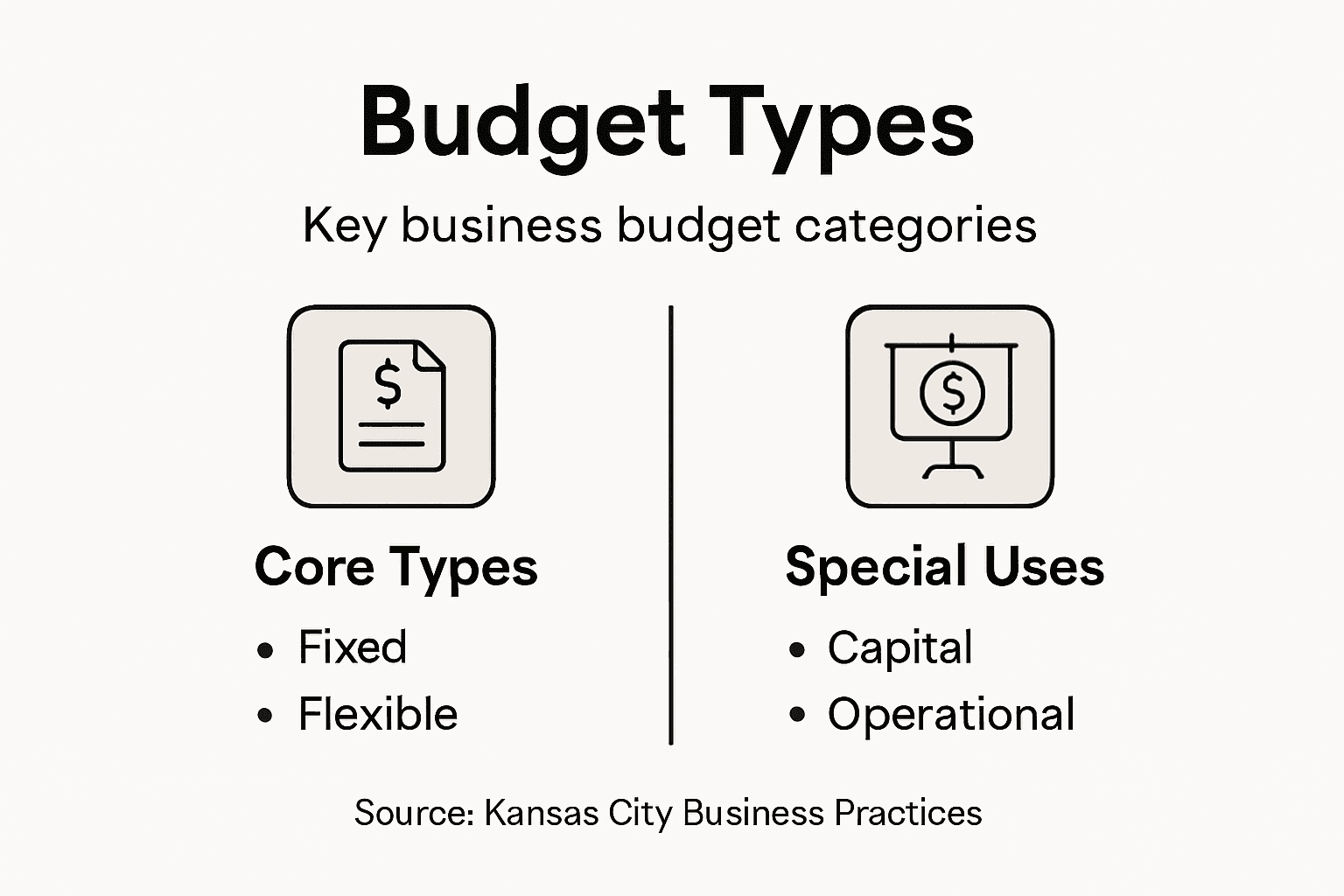
Operational Budgets cover the day-to-day expenses of running a business, including payroll, utilities, supplies, and routine operational costs. Capital Budgets focus on long-term investments in equipment, property, or significant infrastructure improvements that extend beyond immediate operational needs. Cash Flow Budgets track the actual movement of money in and out of the business, helping owners anticipate potential liquidity challenges and ensure sufficient funds for ongoing operations.
Budgets can be classified into distinct management styles that offer different levels of financial flexibility. Fixed budgets remain static regardless of business activity, providing a stable baseline for financial planning. Flexible budgets adapt to changing activity levels, allowing more dynamic response to business fluctuations. Zero-based budgets require justification for every expense, forcing a critical evaluation of each financial commitment. Incremental budgets build upon previous periods with strategic adjustments, offering a balanced approach between stability and adaptability.
Pro tip: Create a comprehensive budget document that combines multiple budget types, allowing for both strategic long-term planning and responsive short-term financial management.
Here’s how various budget types differ in purpose and flexibility:
| Budget Type | Main Focus | Typical Use Case | Flexibility |
|---|---|---|---|
| Operational Budget | Daily operating costs | Routine expense management | Moderate |
| Capital Budget | Major long-term investments | Equipment, infrastructure | Low |
| Cash Flow Budget | Monitoring cash inflows/outflows | Preventing shortfalls | High |
| Fixed Budget | Static financial baseline | Predictable environments | Low |
| Flexible Budget | Adapts to business activity changes | Fluctuating revenue streams | High |
| Zero-Based Budget | Justifies every expense | Rigorous cost control | Moderate |
| Incremental Budget | Adjusts prior period’s figures | Gradual growth or contraction | Moderate |
How Business Budgeting Works in Practice
Business budgeting is a systematic financial planning process that transforms strategic vision into actionable financial roadmaps for small businesses. The process goes beyond simple number tracking, serving as a comprehensive tool for aligning organizational goals, managing resources, and creating a clear financial trajectory. For Kansas City entrepreneurs, this means developing a strategic document that provides both direction and accountability for fiscal performance.
The budgeting workflow typically involves several critical stages. Sales Forecasting becomes the initial foundation, where businesses predict future revenue based on historical data, market trends, and anticipated growth. Expense Projection follows, meticulously detailing anticipated operational costs, including payroll, utilities, marketing, and overhead expenses. Companies develop master budgets with operating and financial projections/07%3A_Budgeting/7.03%3A_Introduction_to_Budgeting_and_Budgeting_Processes) that include comprehensive income statements and potential balance sheet scenarios.

Once created, budgets become dynamic management tools for continuous financial evaluation. Regular budget reviews allow businesses to compare actual performance against projected figures, identifying variances and making real-time adjustments. This process of Variance Analysis helps business owners understand where they are exceeding or falling short of financial expectations, enabling proactive financial management and strategic pivoting when necessary.
Pro tip: Schedule quarterly budget review meetings to compare actual financial performance against your projected budget, making incremental adjustments to maintain financial accuracy and strategic alignment.
QuickBooks Online and Budget Integration
QuickBooks Online provides cloud-based accounting solutions that transform financial management for small businesses in Kansas City. This powerful platform goes beyond traditional bookkeeping, enabling entrepreneurs to seamlessly integrate budgeting processes with real-time financial tracking. By centralizing income, expenses, and budget projections, QuickBooks Online helps business owners gain unprecedented visibility into their financial landscape.
The Budget vs. Actual feature stands out as a critical tool for financial control. Business owners can create detailed budget templates that automatically compare projected expenses against actual spending, highlighting variances in real time. This functionality allows for immediate insights into financial performance, helping entrepreneurs make data-driven decisions quickly. Key budget integration capabilities include automatic expense categorization, income tracking, and customizable reporting that adapts to unique business needs.
Small businesses can track budgets and monitor expenses efficiently through QuickBooks Online’s comprehensive financial management tools. The platform supports multiple budget creation strategies, from zero-based budgeting to incremental approaches. Users can generate detailed financial reports, track cash flow, and set up alerts for potential budget overruns. Advanced features like bank connection and transaction categorization streamline the budgeting process, reducing manual data entry and minimizing human error.
Pro tip: Set up monthly budget review meetings using QuickBooks Online’s reporting features, comparing actual financial performance against your projected budget to maintain strategic financial alignment.
Common Budgeting Mistakes to Avoid
Common budgeting mistakes can derail financial success for small businesses in Kansas City. Many entrepreneurs unknowingly sabotage their financial stability through predictable yet avoidable errors that compound over time. Understanding these pitfalls is the first step toward creating a robust and sustainable financial strategy that supports business growth and resilience.
One significant mistake is Unrealistic Budgeting, where business owners create overly optimistic projections that do not align with actual financial performance. This often involves underestimating expenses and overestimating revenue, leading to cash flow challenges. Entrepreneurs frequently neglect planning for unexpected expenses and fail to build adequate financial buffers, which can leave businesses vulnerable during economic uncertainties.
Another critical error is Inconsistent Tracking. Successful budgeting requires consistent monitoring and updating of financial records. Many small business owners create a budget and then abandon it, losing sight of their financial goals. This lack of ongoing review prevents timely adjustments and leaves businesses reactive instead of proactive. Key tracking failures include not categorizing expenses accurately, ignoring small recurring costs, and failing to reconcile bank statements regularly.
Below is a summary of common budgeting mistakes and how to avoid them:
| Mistake | Impact on Business | Prevention Strategy |
|---|---|---|
| Unrealistic Forecasts | Cash flow shortages | Use historical data for projections |
| Ignoring Emergencies | Vulnerability to surprises | Set aside contingency funds |
| Infrequent Review | Missed financial warnings | Schedule monthly budget check-ins |
| Poor Categorization | Inaccurate financial reports | Standardize expense categories |
| Not Tracking Recurring Costs | Unexpected overspending | Audit subscriptions and contracts |
Pro tip: Develop a monthly budget review ritual, allocating specific time to compare actual expenses against projected budget and make strategic adjustments.
Take Control of Your Business Budget with Expert Bookkeeping Support
Managing a business budget in Kansas City can feel overwhelming when you are juggling sales forecasting, expense projections, and regular budget reviews while trying to grow your company. The challenge is turning complex budgeting concepts into clear financial insights without wasting precious time or risking costly errors. You want real help with keeping your budget flexible yet disciplined and avoiding common mistakes like unrealistic forecasts or inconsistent tracking.

Kenworthy Bookkeeping specializes in providing small businesses just like yours with effortless, expert bookkeeping services powered by QuickBooks Online. From accurate categorization to thorough bank reconciliations and up-to-date Profit and Loss reports, we help you maintain a dynamic, reliable budget that adapts to your needs. Don’t let financial confusion slow your growth. Take the next step now by scheduling a consultation at Kenworthy Bookkeeping Consult and regain clear financial control for your Kansas City business today.
Frequently Asked Questions
What is business budgeting?
Business budgeting is a strategic financial planning process that involves estimating and allocating financial resources, tracking income and expenses, and analyzing financial indicators to support small business growth.
What are the different types of budgets for small businesses?
Small businesses can utilize various types of budgets, including operational budgets for daily expenses, capital budgets for long-term investments, and cash flow budgets to monitor cash movement. Other types include fixed, flexible, zero-based, and incremental budgets.
How does budgeting work in practice?
Budgeting involves multiple stages, starting with sales forecasting, followed by expense projection, and culminating in continuous monitoring through variance analysis. This ensures that businesses can align their financial performance with their overall strategic goals.
What common budgeting mistakes should I avoid?
Common budgeting mistakes include creating unrealistic forecasts, ignoring unexpected expenses, inconsistent tracking of financial records, poor expense categorization, and not tracking recurring costs. Avoiding these mistakes helps maintain accurate financial management.
Recommended
- Role of Budgeting in Small Business Success
- 7 Essential Business Budgeting Tips for Kansas City Owners
- Business Financial Literacy: Why It Matters for Kansas City Owners
- Master Budget Planning Workflow for Small Businesses – Kenworthy Bookkeeping Blog
- How to Set Marketing Budget for SaaS and Tech Startups – Kadima






One Comment
Comments are closed.