

Role of Bookkeeping in Compliance for Kansas City Businesses
Getting your books in order often feels like one more chore on a busy Kansas City workweek. Yet, proper bookkeeping provides the clarity and control needed to keep your home service business compliant and prepared for tax season. Whether you run a local plumbing crew or a small HVAC team, organizing your financial records from job receipts to payroll is not just about avoiding penalties, but about making smarter everyday decisions. This guide shows how simple habits make compliance and tax filing far less stressful.
Table of Contents
- Bookkeeping Basics For Home Services
- Compliance Standards Small Businesses Must Meet
- Key Bookkeeping Processes That Ensure Compliance
- Legal Risks Of Inadequate Bookkeeping
- Common Bookkeeping Mistakes And Prevention
Key Takeaways
| Point | Details |
|---|---|
| Importance of Bookkeeping | Bookkeeping is essential for managing finances, ensuring compliance, and making informed business decisions in home service industries. |
| Weekly Bookkeeping Tasks | Mastering weekly bookkeeping routines can greatly reduce tax preparation stress and maintain accurate financial records throughout the year. |
| Compliance Necessities | Small businesses must adhere to specific compliance standards, including business registration and tax obligations, to avoid legal penalties. |
| Risks of Negligence | Poor bookkeeping can lead to severe legal repercussions, including criminal charges and damage to business reputation, necessitating diligent recordkeeping practices. |
Bookkeeping Basics for Home Services
Bookkeeping is the backbone of any home service business, but many owners treat it like a necessary evil instead of a strategic tool. At its core, bookkeeping means recording every transaction your business makes, organizing it properly, and using that information to understand your finances. For a Kansas City plumbing crew, HVAC contractor, or cleaning service with fewer than 20 employees, this process directly impacts your ability to pay taxes accurately, track profitability, and make smart business decisions when it matters most.
The accounting cycle forms the foundation of all bookkeeping work. Money comes in from customers, money goes out for supplies and labor, and you need to track both sides accurately. This means categorizing expenses correctly so you know exactly how much you spent on parts versus labor, recording income from each job properly, and reconciling your bank account monthly to catch errors before tax season arrives. Understanding bookkeeping fundamentals and the accounting cycle helps you see why these daily tasks matter beyond just compliance. When your electrician completes a job and you receive payment, that transaction needs to be recorded with the right category. When you buy a new ladder or equipment for your team, that purchase needs to be logged. These individual entries pile up throughout the year, and if they are organized correctly from the start, tax preparation becomes straightforward instead of chaotic.
For home service businesses specifically, accurate categorization is critical. You likely have multiple revenue streams (service calls, equipment sales, emergency jobs) and diverse expenses (vehicle maintenance, fuel, employee wages, licensing fees). The 7 weekly bookkeeping tasks every owner should master help establish a routine that prevents chaos. QuickBooks Online and similar tools make this easier because you can set up the right categories from day one, and your team can log expenses as they happen. When you receive a supplier invoice, snap a photo and categorize it immediately instead of waiting until December. When a customer pays you, record it right away. This consistent habit means your financial records reflect reality throughout the year, not just at tax time.
Your P&L report, also called an income statement, shows you whether your business is actually making money. It lists all income from your service calls, subtracts your direct costs (materials, labor), and shows your profit or loss. This is how you answer questions like, “Am I charging enough for my services?” or “Which service line is most profitable?” Organizations like the NACPB offer practical bookkeeping education tailored for small business owners managing payroll and tracking profitability, which directly applies to your home service operation. Monthly P&L reports tell you whether you are on track or heading toward problems.
Pro tip: Set up your bookkeeping categories this week using your most recent business year as a guide. If you cannot quickly answer how much you spent on vehicle fuel versus vehicle repairs last year, your categories need work. Clean categories now save you hours during tax season.
Compliance Standards Small Businesses Must Meet
Small businesses operating in Kansas City face a specific set of compliance requirements that differ from larger corporations, yet many owners operate without fully understanding what they are obligated to do. Compliance is not optional, and missing deadlines or failing to meet standards can result in penalties, fines, or loss of operating privileges. For a home service business with fewer than 20 employees, compliance falls into several overlapping categories: business registration and licensing, tax obligations, employment law, and financial record-keeping. The good news is that these requirements are manageable when you understand them upfront and have systems in place to track them throughout the year.
Your first compliance step happens before you even start serving customers. Kansas requires businesses to register with the Kansas Secretary of State to gain legal recognition and maintain compliance with state law. This registration protects your business name, establishes your legal structure, and creates the official records that authorities reference when checking your standing. If you operate as a sole proprietorship, LLC, S-corporation, or C-corporation, each structure has different registration requirements and ongoing compliance obligations. Once registered, you cannot simply ignore the system. You must renew licenses and registrations on their due dates, update your business information when it changes, and file annual reports that confirm your company is still active and operating lawfully.
Tax compliance is where bookkeeping directly supports your legal obligations. Federal income tax, Kansas state income tax, payroll taxes, and sales tax (if applicable) all depend on accurate financial records. You cannot guess at what you owe or estimate your numbers. The IRS and Kansas Department of Revenue expect businesses to maintain detailed records proving income, expenses, and tax payments. When you have solid bookkeeping in place, your tax filing becomes straightforward because your records already reflect reality. Payroll taxes for your employees require timely deposits and quarterly filings. Sales tax collection depends on tracking taxable versus non-taxable services, which again connects directly to how you categorize transactions in your bookkeeping system. Missing a tax deadline can trigger penalties even if you eventually pay the full amount owed.

Employment compliance is often overlooked by small business owners until something goes wrong. Hiring employees means following federal wage and hour laws, withholding taxes correctly, carrying workers compensation insurance, and maintaining employment records. Independent contractor classifications must be accurate, or the IRS may reclassify them as employees and assess back taxes. Your financial records must clearly show how much you paid each person and what was withheld. This is where professional bookkeeping protects both your business and your employees. When you prepare for an audit or investigation, accurate records demonstrate that you operated in good faith and complied with the law.
Pro tip: Create a compliance calendar for your business right now with all renewal dates, tax filing deadlines, and annual reporting requirements highlighted. Add these dates to your phone with 30-day reminders, so you never miss a deadline that could jeopardize your business standing.
Key Bookkeeping Processes That Ensure Compliance
Compliance does not happen by accident. It requires deliberate bookkeeping processes executed consistently throughout your business year. When you establish the right systems and follow them religiously, compliance becomes a byproduct of normal operations rather than a frantic scramble before tax season. For a Kansas City home service business, three core bookkeeping processes form the foundation of compliance: detailed transaction recording, account reconciliation, and financial reporting. Each process serves a specific compliance purpose, and skipping any one of them creates gaps that auditors, tax authorities, or regulators will eventually find.
The first critical process is maintaining accurate and complete transaction records. The IRS requires detailed records of all business transactions because income and deductions must be substantiated if questioned during an audit. This means every dollar that comes in and goes out of your business needs documentation. When a customer pays you for a service, you must record the date, amount, customer name, and service description. When you pay for supplies, fuel, or labor, you must keep the receipt and categorize the expense properly. The IRS also requires employment tax records to be retained for at least four years, which includes payroll records, tax deposits, and wage statements for every employee. Many home service owners think this is burdensome until they face an audit and realize their lack of documentation could cost them thousands in penalties and back taxes.
The second process is monthly bank and credit card reconciliation. This means comparing your bookkeeping records against your actual bank statements to identify errors, fraudulent charges, or transactions you recorded incorrectly. Account reconciliation catches discrepancies before they compound into larger compliance problems. When you reconcile monthly, you immediately spot if a check was never cashed, if a deposit was recorded twice, or if an employee expense was miscategorized. This process also creates an internal control that deters theft and fraud. If your bookkeeper knows you reconcile accounts every month, they are far less likely to misappropriate funds. More importantly, monthly reconciliation ensures your financial records match reality, which is what regulators care about most.
The third essential process is generating accurate financial statements and tax reports. Your bookkeeping system must produce P&L reports, balance sheets, and tax documentation that reflect your actual business performance. Precision in bookkeeping records and financial report generation ensures you are audit ready at any moment. When your bookkeeper pulls a report, it should match your bank balance, your tax filings should align with your financial statements, and every number should be traceable back to original documentation. This level of accuracy protects you because it demonstrates good faith compliance efforts. If you are ever audited, authorities see a business owner who took compliance seriously and maintained proper controls.
Here is a summary of essential bookkeeping processes and the compliance issues each one addresses:
| Bookkeeping Process | Main Purpose | Compliance Issue Addressed |
|---|---|---|
| Detailed Transaction Logs | Documents every financial event | Tax and audit substantiation |
| Account Reconciliation | Verifies records match statements | Detects fraud and catches recording errors |
| Financial Reporting | Summarizes business performance | Provides evidence for filings and audits |
Pro tip: Set a recurring calendar reminder to reconcile your bank account on the same day every month, ideally within two days of receiving your bank statement. Designate one person responsible for this task, even if it is not you, and require their sign-off monthly. This single habit prevents small errors from becoming audit nightmares.
Legal Risks of Inadequate Bookkeeping
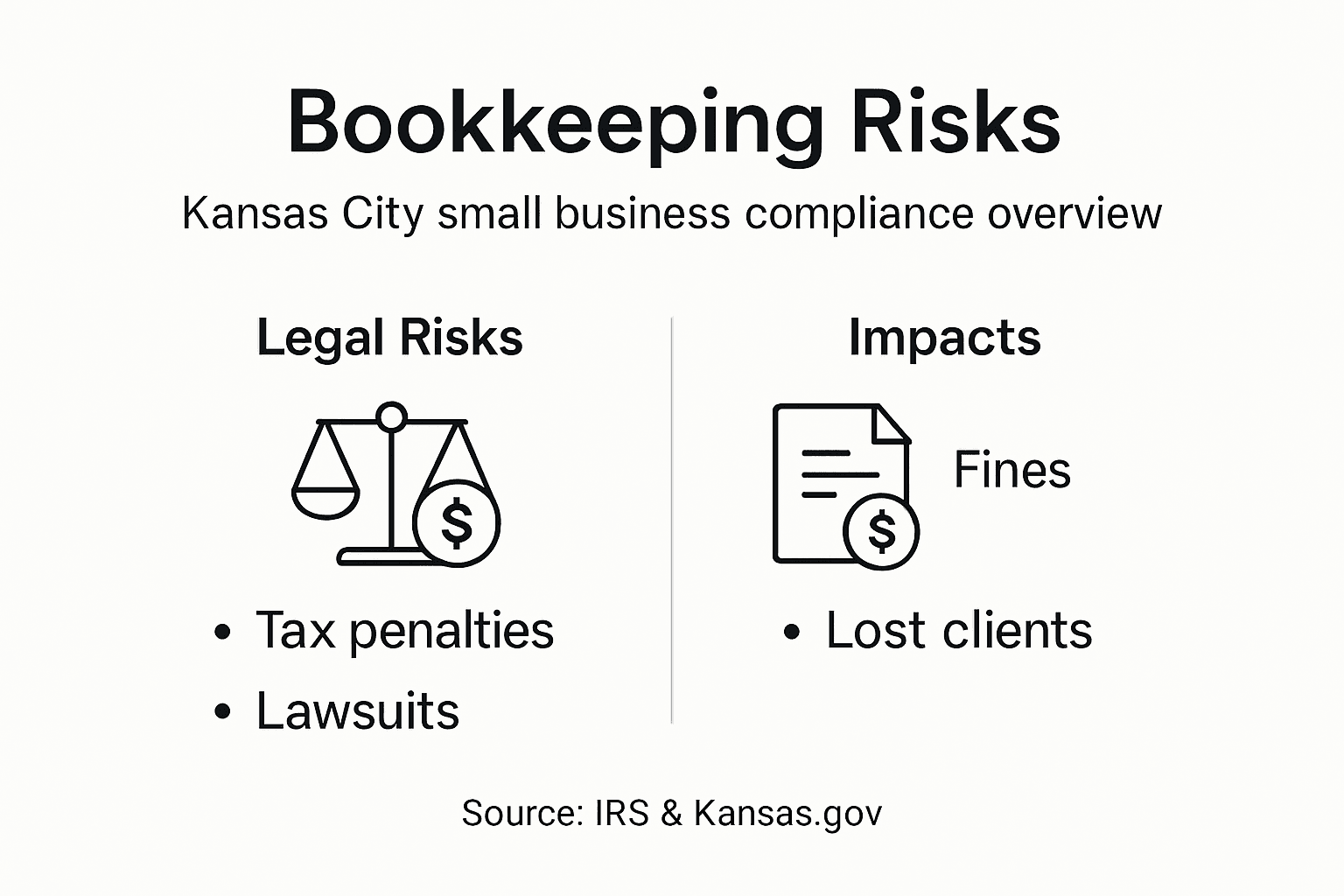
Inadequate bookkeeping is not just a financial problem. It is a legal liability that can expose your home service business to criminal charges, civil lawsuits, regulatory penalties, and severe reputational damage. Many Kansas City business owners assume that poor bookkeeping is merely inefficient or that they will simply owe back taxes if caught. That assumption is dangerously wrong. When authorities investigate a business with inadequate records, they do not assume good faith. Instead, they suspect intentional fraud, underreporting of income, or misappropriation of funds. The burden then shifts to you to prove otherwise, and without clear documentation, that burden becomes almost impossible to meet.
The legal consequences of inadequate bookkeeping fall into two main categories: criminal and civil liability. Inadequate or fraudulent bookkeeping can result in criminal liability including fines and imprisonment for misrepresenting financial information. The IRS does not have to prove intent. If your records are so poor that income cannot be verified, prosecutors can argue you deliberately hid earnings. If expense deductions are not documented, they assume they do not exist. Criminal tax evasion charges carry felony penalties including prison time of up to five years per count. Even if authorities determine there was no criminal intent, civil penalties can still apply. The IRS imposes accuracy-related penalties of 20 percent on underpaid taxes and fraud penalties of 75 percent on amounts the agency determines were fraudulently underpaid. For a home service business with inconsistent records, these penalties can dwarf the original tax liability.
Beyond tax authorities, inadequate bookkeeping exposes you to legal risks from failing to comply with employment and regulatory laws. Employees can sue for wage and hour violations if you cannot prove what you paid them. Contractors can file lawsuits claiming misclassification if your records do not show their work arrangements clearly. Licensing boards can revoke your business license if you cannot demonstrate compliance with renewal or reporting requirements. Lenders and suppliers may demand repayment or pursue legal action if financial statements were inaccurate. Your insurance company might deny claims if investigation reveals falsified records. The longer you operate without proper bookkeeping, the more potential liability you accumulate. By the time an audit or investigation occurs, years of inadequate records create exposure across multiple legal fronts.
The reputational damage compounds these legal risks. Customers research businesses before hiring, and news of compliance violations or fraud investigations spreads quickly in Kansas City. Employees lose confidence in leadership when they discover payroll records are inaccurate or tax withholdings were mishandled. Suppliers become hesitant to extend credit. Future buyers or investors will demand discounts or walk away entirely if they discover your bookkeeping is unreliable. One investigation or lawsuit can destroy years of relationship building. The irony is that proper bookkeeping actually prevents all of this. When your financial records are accurate and regularly reviewed, you have nothing to fear from audits. You have documentation to support every decision. You demonstrate to regulators, employees, and customers that you run a legitimate operation with integrity.
This table compares the risks of inadequate bookkeeping and its impact on a home service business:
| Risk Type | Legal Consequence | Business Impact |
|---|---|---|
| Criminal | Fines, imprisonment, felony | Loss of license, reputation harm |
| Civil | Back taxes, penalties, lawsuits | Loss of employees, lost credit |
| Reputational | Damaged credibility, lawsuits | Lost customers, denied insurance claims |
Pro tip: If your bookkeeping has been inadequate or nonexistent, do not wait for an audit to fix it. Contact a professional bookkeeper immediately and hire a tax professional to review your past returns. Voluntary disclosure to the IRS before they initiate contact can substantially reduce penalties and may eliminate criminal liability entirely.
Common Bookkeeping Mistakes and Prevention
Bookkeeping mistakes are not minor inconveniences. They compound throughout your year, creating a tangled mess that costs time, money, and credibility when tax season arrives. For Kansas City home service businesses, the mistakes tend to follow predictable patterns because the work itself creates unique challenges. You are managing multiple job sites, coordinating crews, handling cash payments, and tracking materials and labor costs simultaneously. In that chaos, it is easy to let bookkeeping slide. The good news is that most mistakes are entirely preventable if you know what to watch for and establish basic safeguards from the start.
The first critical mistake is failing to save and organize receipts and documentation. Common bookkeeping mistakes for small businesses include failing to save receipts and neglecting reimbursable expenses, which creates gaps in your records when you need them most. Many home service owners pay for supplies or materials out of pocket, intending to reimburse themselves later, but then lose the receipt or forget to log the expense. Six months later during tax season, you cannot prove you spent that money, so you lose the deduction. Worse, if you cannot document where cash went, auditors assume you misappropriated it. Prevention is straightforward. Set a system where every receipt gets photographed or saved immediately, either in a folder on your phone using an app or a physical envelope in your truck. Require anyone who spends business money to submit receipts within one week. Do not let expenses pile up until year end.
The second mistake is misclassifying workers as independent contractors when they should be employees, or vice versa. This creates payroll tax problems and exposure to wage and hour lawsuits. The IRS looks at control, investment, and relationship when determining classification. If your crew member works exclusively for you, uses your tools, and works on your schedule, they are likely an employee even if you call them a contractor. Classification errors lead to back taxes, penalties, and legal liability. Prevention requires understanding IRS guidelines and documenting how each worker is classified and why. If you are uncertain, consult a tax professional before bringing someone on.
The third major mistake is inconsistent or absent account reconciliation. When you do not reconcile monthly, small errors compound into large discrepancies by year end. A transaction recorded twice, a deposit that never posted, or an unauthorized charge goes unnoticed. Regular reviews of your bookkeeping prevent costly tax errors and support business growth by catching problems early. Reconciliation takes one or two hours per month if done consistently, but sixteen hours or more if you wait until December. Set a specific day each month to review your bank statement against your records. Assign this task to one person and hold them accountable. This discipline protects your compliance and gives you accurate financial information to make decisions.
Pro tip: Create a simple checklist of your five biggest bookkeeping vulnerabilities based on how you operate, then assign responsibility for each item to a specific team member or system. Review compliance on this checklist monthly during your bank reconciliation to catch drift before it becomes a crisis.
Take Control of Your Kansas City Home Service Business Compliance Today
Navigating bookkeeping challenges like detailed transaction logs, account reconciliation, and accurate financial reporting can feel overwhelming for small business owners in Kansas City. When compliance deadlines loom and the risk of costly penalties grows, relying on expert support is critical to protect your business and peace of mind. Kenworthy Bookkeeping specializes in helping home service businesses streamline their finances while meeting all legal and tax obligations with ease.

Discover how effortless bookkeeping services with QuickBooks Online can transform your business. From precise categorization of expenses to monthly bank reconciliations and clear P&L reports, our trusted team ensures your records are always audit ready and compliance risks are minimized. Avoid the stress of late filings and financial confusion by partnering with professionals committed to your success and trust. Start regaining control today by scheduling a consultation with us at Kenworthy Bookkeeping. Let us help you build a reliable bookkeeping foundation that safeguards your Kansas City business now.
Frequently Asked Questions
What is the role of bookkeeping in compliance for businesses?
Bookkeeping plays a crucial role in compliance by ensuring that all financial records are accurately maintained and documented. This helps businesses meet tax obligations, employment laws, and regulatory standards.
How can improper bookkeeping affect my business legally?
Improper bookkeeping can expose your business to criminal charges, civil lawsuits, and regulatory penalties, as authorities may suspect fraud or intentional misrepresentation of financial information when records are inadequate.
What are the main bookkeeping processes that support compliance?
Key processes include detailed transaction recording, monthly bank and credit card reconciliation, and generating accurate financial reports. These processes help maintain compliance and provide evidence during audits.
How often should I reconcile my accounts to ensure compliance?
It is recommended to reconcile your accounts monthly. This allows for the timely identification of discrepancies and ensures your financial records accurately reflect your business operations.