
Bookkeeping’s Role in Cash Control for Small Businesses
Running a home service business in Kansas City means constantly watching your cash flow as jobs wrap up and bills come in. For owners with small teams, missing a payment or losing track of receipts can derail payroll or set back growth plans. Mastering bookkeeping is the process of recording, organizing, and maintaining your business’s financial transactions, and strong cash control practices help you keep every dollar accounted for. Here, you’ll learn how professional bookkeeping services give Kansas City business owners a clear financial snapshot, helping you stay confident when making day-to-day spending decisions.
Table of Contents
- Defining Bookkeeping And Cash Control
- Types Of Bookkeeping Systems Used
- Tracking Income, Expenses, And Accounts
- Managing Cash Flow And Bank Reconciliation
- Legal Requirements And Tax Compliance
- Common Mistakes Affecting Cash Control
Key Takeaways
| Point | Details |
|---|---|
| Importance of Bookkeeping | Accurate bookkeeping is essential for monitoring business progress and making informed decisions. It establishes a clear picture of cash flow and financial health. |
| System Choice | Choosing between single-entry and double-entry bookkeeping depends on business complexity. Growing businesses benefit significantly from the accuracy of double-entry systems. |
| Cash Flow Management | Regular cash flow tracking and bank reconciliation are critical for identifying discrepancies and preventing cash shortages. Consistent practices ensure financial stability. |
| Legal Compliance | Proper bookkeeping is vital for meeting IRS requirements and maximizing deductions. Organized records prevent issues during audits and ensure tax obligations are met accurately. |
Defining Bookkeeping and Cash Control
Let’s start with the basics. Bookkeeping is the process of recording, organizing, and maintaining your business’s financial transactions to ensure accurate financial management. Think of it as the backbone of your financial health. Every dollar that comes in, every expense that goes out, every payment to suppliers—it all gets recorded and organized. This creates a complete financial picture of your home service business. Whether you’re running an HVAC company, a plumbing operation, or a cleaning service in the Kansas City area, accurate bookkeeping means you’re not flying blind when it comes to your money.
Why does this matter for your business specifically? Maintaining accurate financial records helps you monitor your business progress, prepare accurate financial statements, and track both your income and deductible expenses. But here’s what makes bookkeeping different from just having a pile of receipts: it’s about systematization. It’s about knowing exactly where your money is at any given moment. When you can track income, expenses, and cash flow with precision, you gain the ability to make informed business decisions instead of guessing. For a small home service business with under 20 employees, this clarity is everything. It’s the difference between knowing whether you can afford to hire another technician and hoping things work out.
Cash control is the practical outcome of good bookkeeping. It means having visibility into your cash position, understanding your cash flow patterns, and preventing money from slipping through the cracks. Cash control answers critical questions: Do you have enough money to cover payroll next Friday? Can you invest in new equipment? Are you collecting from customers fast enough, or are invoices sitting unpaid for months? When you have proper bookkeeping systems in place, you can answer these questions with confidence. Many small business owners focus only on revenue, but experienced operators know that cash—not profit on paper—keeps the lights on. Your HVAC technicians need to be paid whether or not your invoice to that commercial client has been collected yet.
The connection between the two is straightforward: without solid bookkeeping, you cannot have effective cash control. One flows from the other. Recording every financial transaction creates the foundation that makes cash tracking possible. This is why professional bookkeeping services matter for small businesses. You’re not just organizing papers; you’re building a system that protects your business, reveals opportunities, and keeps your cash flowing smoothly.
Pro tip: Start tracking your cash in and out separately from profit and loss, even before you overhaul your entire bookkeeping system—knowing your cash position weekly can reveal payment and spending patterns you’d otherwise miss.
Types of Bookkeeping Systems Used
When it comes to managing your finances, you have choices. Small businesses typically operate using one of two bookkeeping systems, and understanding which one fits your operation is critical. Single-entry bookkeeping records each transaction once, capturing it from a single perspective. Imagine writing down every check you write and every payment you receive in a simple ledger. It’s straightforward, requires less training, and costs less to implement. For a very small home service business just starting out, this approach can work. You record the money in and money out, and you have a basic sense of your cash position. But here’s the catch: single-entry bookkeeping can hide mistakes. If you accidentally skip a transaction or record an amount incorrectly, the error stays hidden because there’s nothing cross-checking your work.
Double-entry bookkeeping is the more sophisticated system, and it’s what most growing businesses use. Double-entry bookkeeping records both debit and credit entries for every transaction, improving accuracy and providing detailed financial information. Think of it this way: every transaction has two sides. When you invoice a customer for an HVAC service, that’s money owed to you (an asset) and revenue earned (income). Both sides get recorded. When you pay a supplier invoice, that’s cash going out (reducing your assets) and an expense (reducing your profit). This dual recording creates a built in error detection system. If your books don’t balance, you know something is wrong. The system catches mistakes and ensures your financial records are trustworthy.
For a small home service business in Kansas City with under 20 employees, double-entry bookkeeping is almost always the better choice as you grow. Single-entry might work for your first few months, but the moment you’re managing multiple employees, various types of revenue, and regular business expenses, you need the accuracy that double-entry provides. Professional bookkeeping services handle the complexity of double-entry systems for you, which means you don’t need to become an accountant to run your business. Many business owners find that moving to double-entry bookkeeping systems actually makes their business run more smoothly because they have complete visibility into what’s happening financially. You can track job profitability, see where money is being spent, and identify trends. That’s information you simply cannot get reliably from single-entry systems.
The real question isn’t which system is objectively better. It’s which system matches your business complexity and growth stage. Starting lean is fine. But don’t stay in single-entry so long that you lose control of your finances.
Here’s a direct comparison of single-entry and double-entry bookkeeping systems for small businesses:
| Aspect | Single-Entry System | Double-Entry System |
|---|---|---|
| Complexity | Simple to use | More structured, detailed |
| Error Detection | Errors easily missed | Built-in cross-checks |
| Business Suitability | Very small, early-stage | Growing, multi-employee |
| Financial Insight | Limited reports | Complete visibility |
| Audit Readiness | Weak supporting trail | Reliable audit trail |
Pro tip: If you’re currently using single-entry bookkeeping and your business has grown, plan your transition to double-entry now rather than waiting for problems to force the switch—the earlier you make the change, the cleaner your historical records will be.
Tracking Income, Expenses, and Accounts
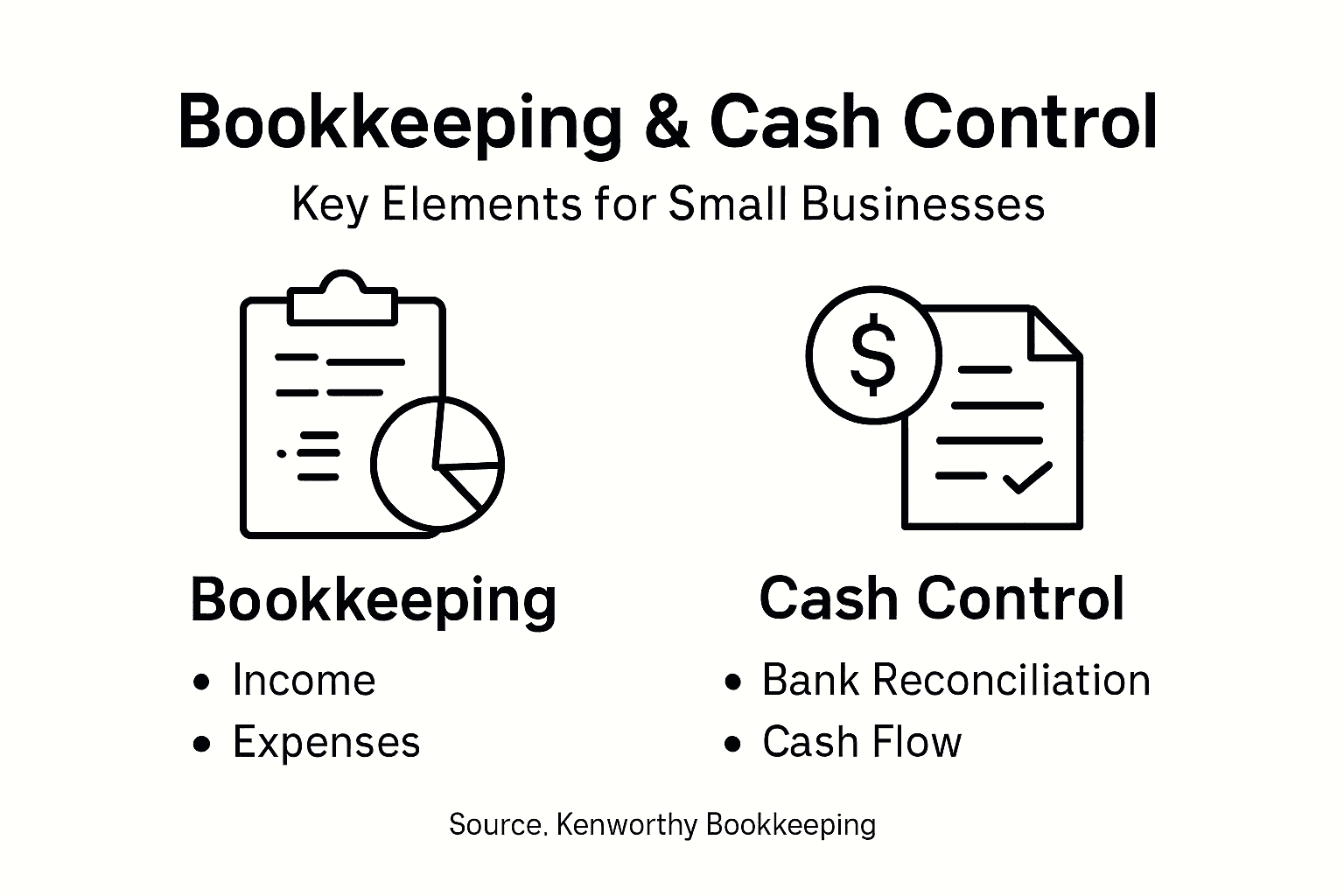
Here’s where bookkeeping gets practical. You need a system that captures every dollar coming in and every dollar going out. Tracking income means recording every payment from customers, whether it’s a check, credit card payment, or cash. For a plumbing business, that might be invoices from residential jobs, emergency call charges, or service contracts. For a cleaning company, it could be weekly client payments or monthly retainer agreements. Every source of income matters because it all contributes to your cash position and your tax obligations. The key is consistency. If you record income sporadically, you’ll lose visibility into your actual cash flow and miss trends that could help you grow.

Tracking expenses is equally critical, and this is where many small business owners miss opportunities. Every business expense tells a story. Keeping various supporting documents like sales slips, invoices, receipts, and canceled checks helps you understand where your money is actually going. For a home service business, that includes vehicle maintenance, fuel, equipment purchases, employee wages, insurance, and supplies. When you categorize and track these properly, something remarkable happens: you can see which services are actually profitable. You might discover that your emergency calls are significantly more profitable than your routine maintenance jobs, which completely changes how you should price and market your services. You might find that you’re spending more on a particular supplier than necessary, or that labor costs on certain job types are unsustainable.
The backbone of this system is your general ledger, which is essentially the master list of all your financial accounts. Proper bookkeeping involves creating a system to record every financial transaction with accounts representing income, expenses, assets, and liabilities. Think of it as organized folders. You have one folder for vehicle expenses, another for payroll, another for equipment purchases. Each transaction goes into the right folder automatically. Regular recording and reconciliation of these transactions maintain accurate financial records. This isn’t about being obsessive with paperwork. It’s about having a clear picture of your business health. When you know exactly what’s in each account, you can answer real business questions: Can I afford new equipment this quarter? Is my pricing keeping up with my rising labor costs? Which service lines are healthy, and which ones are dragging down my profitability?
Pro tip: Set up your expense categories based on the business decisions you actually make, not generic accounting categories—if you need to decide between service lines, create separate categories for each one so you can compare their profitability directly.
Managing Cash Flow and Bank Reconciliation
You have a problem that most small business owners face: your bank balance doesn’t match your bookkeeping records. Maybe it’s off by a few hundred dollars, maybe more. Your immediate reaction is panic. Did you make an error? Did someone steal from you? Is your bookkeeping system broken? Stop. This is exactly what bank reconciliation exists to solve. Bank reconciliation is the process of comparing your bank statement with your internal accounting records and adjusting for differences. It’s not glamorous work, but it’s absolutely critical. When you reconcile your accounts regularly, you catch errors early, spot unauthorized transactions immediately, and understand exactly how much cash you actually have available.
Here’s why this matters for cash control. Your business account at the bank and your business records in your bookkeeping system will naturally differ on any given day. You might have written checks that haven’t cleared yet. A customer might have sent a deposit that hasn’t posted to your account. Your bank might have charged fees you haven’t recorded. These timing differences are normal and expected. But they hide the truth about your cash position. If you’re looking at your bank balance online and it says you have $15,000, but you have $8,000 in outstanding checks, your real available cash is actually $7,000. That’s the difference between being able to make payroll on Friday and having a crisis. Bank reconciliation ensures that the cash balance recorded by your business matches the bank’s records by accounting for outstanding checks, deposits in transit, bank fees, and errors. This internal control mechanism is critical for managing cash flow effectively and safeguarding your assets.
The reconciliation process itself is straightforward. You start with your bank statement balance, add any deposits you’ve recorded but the bank hasn’t received yet, subtract any checks you’ve written that haven’t cleared, and adjust for bank fees or errors. Your bookkeeping balance should then match. If it doesn’t, something is wrong and you need to find it. For a home service business in Kansas City, this might mean discovering that one of your field techs submitted an invoice that never got entered into the system, or that a customer payment got recorded twice. These are exactly the kinds of mistakes that create cash flow chaos if left uncaught. When you reconcile monthly, these errors stay small and easy to fix. When you let them stack up for six months, they become nightmares.
Consistent reconciliation helps ensure accurate cash flow management and the financial health of your business. For small business owners, this is one of the highest return activities you can do. Fifteen minutes of reconciliation per week prevents weeks of scrambling later. Professional bookkeeping services typically handle reconciliations as part of their work, which means you don’t have to be the person hunting down missing transactions or calling the bank.
Pro tip: Schedule your bank reconciliation for the same day each week, right after you receive your bank transactions—checking it fresh takes half the time and catches errors before they compound.
Legal Requirements and Tax Compliance
Here’s a reality that no small business owner enjoys thinking about: the IRS is watching. Not in a paranoid way, but in a very real, regulatory way. Your bookkeeping isn’t just about knowing if your business is profitable. It’s about meeting legal obligations that carry real consequences if ignored. The IRS requires small businesses to keep accurate records that clearly show income, expenses, and deductions. These records must be maintained for as long as necessary to substantiate tax returns, typically for several years. That pile of receipts sitting in a shoebox doesn’t count. Your bookkeeping system must be organized, accessible, and capable of proving to the IRS exactly what you earned and what you spent if an audit happens.
Why does this matter beyond just staying out of trouble? Because bad bookkeeping costs you money in multiple ways. If you can’t document your deductions, you lose them. Period. That truck maintenance expense that you paid cash for but didn’t record? The IRS won’t recognize it. That equipment purchase you forgot to log? No deduction. For a small home service business in Kansas City, deductions matter enormously. Your vehicle expenses, equipment costs, materials, labor, insurance, and countless other items are legitimate business expenses that reduce your taxable income. When you lose track of these expenses, you’re essentially paying taxes on money you never actually kept. Conversely, if you claim deductions you can’t back up with documentation, you’re inviting audit problems.
Small businesses must comply with various tax obligations including income tax, self-employment tax, employment taxes, and excise taxes. Bookkeeping practices must align with these legal requirements to ensure correct tax payments and filings. Your bookkeeping system needs to track not just income and expenses, but also payroll withholdings if you have employees, quarterly estimated tax payments, and separate business and personal finances. Many small business owners make the mistake of mixing personal and business money in the same account. This creates a nightmare during tax time and opens the door to IRS questions. The IRS looks at your business account activity and expects to see clear business purpose for every transaction. When personal expenses and business expenses are jumbled together, you lose credibility and documentation.
The good news is that this isn’t complicated when you do it right from the start. Proper bookkeeping creates an audit trail. Every transaction is documented, categorized, and traceable. If the IRS ever asks about a specific deduction or income source, you can pull up the supporting documentation and prove it. For a business owner, that’s peace of mind. Professional bookkeeping services understand these requirements inside and out. They know which expenses are deductible, how to properly categorize transactions for tax purposes, and how to structure your records so that tax season becomes a process instead of a crisis.
Pro tip: Keep your supporting documents organized by month and category from the start—when tax time arrives, your bookkeeper can prepare your return in hours instead of days because everything is already organized and ready to review.
Common Mistakes Affecting Cash Control
Most small business owners don’t set out to make bookkeeping mistakes. They happen gradually, often without you realizing the damage until it’s too late. The first mistake almost every home service business owner makes is treating bookkeeping like something to do when you have time. You don’t have time. You’re out managing jobs, dealing with customers, handling equipment problems. Bookkeeping gets pushed to the back burner until suddenly you’re three months behind and have no idea what your cash position actually is. By then, the mistakes have piled up and untangling them becomes a nightmare. Failing to save receipts and document transactions is the foundation of almost every bookkeeping disaster. You get a cash payment from a customer and forget to record it. You buy supplies on a credit card and never enter the expense. These individual oversights seem minor in the moment. But when you can’t account for thousands of dollars in transactions, your bookkeeping becomes unreliable. You can’t trust your cash balance. You can’t answer basic questions about where your money went.
Another devastating mistake is neglecting cash flow tracking. Many small business owners confuse profit with cash. You might be profitable on paper while running out of cash in reality. That customer who owes you $8,000 for work you completed three months ago is eating your working capital. Your bookkeeping might show revenue, but that money isn’t in your bank account. Consistent bookkeeping practices and using accounting software can mitigate these risks and improve financial accuracy. If you’re not actively tracking when money comes in versus when it goes out, you’ll be blindsided by cash shortages. You’ll miss opportunities to collect from slow-paying customers. You might take on jobs you can’t afford to wait on payment for. For a home service business with employees to pay, this isn’t just poor management. It’s a threat to survival.
Then there’s the critical mistake of failing to reconcile accounts regularly. You assume your bookkeeping is accurate because you recorded the transactions. But errors hide in the details. A deposit might have been entered twice. A check might have been recorded but never actually cleared. Bank fees might be unaccounted for. When you don’t reconcile monthly, these errors compound. By year-end, your books might be off by thousands of dollars and you’ll spend weeks hunting down what went wrong. Poor communication with bookkeepers and failing to reconcile accounts are mistakes that can be prevented with simple discipline.
The good news is that these mistakes are all preventable. They require systems and consistency, not genius level accounting knowledge. Using accounting software instead of manual record-keeping eliminates most data entry errors automatically. Setting a specific day each week to reconcile catches problems while they’re small. Communicating clearly with your bookkeeper or accounting team about your business priorities ensures they’re categorizing transactions the way that matters for your decisions. The businesses that maintain strong cash control aren’t smarter than their competitors. They’re just more systematic.
Consider these common cash control mistakes and ways to avoid them:
| Mistake | Financial Risk Created | Prevention Strategy |
|---|---|---|
| Delayed bookkeeping | Missed cash shortages | Weekly bookkeeping schedule |
| Skipped receipts | Unclaimed deductions | Mobile receipt capture app |
| No cash flow tracking | Payroll or bill shortfalls | Use cash flow statement software |
| Lax bank reconciliation | Unnoticed errors or fraud | Set fixed monthly review time |
Pro tip: Choose one specific day each week to handle all bookkeeping tasks together rather than spreading them throughout the week, which prevents transactions from falling through the cracks and makes patterns easier to spot.
Take Control of Your Cash Flow with Expert Bookkeeping Support
Managing accurate bookkeeping and cash control is critical for small home service businesses in Kansas City looking to thrive. If you find it challenging to keep your financial records organized, reconcile your bank accounts regularly, or track cash flow confidently, you are not alone. The article highlights how missing receipts, delayed bookkeeping, and lack of consistent reconciliation can lead to cash shortages and lost tax deductions. You deserve a seamless system that shows every dollar coming in and going out clearly and reliably.
Kenworthy Bookkeeping specializes in providing effortless bookkeeping solutions tailored for small businesses like yours. Using QuickBooks Online, they handle everything from categorization and bank reconciliations to detailed profit and loss reports and tax season preparation. This means you can regain control of your cash flow without the stress or guesswork. Discover how professional bookkeeping can transform your financial management and help you make informed business decisions for steady growth.

Ready to stop worrying about your cash position and start focusing on growing your business? Schedule your personalized consultation today and see how Kenworthy Bookkeeping’s expert services can provide the clarity and peace of mind you need. Don’t wait until bookkeeping mistakes threaten your business stability. Take action now by visiting our consultation page and begin your path to effortless financial control.
Frequently Asked Questions
What is the difference between single-entry and double-entry bookkeeping?
Single-entry bookkeeping records each transaction once and is simpler, while double-entry bookkeeping records both debit and credit for every transaction, providing greater accuracy and detailed financial insights.
How can accurate bookkeeping improve cash control for small businesses?
Accurate bookkeeping allows businesses to track income and expenses meticulously, providing the insights needed to manage cash flow effectively and make informed financial decisions.
Why is bank reconciliation important in bookkeeping?
Bank reconciliation is essential because it ensures that your internal records match your bank statements, helping you identify errors and unauthorized transactions while maintaining an accurate cash position.
What are common bookkeeping mistakes that affect cash control?
Common mistakes include delayed bookkeeping, skipped receipts, lack of cash flow tracking, and infrequent bank reconciliation, all of which can lead to cash shortages and financial mismanagement.