
Role of Bookkeeping in Lending Success for Small Business
Securing a loan often feels uncertain for small home service business owners in Kansas City who depend on reliable funding to grow their teams and serve the community. Many find that lenders weigh their decisions on one foundation above all: clear, well-kept financial records. Consistent and accurate bookkeeping gives banks transparency and builds trust, helping you stand out as a strong, dependable borrower.
Table of Contents
- Defining Bookkeeping’s Role In Lending Decisions
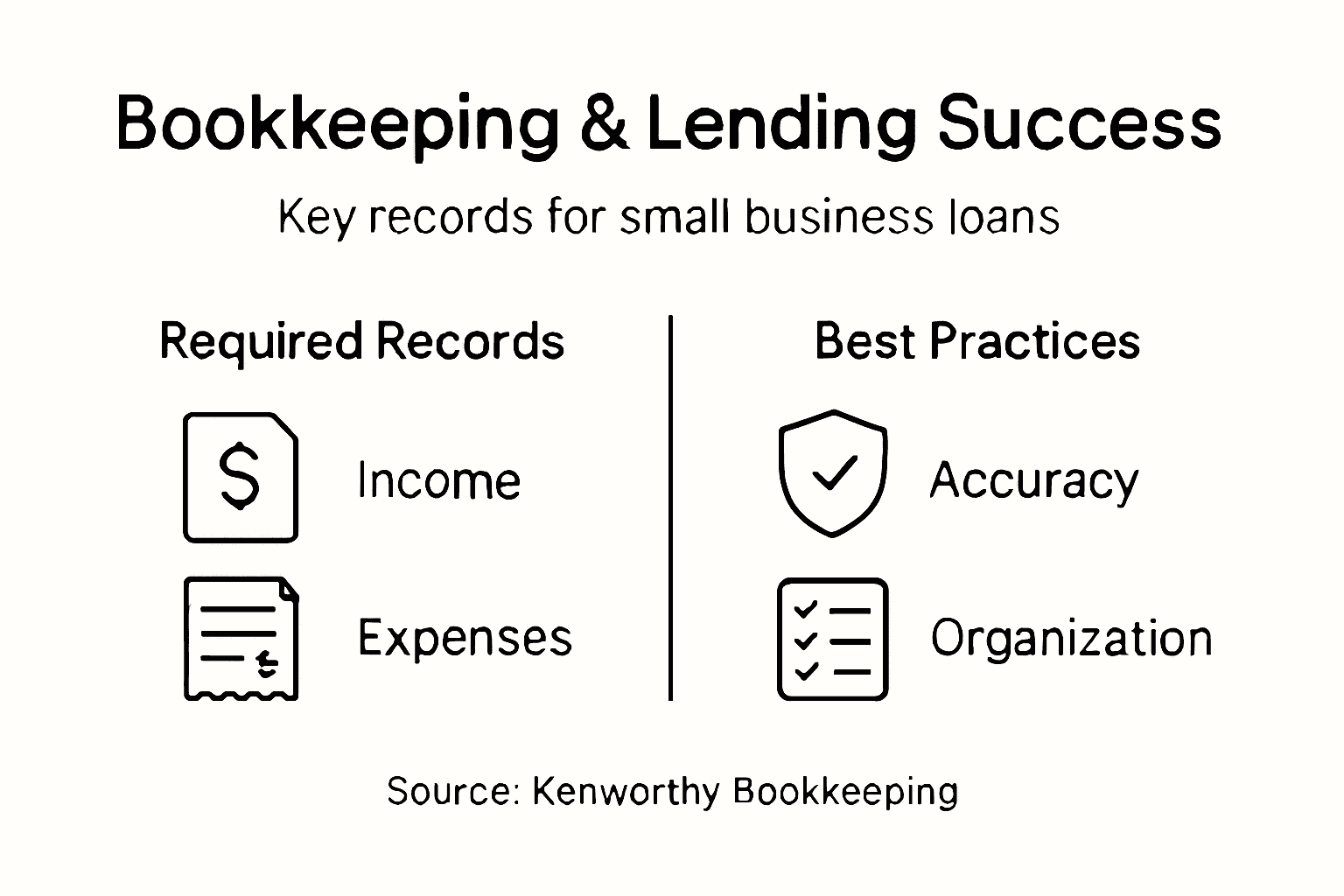
- Types Of Financial Records Lenders Require
- How Bookkeeping Impacts Loan Eligibility
- Maintaining Cash Flow And Tax Compliance
- Common Bookkeeping Mistakes That Hurt Funding
Key Takeaways
| Point | Details |
|---|---|
| Bookkeeping’s Critical Role | Accurate bookkeeping is essential for small businesses to secure loans, as it demonstrates financial reliability to lenders. |
| Essential Financial Records | Lenders require key financial documents, such as balance sheets and income statements, to evaluate a business’s creditworthiness. |
| Impact on Loan Eligibility | Organized bookkeeping enhances loan eligibility by showcasing transparency and compliance with lending standards. |
| Avoid Common Mistakes | Common bookkeeping errors, like commingling finances and inconsistent records, can negatively affect funding opportunities. |
Defining Bookkeeping’s Role in Lending Decisions
Bookkeeping serves as the financial backbone that directly influences a small business’s ability to secure lending. Banks and financial institutions rely on meticulously maintained financial records to assess a company’s creditworthiness and potential risk. Accurate financial records provide critical insights into a business’s fiscal health, serving as a comprehensive snapshot of its financial performance.
Lenders examine several key financial indicators generated through professional bookkeeping to make informed lending decisions:
- Cash flow consistency and patterns
- Revenue growth trends
- Expense management efficiency
- Debt-to-income ratio
- Profit margin stability
Professional bookkeeping goes beyond simple record-keeping. Loan portfolio management requires detailed financial documentation that demonstrates a business’s ability to manage and repay potential loans. Comprehensive records help lenders understand the nuanced financial landscape of a small business, reducing perceived risk and increasing lending opportunities.

Pro tip: Maintain consistent, accurate financial records throughout the year, not just during loan application periods, to build credibility with potential lenders.
Types of Financial Records Lenders Require
Small businesses must prepare a comprehensive set of financial documents to demonstrate their fiscal stability and creditworthiness to potential lenders. Financial statement records play a critical role in loan underwriting, providing lenders with a detailed perspective on a business’s financial health and potential for loan repayment.
The primary financial records lenders typically require include:
- Balance sheets: Snapshot of assets, liabilities, and equity
- Income statements: Detailed breakdown of revenue and expenses
- Cash flow statements: Illustrating money movement and liquidity
- Tax returns (personal and business)
- Bank statements from the past 2-3 years
- Accounts receivable and payable ledgers
- Proof of collateral
Beyond standard financial documents, business record keeping involves maintaining supporting documentation that validates financial claims. This includes sales slips, invoices, receipts, canceled checks, and payroll records. These documents provide additional context and credibility to the financial statements, helping lenders assess the business’s operational efficiency and financial management.
Here’s how each financial record supports your loan application:
| Financial Record Type | Purpose for Lenders | What It Reveals |
|---|---|---|
| Balance Sheet | Assess business stability | Assets, liabilities, equity balance |
| Income Statement | Evaluate profit performance | Revenue sources and expenses |
| Cash Flow Statement | Analyze liquidity | Payment capacity and timing |
| Tax Returns | Verify compliance | Accurate income disclosure |
| Accounts Receivable Ledger | Track incoming payments | Customer payment reliability |
| Bank Statements | Confirm transaction integrity | Actual cash activity |
| Proof of Collateral | Secure loan risk | Available assets for backup |
Comprehensive and organized financial records can significantly improve a small business’s chances of securing a loan.
Pro tip: Digitize and organize your financial records systematically, ensuring easy access and presentation to potential lenders.
How Bookkeeping Impacts Loan Eligibility
Bookkeeping serves as a critical determinant in a small business’s loan eligibility, directly influencing lenders’ perceptions of financial reliability. Loan approval metrics demonstrate that comprehensive financial documentation can significantly enhance a business’s chances of securing funding.
Key ways bookkeeping impacts loan eligibility include:
- Transparency: Providing clear financial history
- Credibility: Showing consistent revenue patterns
- Risk Assessment: Enabling accurate financial evaluation
- Compliance: Meeting lending institution standards
- Performance Tracking: Illustrating business growth potential
Professional bookkeeping goes beyond simple record maintenance. It creates a narrative of financial responsibility that lenders use to assess a business’s creditworthiness. Detailed and organized financial records signal to lenders that a business is well-managed, financially disciplined, and capable of repaying borrowed funds.
Precise bookkeeping can mean the difference between loan approval and rejection.
Pro tip: Maintain a consistent bookkeeping system at least 12-18 months before applying for a loan to build a compelling financial track record.
Maintaining Cash Flow and Tax Compliance
Effective bookkeeping is the cornerstone of managing both cash flow and tax obligations for small businesses. Tax recordkeeping requirements demand meticulous financial documentation that supports long-term business sustainability and regulatory compliance.
Critical aspects of maintaining cash flow and tax compliance include:
- Consistent Income Tracking: Recording all revenue streams
- Expense Categorization: Organizing business expenditures precisely
- Regular Reconciliation: Matching bank statements with internal records
- Quarterly Tax Estimation: Preparing for periodic tax payments
- Deduction Documentation: Maintaining receipts and financial evidence
Small businesses must develop a systematic approach to financial record management that supports both operational efficiency and tax compliance. This involves creating a robust system that tracks every financial transaction, separates personal and business expenses, and provides clear documentation for potential audits.
Precise financial tracking transforms tax compliance from a challenge into a strategic advantage.
Pro tip: Implement a digital bookkeeping system that automatically categorizes transactions and generates quarterly financial reports to streamline tax preparation and cash flow management.
Common Bookkeeping Mistakes That Hurt Funding
Small business owners frequently undermine their lending potential through critical bookkeeping errors that raise red flags for potential lenders. Small business bookkeeping practices reveal several common mistakes that can significantly diminish funding opportunities.
Key bookkeeping mistakes that damage funding prospects include:
- Commingling Finances: Mixing personal and business accounts
- Inconsistent Record Maintenance: Irregular financial documentation
- Poor Expense Tracking: Inadequate categorization of business expenditures
- Missing Receipt Documentation: Lack of supporting financial evidence
- Delayed Reconciliation: Infrequent bank statement comparisons
- Incomplete Tax Reporting: Insufficient financial transparency
These errors create significant credibility issues for lenders, who view comprehensive and accurate financial records as fundamental indicators of business management capability. Potential funding sources interpret sloppy bookkeeping as a sign of potential financial mismanagement, which directly reduces the likelihood of loan approval.
Below are the impacts of common bookkeeping mistakes on funding opportunities:
| Mistake Type | Lending Impact | Long-term Consequence |
|---|---|---|
| Commingling finances | Perceived as high-risk | Difficulty separating expenses |
| Inconsistent records | Reduces credibility | Missed deductions and penalties |
| Missing receipts | Insufficient documentation | Increased audit risk |
| Delayed reconciliation | Lenders lose trust | Errors accumulate over time |
| Incomplete tax reporting | Non-compliance alert to banks | Legal or financial penalties |
Precision in financial record-keeping is not optional – it’s a critical business survival skill.
Pro tip: Implement a dedicated business bank account and digital tracking system to maintain clear financial boundaries and create a professional financial trail.
Unlock Lending Success with Expert Bookkeeping Support
Small businesses often face the challenge of maintaining precise and organized financial records that lenders require to approve loans. This article highlights the critical importance of consistent bookkeeping, clear categorization, and accurate financial reporting in building lender trust and improving loan eligibility. If you are struggling with commingled finances, incomplete tax reporting, or delayed reconciliations, these issues directly hurt your chance to secure funding and grow your business.
At Kenworthy Bookkeeping, we understand these pain points. Our expert bookkeeping services leverage QuickBooks Online to provide reliable bank reconciliations, detailed P&L reports, and thorough tax season preparation. We help you maintain a clear financial narrative that lenders recognize and respect. Our mission is to give Kansas City small business owners peace of mind through trustworthy and effortless bookkeeping.
Take control of your loan readiness and financial health now. Consult with Kenworthy Bookkeeping to start transforming your records into a powerful lending asset.

Ready to strengthen your loan applications and improve your business’s financial credibility? Act today to ensure your bookkeeping supports your growth goals. Discover how our dedicated team can simplify your finances and increase your chances of lending success by visiting Kenworthy Bookkeeping Consultation. Better bookkeeping means better funding opportunities—don’t wait to elevate your business’s financial future.
Frequently Asked Questions
How does bookkeeping affect my small business’s loan eligibility?
Accurate bookkeeping directly impacts loan eligibility by providing lenders with clear financial histories and patterns, demonstrating the business’s financial responsibility and stability.
What types of financial records are essential for securing a loan?
Key financial records include balance sheets, income statements, cash flow statements, tax returns, bank statements, accounts receivable and payable ledgers, and proof of collateral.
What common bookkeeping mistakes can hurt my chances of getting funding?
Common mistakes include commingling personal and business finances, inconsistent record maintenance, poor expense tracking, missing receipts, delayed reconciliation, and incomplete tax reporting.
Why is it important to maintain consistent financial records throughout the year?
Maintaining consistent financial records builds credibility with potential lenders, showcasing the business’s financial stability and management capabilities, which can improve the chances of securing loans.