

Role of Bookkeeping in Business Planning Success
Nearly half of American small business owners admit that unclear bookkeeping slows their growth plans. For home service businesses in Kansas City with fewer than 20 employees, juggling daily operations and financial records can feel overwhelming. Understanding the true role of bookkeeping offers a practical way to improve financial planning, stay organized, and open new opportunities for your business to succeed.
Table of Contents
- Defining Bookkeeping’s Role In Small Business
- Types Of Bookkeeping Methods For Home Services
- How Bookkeeping Drives Financial Planning Goals
- Integrating Quickbooks Online For Streamlined Records
- Bookkeeping Pitfalls That Undermine Business Growth
Key Takeaways
| Point | Details |
|---|---|
| Importance of Bookkeeping | Bookkeeping is essential for small businesses, transforming raw financial data into strategic insights for growth and stability. |
| Choosing the Right Method | Select a bookkeeping method that suits your business size and complexity, utilizing software for efficiency and scalability. |
| Regular Financial Reviews | Conduct consistent reviews of financial records to catch discrepancies, adjust strategies, and maintain a clear financial overview. |
| Avoiding Common Pitfalls | Ensure rigorous documentation and expense tracking to prevent financial mismanagement that could hinder business growth. |
Defining Bookkeeping’s Role in Small Business
Bookkeeping serves as the financial backbone for small businesses, providing critical infrastructure that transforms raw financial data into actionable insights. Bookkeepers manage complex financial tasks that extend far beyond simple number tracking, acting as essential strategic partners for business growth and stability.
At its core, bookkeeping involves systematically recording, categorizing, and organizing financial transactions. This process includes tracking income and expenses, managing invoices, reconciling bank statements, and maintaining precise records of payroll and inventory. By creating a comprehensive financial narrative, bookkeepers enable business owners to understand their financial health with clarity and confidence.
The strategic value of bookkeeping goes beyond mere record keeping. These financial professionals help small businesses navigate complex regulatory landscapes, ensure tax compliance, and generate critical reports that inform strategic decision making. Accurate financial documentation allows entrepreneurs to identify spending patterns, recognize potential cost-saving opportunities, and develop data-driven growth strategies that minimize financial risks.
Pro tip: Implement a consistent monthly review of your financial records to catch potential discrepancies early and maintain accurate financial insights.
Types of Bookkeeping Methods for Home Services
Home service businesses have multiple bookkeeping approaches available, each designed to meet different operational complexities and financial tracking needs. Different bookkeeping systems offer unique advantages depending on the size and structure of the business. Understanding these methods is crucial for maintaining accurate financial records and supporting strategic decision making.
The two primary bookkeeping methods are single-entry and double-entry systems. Single-entry bookkeeping represents a straightforward approach where each financial transaction is recorded only once, typically in a simple spreadsheet or ledger. This method works well for extremely small home service businesses with minimal transactions and uncomplicated financial structures. Conversely, double-entry bookkeeping provides a more robust framework, recording every transaction as both a debit and credit. This approach offers greater financial transparency, helps prevent accounting errors, and creates a comprehensive view of the business’s financial health.

Modern home service businesses increasingly leverage computerized bookkeeping methods that automate traditional accounting processes. These digital systems integrate single-entry and double-entry principles with advanced software capabilities, enabling real-time financial tracking, instant report generation, and seamless integration with tax preparation tools. Computerized methods reduce manual data entry errors, provide instant financial insights, and allow business owners to focus more on service delivery and growth strategies.
Pro tip: Choose a bookkeeping method that matches your business complexity and invest in user-friendly software that can scale with your home service business growth.
Here is a comparison of common bookkeeping methods for home service businesses:
| Method | Ideal Use Case | Key Advantage | Limitation |
|---|---|---|---|
| Single-entry | Small businesses with few transactions | Simple to implement | Limited error detection |
| Double-entry | Growing businesses needing accuracy | Greater financial transparency | More complex to learn |
| Computerized systems | Businesses aiming for scalability | Real-time reporting and automation | Requires software investment |
How Bookkeeping Drives Financial Planning Goals
Bookkeeping serves as the critical foundation for strategic financial planning, transforming raw financial data into actionable insights that guide business decision making. Collecting and organizing financial information creates the roadmap for sustainable business growth and long-term financial success. By maintaining precise and comprehensive financial records, businesses can develop realistic budgets, anticipate potential challenges, and make informed strategic choices.
The strategic role of bookkeeping extends beyond simple record keeping. Financial documentation provides business owners with a comprehensive view of their financial landscape, enabling them to track revenue streams, analyze spending patterns, and identify potential areas for cost optimization. These detailed records help create nuanced financial projections that account for seasonal variations, unexpected expenses, and potential investment opportunities. Accurate bookkeeping allows entrepreneurs to develop flexible financial strategies that adapt to changing market conditions and business needs.
Advanced bookkeeping practices integrate predictive financial analysis into business planning. By maintaining meticulous records of income, expenses, cash flow, and financial trends, businesses can develop sophisticated financial models that support proactive decision making. These models help entrepreneurs understand their financial health, predict potential cash flow challenges, and create contingency plans that ensure business resilience. The insights generated through comprehensive bookkeeping transform financial data from a retrospective reporting tool into a forward-looking strategic asset.
Pro tip: Review your financial records quarterly to identify trends, adjust your financial strategies, and maintain a clear understanding of your business’s financial trajectory.
Integrating QuickBooks Online for Streamlined Records
Small businesses can dramatically improve their financial management by leveraging QuickBooks Online’s powerful integration capabilities. QuickBooks offers comprehensive app connections that automate critical business processes, transforming how home service entrepreneurs track, manage, and optimize their financial operations. These integrations eliminate manual data entry, reduce potential errors, and provide real-time insights into business performance.
Automated financial workflows represent the core advantage of QuickBooks Online integration. The platform seamlessly connects with banking systems, payment processors, expense tracking applications, and customer relationship management tools. This interconnected ecosystem allows businesses to synchronize transactions automatically, generate accurate financial reports with minimal effort, and maintain a comprehensive, up-to-date view of their financial landscape. By centralizing financial data, home service businesses can make more informed decisions, identify spending patterns, and create more precise financial forecasts.
Implementing QuickBooks Online integration requires strategic planning and a systematic approach. Business owners should start by identifying their most critical financial processes and selecting compatible applications that streamline those specific workflows. The platform’s extensive app marketplace includes solutions for invoicing, payroll management, time tracking, and inventory control. By carefully selecting and configuring these integrations, home service businesses can create a customized financial management system that adapts to their unique operational requirements, reduces administrative overhead, and provides granular insights into financial performance.
Pro tip: Schedule a quarterly review of your QuickBooks Online integrations to ensure they continue meeting your evolving business needs and remove any redundant or underutilized applications.
Bookkeeping Pitfalls That Undermine Business Growth
Home service businesses often encounter critical bookkeeping mistakes that can silently erode their financial stability and growth potential. Understanding common bookkeeping challenges is essential for preventing financial mismanagement that could compromise long-term business success. These pitfalls range from inconsistent record keeping to inadequate financial tracking, each capable of creating significant operational and strategic vulnerabilities.
Inconsistent financial documentation represents one of the most destructive bookkeeping errors for small businesses. Many entrepreneurs struggle with irregular transaction recording, leading to incomplete financial records that obscure true business performance. This lack of precision creates multiple downstream problems: inaccurate tax reporting, missed expense deductions, imprecise profit calculations, and compromised decision-making capabilities. When financial records are fragmented or poorly maintained, business owners lose the ability to understand their true financial health, making strategic planning nearly impossible.
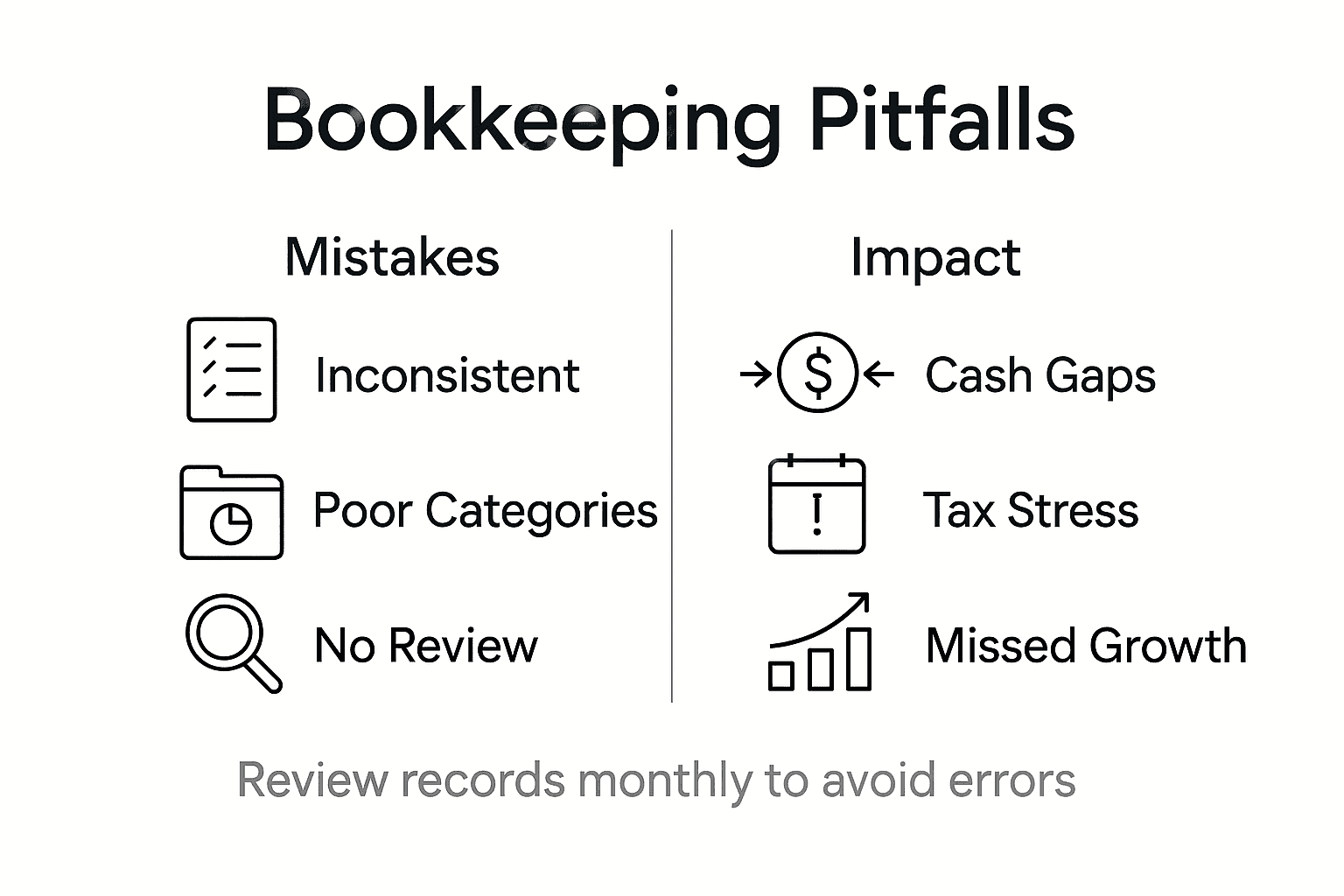
Another significant bookkeeping pitfall involves neglecting proper expense categorization and reconciliation. Home service businesses frequently mix personal and business expenses, fail to track reimbursable costs, or overlook minor transactions that can accumulate significant financial impact. These seemingly small oversights can result in substantial tax complications, reduced profitability, and missed opportunities for financial optimization. Entrepreneurs who do not implement rigorous, systematic approaches to expense tracking effectively handicap their own business growth potential, creating unnecessary financial friction and complexity.
Below is a summary of major bookkeeping pitfalls and their long-term impact:
| Pitfall | Example Situation | Long-term Impact |
|---|---|---|
| Inconsistent documentation | Skipping monthly reconciliations | Inaccurate tax returns |
| Poor expense categorization | Mixing business and personal spending | Lost deductible expenses |
| Failing to track minor transactions | Ignoring small cash payments | Understated expenses, profit errors |
| Lack of regular reviews | Neglecting to audit records quarterly | Missed financial trends, risk exposure |
Pro tip: Develop a consistent monthly bookkeeping routine that includes categorizing all transactions, reconciling bank statements, and reviewing financial reports to maintain accurate and actionable financial records.
Take Control of Your Business Finances with Expert Bookkeeping Support
The article highlights the crucial role accurate bookkeeping plays in successful business planning and financial growth. Key challenges like inconsistent documentation, poor expense categorization, and lack of regular reviews can hold your business back from reaching its full potential. If these pain points sound familiar, Kenworthy Bookkeeping offers tailored solutions that bring clarity and control to your financial records.

Don’t let bookkeeping pitfalls undermine your progress. With our expert services using QuickBooks Online, we handle everything from meticulous categorization to timely bank reconciliations and detailed profit and loss reports. Serving the Kansas City area, we help you streamline your finances and focus on growing your home service business. Discover how our trusted team supports your financial planning goals by scheduling a consultation today at Kenworthy Bookkeeping Consult. Take the first step toward financial confidence now.
Frequently Asked Questions
What is the importance of bookkeeping in business planning?
Bookkeeping is crucial for business planning as it provides accurate financial data, helping entrepreneurs make informed decisions, develop budgets, and anticipate challenges, which ultimately supports sustainable growth.
How do different bookkeeping methods impact small businesses?
Different bookkeeping methods, like single-entry and double-entry systems, affect how businesses track transactions and manage their finances. Choosing the right method based on business complexity can enhance accuracy and financial transparency.
What are common bookkeeping pitfalls that can hinder business growth?
Common pitfalls include inconsistent financial documentation, poor expense categorization, and neglecting regular reviews. These mistakes can lead to inaccurate records, tax complications, and missed financial opportunities, ultimately impacting growth.
How can software like QuickBooks Online improve bookkeeping practices?
QuickBooks Online automates financial workflows, integrates with various apps, and provides real-time insights, reducing manual entry errors and enabling small businesses to gain a comprehensive view of their financial health.






2 Comments
Comments are closed.