

End-of-Year Reporting: Boosting Compliance and Clarity
Every Kansas City home service business owner knows the scramble that comes as the year wraps up—sorting receipts, checking bank statements, and trying to get your books in order before tax deadlines. These moments matter because accurate financial reporting not only keeps the Internal Revenue Service satisfied but also shows you how well your plumbing, electrical, or HVAC crew performed. You will discover how end-of-year reporting brings clarity and confidence to tax season, helping you make smarter decisions and avoid costly mistakes.
Table of Contents
- What Is End-of-Year Reporting for Small Businesses
- Essential Financial Statements for Year-End
- Key IRS Filing Deadlines and Requirements
- How Accurate Reporting Supports Tax Season Success
- Common Pitfalls and Bookkeeping Errors to Avoid
Key Takeaways
| Point | Details |
|---|---|
| End-of-Year Reporting Importance | End-of-year reporting provides a clear financial overview, which helps business owners understand profitability and compliance with IRS requirements. |
| Essential Financial Statements | The Balance Sheet, Income Statement, and Cash Flow Statement are crucial for assessing business health and tax liability. |
| Timely Documentation | Gathering financial documents ahead of deadlines ensures smooth tax preparation and minimizes the risk of penalties. |
| Common Bookkeeping Errors | Avoid mixing personal and business finances, as well as failing to reconcile accounts, to maintain accurate financial records and prevent costly mistakes. |
What Is End-of-Year Reporting for Small Businesses
End-of-year reporting is the process of preparing and finalizing all financial records for the calendar or fiscal year. For home service business owners in Kansas City, this means pulling together everything your plumber, electrician, or HVAC crew earned and spent over the past 12 months.
You’re basically closing the books and making sure every dollar is accounted for. This involves closing books after recording transactions and ensuring nothing falls through the cracks before tax season arrives.
Here’s what end-of-year reporting actually includes:
- Recording all final transactions and adjustments
- Reconciling bank accounts and credit cards
- Preparing financial statements that show your profit and loss
- Organizing documents for tax filings
- Ensuring compliance with IRS requirements
Why This Matters for Your Business
Think of end-of-year reporting like a final inspection before handing over a completed job. You wouldn’t tell a customer their roof is done without walking through it first, right? Same principle applies to your finances.
When you complete proper financial reporting workflows, you gain a clear picture of where your business actually stands. Did you make more money this year than last? Which service lines are most profitable? Where did you overspend?
Beyond clarity, there’s compliance. The IRS requires specific tax forms and documentation from small business owners. Missing deadlines or submitting incomplete information can trigger penalties, audits, or bigger headaches down the road.
End-of-year reporting transforms a year of scattered receipts and bank transactions into actionable business intelligence and proper tax documentation.
For home service businesses operating in Kansas City with fewer than 20 employees, end-of-year reporting typically involves these key components:
- Reviewing all income from service calls and project work
- Categorizing expenses like truck maintenance, equipment, and materials
- Recording depreciation on tools and vehicles
- Documenting all business mileage and vehicle expenses
- Finalizing contractor payments if you work with subcontractors
The Real-World Impact
You probably started your business to do great work and build something meaningful. End-of-year reporting isn’t about red tape—it’s about protecting what you’ve built. Clear financial records mean better decision-making and peace of mind during tax season.
Many home service owners postpone this work because it feels overwhelming. A messy box of receipts, scattered credit card statements, and months of unorganized transactions create stress. That’s exactly where a structured end-of-year reporting process saves time and money.
Pro tip: Start gathering your end-of-year documents by November rather than waiting until December 31st. This gives you time to catch missing receipts, reconcile accounts, and address any discrepancies before year-end deadlines hit.
Essential Financial Statements for Year-End
Three core financial statements form the backbone of end-of-year reporting: the balance sheet, income statement, and cash flow statement. For your home service business, these documents translate 12 months of work into clear snapshots of your financial health.
Think of them as your business’s report card. They show what you own, what you owe, how much profit you made, and where your cash actually went. Understanding financial statements helps you see the real story behind your numbers.
Here’s how the three primary financial statements differ in focus and value:
| Statement Type | Key Purpose | What It Tells Owners |
|---|---|---|
| Balance Sheet | Shows financial position at year-end | Reveals what the business owns and owes |
| Income Statement | Measures profit over the year | Highlights profit drivers and expenses |
| Cash Flow Statement | Tracks cash movement | Identifies liquidity and cash challenges |
The Balance Sheet
Your balance sheet shows your financial position on a specific date—usually December 31st. It answers one simple question: what’s your business worth right now?
This statement lists three categories:
- Assets (what you own): cash, trucks, tools, customer invoices owed to you
- Liabilities (what you owe): bank loans, credit card debt, unpaid bills
- Equity (your stake): what remains after subtracting liabilities from assets
For a Kansas City HVAC business with five trucks and some equipment, your balance sheet shows the real value of those assets and any loans attached to them.

The Income Statement
Your income statement (also called a P&L or profit and loss statement) covers a time period—in this case, the entire year. It shows everything you earned and everything you spent.
Breakdown:
- Revenue: total dollars from service calls, maintenance contracts, and jobs
- Expenses: materials, labor, truck fuel, insurance, equipment repairs
- Net income: revenue minus expenses (your actual profit)
This statement reveals which service lines generate the most profit and where you’re overspending. Many home service owners discover they’re spending too much on materials or vehicle maintenance through this analysis.
The Cash Flow Statement
Your cash flow statement tracks money moving in and out of your business. Profit doesn’t equal cash—you might be profitable but still short on cash if customers owe you money.
This statement shows:
- Cash from your actual operations
- Cash used for investments (buying equipment)
- Cash from borrowing or owner contributions
These three statements work together to give you complete financial clarity and ensure tax compliance during year-end reporting.
When financial position and performance are properly documented, you avoid surprises during tax season. You’ll know exactly what you owe the IRS and whether you need to set money aside.
Why Your CPA Needs These
Your tax preparer cannot file accurate returns without these statements. They need your year-end financial data organized and complete. Scrambling to find receipts in January costs time and money.
For small businesses with fewer than 20 employees, these statements don’t need to be fancy—they just need to be accurate and complete. QuickBooks Online generates them automatically when your bookkeeping is current.
Pro tip: Have your year-end financial statements prepared by mid-December so you can review them before meeting with your tax professional, giving you time to address any discrepancies or ask questions about your financial performance.
Key IRS Filing Deadlines and Requirements
Miss an IRS deadline and penalties stack up fast. For home service businesses in Kansas City, staying on top of filing dates protects your bottom line and keeps the IRS satisfied.
The core deadline most small businesses face is April 15th for calendar year filers. That’s when your tax return and all supporting documentation must reach the IRS. Fiscal year businesses have four months after their year ends to file.
But April 15th is just one date. The IRS has a calendar of requirements throughout the year, and understanding tax calendar deadlines keeps you from scrambling at the last minute.
Understanding Your Filing Timeline
Here’s what matters for your business:
- April 15th: Standard deadline for calendar year tax returns (can request extension for six months)
- Quarterly estimated taxes: Due April 15, June 15, September 15, and January 15
- Year-end payroll deadlines: W-2s due to employees by January 31
- 1099 forms: Due to contractors and the IRS by January 31
- Extension deadline: October 15 if you filed Form 4868 by April 15
Extensions give you breathing room, but here’s the catch—taxes still owe by the original April 15 deadline. An extension only extends filing time, not payment time.
Why These Dates Matter for Your Business
Your crew depends on accurate W-2 forms showing their earnings. Contractors need 1099s for their own tax filings. Late filing creates headaches for everyone and risks IRS penalties for you.
Failing to meet IRS filing deadlines costs money in penalties and interest. A missed deadline can trigger a failure-to-file penalty of 5% per month, up to 25% of your unpaid taxes.
Missing even one deadline starts a penalty clock that grows each month until resolved, making timely year-end reporting the most cost-effective choice.
Planning Ahead Prevents Problems
December shouldn’t be your first thought about taxes. Successful home service owners start gathering year-end documents in November. Clean categorized bookkeeping throughout the year makes year-end filing smooth.
When your financial records are current and organized, preparing your return takes days, not weeks. Your tax preparer has everything needed to file on time.
The relationship between solid bookkeeping practices and tax compliance is direct—accurate records mean accurate filings and no missed deadlines.
Pro tip: Create a deadline calendar by December 1st marking April 15 for tax filing, January 31 for W-2 and 1099 distribution, and quarterly estimated tax dates, then set phone reminders two weeks before each date to ensure nothing slips through.
How Accurate Reporting Supports Tax Season Success
Accurate reporting transforms tax season from a stressful scramble into a manageable process. When your year-end numbers are clean and complete, your tax preparer can file quickly and confidently.
The difference between accurate and sloppy reporting shows up immediately. A business with organized records files returns in days. One with scattered receipts and incomplete data takes weeks and costs more money. Worse, inaccurate filing invites IRS scrutiny.
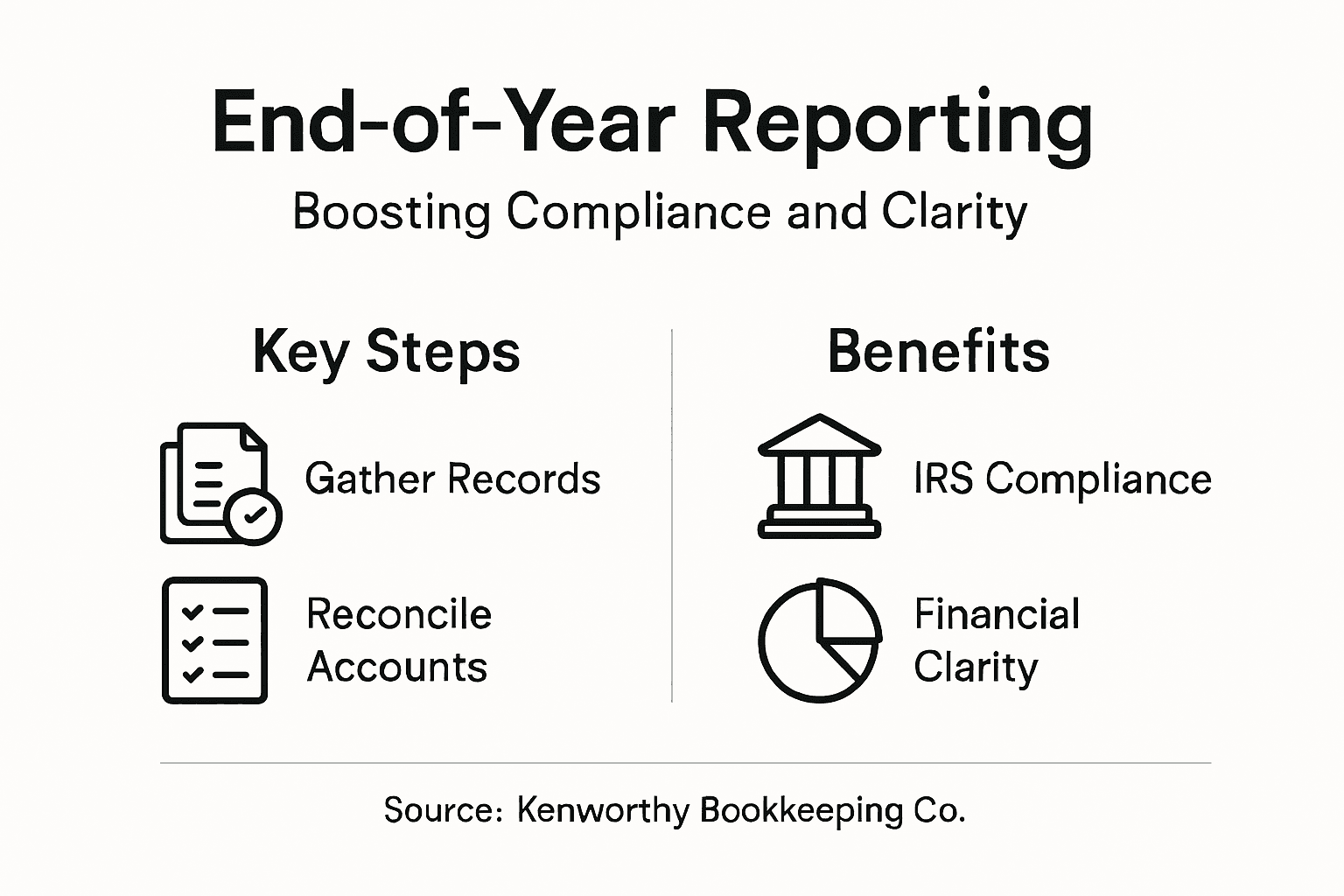
When financial data is complete and reliable, you avoid the errors and omissions that trigger audits or penalties. Accuracy builds trust with tax authorities and protects your business.
The Direct Connection to Tax Outcomes
Accurate reporting means your tax preparer knows exactly what you owe or what refund you should receive. No surprises. No rushed corrections filed months later.
Here’s what solid year-end reporting delivers:
- Clear picture of actual profit and loss
- Documented deductions that survive IRS scrutiny
- Correct tax liability with no underpayment penalties
- Fast filing and quick refunds if applicable
- Reduced audit risk and stress
For home service businesses, accurate expense tracking is critical. That truck maintenance, equipment purchase, materials cost—all need to be categorized correctly to claim legitimate deductions.
Why Documentation Matters Now
The IRS doesn’t just look at your bottom-line numbers. They want to see the evidence behind your claims. A deduction means nothing without receipts, invoices, or bank statements proving it happened.
Accurate year-end reporting means you’ve already organized this documentation throughout the year. You’re not hunting for credit card statements in February or wondering which expense belongs in which category.
This attention to detail during year-end closes strengthens your position if the IRS ever questions your return. Clear, accurate records show you run a legitimate business.
Accurate reporting reduces audit risk, speeds up filing, and ensures you pay the correct amount of tax—no more, no less.
The Ripple Effect on Your Business
Beyond tax season, accurate reporting gives you real insights into your business. You see which service lines are truly profitable. You identify spending patterns that waste money. You make better decisions about pricing, hiring, and growth.
When diligent financial disclosures are maintained throughout the year, tax season becomes a confirmation of what you already know about your business health. Not a surprise.
Pro tip: Set up weekly 15-minute bookkeeping check-ins during November and December to catch categorization errors and missing receipts before your tax deadline, rather than discovering problems in January.
Common Pitfalls and Bookkeeping Errors to Avoid
Small business owners make the same bookkeeping mistakes repeatedly. Knowing what to watch for prevents costly errors and saves time at year-end.
The most dangerous mistake is letting one person control all finances with no oversight. That person gets sick, leaves, or worse—nobody catches errors or fraud. A home service business with five employees and one office manager handling everything is vulnerable.
Another killer mistake is mixing personal and business money. Your truck payment, supplies, and personal groceries all swirled together make it impossible to know what your business actually costs. This creates nightmares during tax season.
The Most Common Errors
Here’s what sinks small businesses every year:
- Not reconciling accounts: Your bank says you have $8,000 but your records show $12,000. Which is right? You don’t know until you reconcile.
- Missing or disorganized receipts: A $3,400 equipment purchase with no receipt means you can’t claim the deduction.
- Skipping transactions: A crew member pays cash for materials and forgets to record it. That expense vanishes.
- Misclassifying expenses: Truck fuel goes under “office supplies” instead of “vehicle expenses.” Your profit looks wrong.
- No backup documentation: You claim a deduction but have zero proof if the IRS asks.
Implementing strong internal controls and regular audits protects against these gaps and reduces fraud risk significantly.
Personal vs. Business Finances
This deserves its own spotlight because it’s so common and so damaging. Your business needs its own bank account and credit card—period.
When you pay a personal expense from the business account, it clouds your financial picture. You don’t know if you’re actually making money. You can’t claim legitimate business deductions because they’re mixed with personal spending.
Documentation Is Everything
Every transaction needs a paper trail. Common bookkeeping errors include omitting transactions and failing to keep receipts, both of which derail tax compliance.
For service businesses, this means receipts for materials, invoices from suppliers, mileage logs, and payment records. Keep them all.
Missing documentation doesn’t just create bookkeeping headaches—it eliminates your ability to prove deductions if audited, costing you money in lost tax benefits.
When you find errors, catching them early matters. You can address them before year-end rather than scrambling in January.
The following table summarizes the most common year-end reporting mistakes and how to prevent them:
| Common Error | Business Risk | Prevention Tip |
|---|---|---|
| No receipt for expenses | Lost tax deductions | Collect and organize all receipts |
| Unreconciled accounts | Missed errors or missing funds | Reconcile accounts every month |
| Misclassified transactions | Inaccurate financial statements | Review transaction categories often |
| Mixing business/personal funds | Complicated tax filings | Use only business accounts |
Pro tip: Reconcile your business bank account every week during November and December so you catch missing transactions or duplicate entries while time permits for corrections.
Simplify Your End-of-Year Reporting and Gain Financial Clarity Today
End-of-year reporting can feel overwhelming with all the details of reconciling accounts, categorizing expenses, and preparing essential financial statements like balance sheets, income statements, and cash flow reports. If you want to avoid common pitfalls such as missing receipts or misclassified transactions, partnering with a trusted bookkeeping service can provide the clarity and compliance your Kansas City home service business needs. Kenworthy Bookkeeping specializes in helping small businesses like yours streamline their year-end financial processes with QuickBooks Online, ensuring accurate records that pave the way for stress-free tax filing and better business insight.
Ready to stop worrying about financial chaos and start focusing on growing your business? Visit Kenworthy Bookkeeping Consult for expert assistance with bank reconciliations, P&L reports, and comprehensive year-end preparation. Let us help you regain control and enter tax season confidently by organizing your books early and avoiding costly IRS penalties. Take the first step to peace of mind today.
Frequently Asked Questions
What is end-of-year reporting?
End-of-year reporting is the process of finalizing all financial records for the year, which includes recording transactions, reconciling accounts, preparing financial statements, and organizing documents for tax filings.
Why is end-of-year reporting important for small businesses?
End-of-year reporting is crucial for providing a clear financial overview, ensuring compliance with IRS requirements, aiding in decision-making, and preventing potential penalties during tax season.
What are the essential financial statements included in year-end reporting?
The three essential financial statements are the balance sheet, income statement (or profit and loss statement), and cash flow statement. These documents provide insights into your business’s financial position, profit, and cash flow.
What common errors should small businesses avoid during year-end reporting?
Common errors include failing to reconcile accounts, missing or disorganized receipts, misclassifying expenses, and mixing personal and business finances. Keeping accurate documentation and regularly reviewing transactions can help prevent these mistakes.






One Comment
Comments are closed.