

Financial Forecasting and Profitability for Kansas City Small Businesses
Nearly half of American small businesses struggle to achieve long-term financial stability without effective forecasting. For Kansas City home service owners, gaining control of your cash flow and planning for changing market conditions can make the difference between survival and growth. This overview highlights practical techniques and common pitfalls, guiding you to build stronger financial foundations and avoid costly mistakes.
Table of Contents
- Financial Forecasting Defined For Small Businesses
- Methods And Types Of Financial Forecasting
- How Forecasting Supports Business Planning
- Key Benefits For Home Service Companies
- Common Mistakes And How To Avoid Them
Key Takeaways
| Point | Details |
|---|---|
| Financial Forecasting is Essential | Effective financial forecasting allows small business owners to predict outcomes, manage risks, and allocate resources efficiently. |
| Choose Appropriate Methods | Select forecasting techniques that match your business needs, combining qualitative and quantitative approaches for best results. |
| Plan for Different Scenarios | Develop multiple financial scenarios—conservative, moderate, and optimistic—to enhance strategic planning and flexibility. |
| Avoid Common Pitfalls | Regularly update forecasts, use rigorous data analysis, and validate assumptions to prevent errors and enhance forecasting accuracy. |
Financial forecasting defined for small businesses
Financial forecasting is a strategic process that enables Kansas City small business owners to predict their financial future with precision and insight. At its core, financial forecasting involves systematically analyzing historical financial data, current market trends, and potential scenarios to estimate future financial performance.
For home service businesses in Kansas City, financial forecasting isn’t just about creating spreadsheets—it’s about understanding potential revenue streams, anticipating expenses, and preparing for different business scenarios. By developing accurate financial projections, small business owners can make informed decisions about investments, budgeting, staffing, and growth strategies. The process typically involves examining past financial statements, evaluating current market conditions, and creating detailed models that predict potential income, expenses, and cash flow.
Small businesses benefit most when financial forecasting moves beyond basic number-crunching and becomes a dynamic planning tool. Effective forecasting helps entrepreneurs identify potential financial challenges before they become critical, understand seasonal revenue fluctuations specific to their industry, and develop contingency plans. Technological advancements now enable more accurate predictions through sophisticated data analysis techniques, allowing even small businesses to create robust financial models.
Pro tip: Start your financial forecasting by tracking at least 12-24 months of historical financial data, which provides the most accurate foundation for future projections.
Methods and types of financial forecasting
Financial forecasting for small businesses in Kansas City involves several strategic methods that help entrepreneurs anticipate future financial performance. Seven primary forecasting techniques provide business owners with tools to analyze potential financial scenarios and make informed decisions. These methods range from simple historical trend analysis to complex predictive modeling that considers multiple economic variables.
The main categories of financial forecasting methods include qualitative techniques, quantitative approaches, and hybrid models. Qualitative methods rely on expert judgment and market research, involving techniques like consulting industry professionals, conducting customer surveys, and analyzing market trends. Quantitative approaches, such as time series analysis and causal modeling, use historical financial data to identify patterns and predict future performance. These techniques might include moving averages, regression analysis, and incremental forecasting, which help small businesses create more accurate financial projections.
For home service businesses in Kansas City, choosing the right forecasting method depends on several factors, including business size, industry complexity, available data, and specific financial goals. Some businesses might benefit from pro forma financial statements that project future income and expenses, while others might find scenario planning more useful for understanding potential financial outcomes under different market conditions. The key is to select a method that provides actionable insights while remaining flexible enough to adapt to changing business environments.
Pro tip: Combine at least two different forecasting methods to create more robust and reliable financial projections, cross-referencing results to improve accuracy and confidence in your predictions.
Here’s a comparison of common financial forecasting methods for small businesses:
| Method Type | Example Techniques | Data Requirement | Typical Use Case |
|---|---|---|---|
| Qualitative | Expert interviews, surveys | Market research, expert input | Launching a new service or product |
| Quantitative | Time series, regression | Detailed historical financials | Predicting seasonal sales trends |
| Hybrid | Scenario modeling, pro forma statements | Combines historical data and judgments | Planning for uncertain economic shifts |
How forecasting supports business planning
Financial forecasting is a critical tool that transforms business planning from reactive guesswork into a strategic, data-driven process. Anticipating performance outcomes allows Kansas City small business owners to make proactive decisions that align with their long-term objectives. By providing a comprehensive view of potential financial scenarios, forecasting enables entrepreneurs to identify opportunities, manage risks, and allocate resources more effectively.

The process of forecasting directly supports business planning by creating a structured approach to understanding future financial possibilities. Small businesses can use these insights to develop more accurate budgets, plan strategic investments, and prepare for potential market fluctuations. Predicting revenue, costs, and cash flow helps business owners set realistic performance metrics and adjust their strategies dynamically. This approach transforms financial planning from a static annual exercise into a flexible, ongoing process of strategic decision-making.
For home service businesses in Kansas City, financial forecasting offers specific planning advantages. It helps entrepreneurs anticipate seasonal revenue changes, plan for equipment investments, manage workforce needs, and understand potential financial constraints. By creating multiple scenario projections, business owners can develop contingency plans, identify potential funding requirements, and make more confident strategic choices. The ability to model different financial scenarios provides a level of strategic insight that can mean the difference between merely surviving and truly thriving in a competitive market.
Pro tip: Create at least three financial forecast scenarios: conservative, moderate, and optimistic, to provide a comprehensive view of potential business outcomes and improve strategic planning flexibility.
Key benefits for home service companies
Home service businesses in Kansas City can unlock significant strategic advantages through robust financial forecasting. Improved cash flow management enables these companies to make critical operational decisions with greater confidence and precision. By anticipating financial needs, service businesses can strategically plan equipment purchases, manage staffing levels, and navigate seasonal revenue fluctuations more effectively.
Financial forecasting provides home service companies with a powerful tool for optimizing resource allocation and strategic planning. Data analytics helps businesses anticipate demand patterns and make informed operational choices that directly impact profitability. This approach allows companies to proactively adjust marketing efforts, manage expenses, and identify potential growth opportunities before they become apparent through traditional reporting methods.
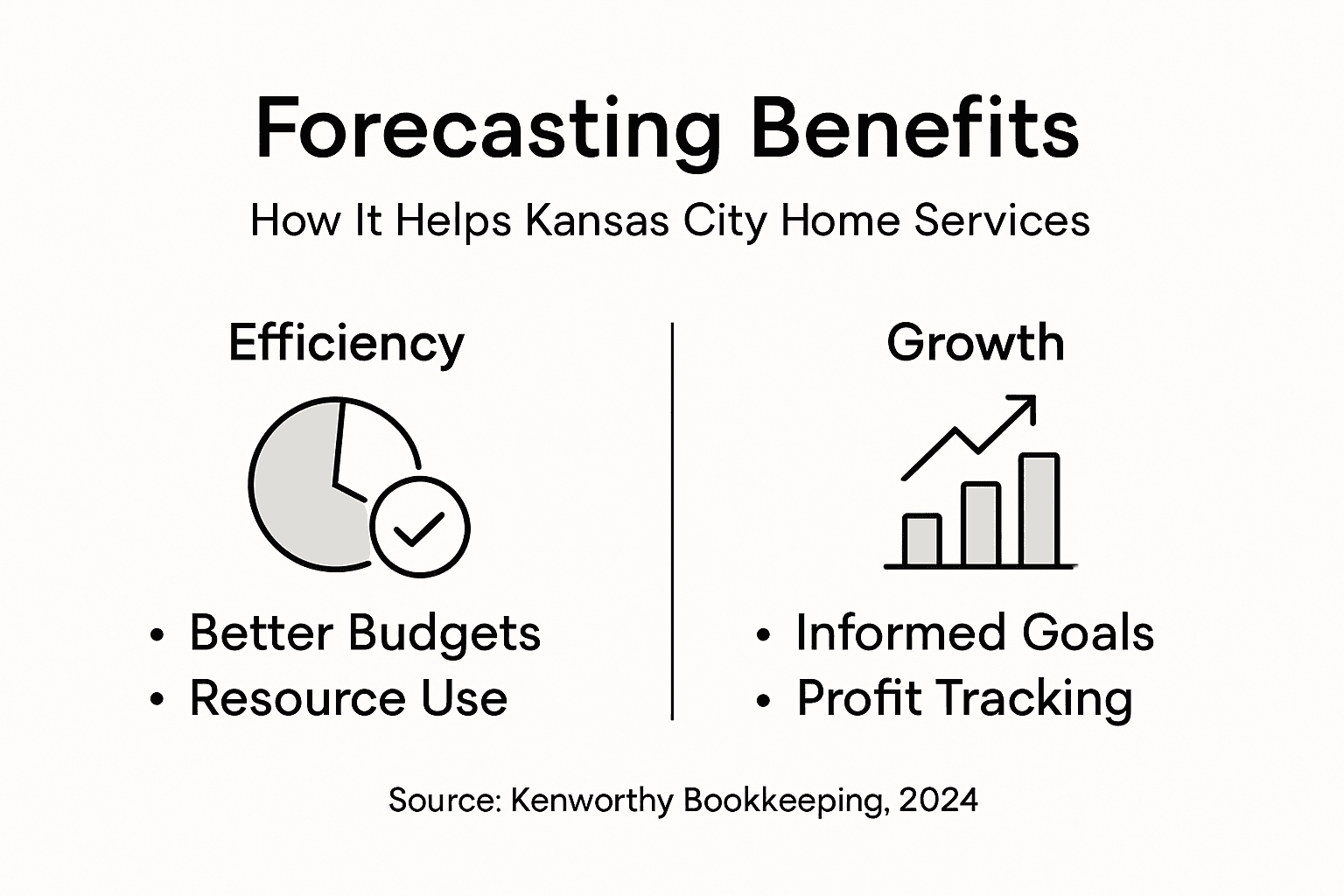
The benefits extend beyond immediate financial planning, providing home service businesses with a comprehensive framework for sustainable growth. Forecasting strengthens a company’s ability to secure financing by demonstrating a well-structured financial future, reduces uncertainty in business operations, and enhances competitive positioning in the local Kansas City market. Small service businesses can use these insights to develop more accurate budgets, plan strategic investments, and create contingency plans that protect against potential financial challenges.
Pro tip: Develop a quarterly financial forecasting review process that compares actual performance against projected scenarios, allowing for real-time strategic adjustments and continuous business improvement.
The table below summarizes strategic benefits small home service companies can achieve with proactive financial forecasting:
| Benefit | Description | Business Impact |
|---|---|---|
| Cash flow management | Predicts shortfalls and surpluses | Enables timely investment decisions |
| Workforce planning | Anticipates seasonal workload changes | Optimizes staffing costs and efficiency |
| Competitive positioning | Models market shifts and demand trends | Strengthens response to competitors |
| Securing financing | Presents future financial projections | Increases lender and investor confidence |
Common mistakes and how to avoid them
Home service businesses often encounter critical pitfalls when developing financial forecasts that can undermine their strategic planning. Relying too heavily on optimistic assumptions represents one of the most dangerous errors, leading to unrealistic expectations and potential financial instability. Kansas City entrepreneurs must cultivate a disciplined approach that balances optimism with rigorous financial analysis, creating projections that are both ambitious and grounded in realistic performance metrics.
The most significant forecasting errors typically stem from inadequate data management and model complexity. Ignoring model instability and overfitting data can create forecasts that look impressive on paper but fail to reflect real-world business conditions. Successful home service companies develop forecasting models that remain flexible, integrating multiple financial metrics, regularly updating projections, and maintaining transparency in their analytical approach. This means creating comprehensive financial models that consider cash flow, profitability ratios, seasonal variations, and potential market disruptions.
Mitigating forecasting risks requires a proactive and systematic approach. Small businesses should implement robust validation processes, including out-of-sample testing and regular performance comparisons between projected and actual results. This involves creating conservative baseline projections, developing multiple scenario models, and maintaining the discipline to revise forecasts as new information becomes available. By approaching financial forecasting as a dynamic, ongoing process rather than a static annual exercise, home service businesses can build more resilient and adaptable financial strategies.
Pro tip: Implement a quarterly forecasting review process that compares projected figures against actual performance, using discrepancies as opportunities to refine and improve your financial modeling approach.
Take Control of Your Financial Future with Expert Bookkeeping Support
Accurate financial forecasting depends on clear, up-to-date financial data and a thorough understanding of your numbers. For Kansas City small business owners striving to balance optimistic growth plans with realistic financial insights, managing detailed bookkeeping tasks like categorization, bank reconciliations, and timely profit and loss reports can be overwhelming yet critical. Without precise bookkeeping, even the best forecasting methods lose their impact, increasing the risk of costly mistakes or missed opportunities.
Start strengthening your financial forecasts today by partnering with Kenworthy Bookkeeping. Our expert, effortless bookkeeping services streamline your finances, delivering the reliable data you need to build effective projections and make confident business decisions. Don’t let uncertainty hold back your home service business or small company any longer. Visit Kenworthy Bookkeeping Consult now to schedule your personalized consultation and reclaim control over your profitability and growth.
Frequently Asked Questions
What is financial forecasting for small businesses?
Financial forecasting is a strategic process that involves analyzing historical financial data, current market trends, and potential scenarios to estimate future financial performance. It helps small business owners make informed decisions about budgeting, investments, and growth strategies.
How can financial forecasting improve profitability for small businesses?
Financial forecasting helps small businesses anticipate revenue streams, manage expenses, and identify potential financial challenges. By creating detailed projections, business owners can allocate resources effectively, make strategic investments, and adapt to market fluctuations to enhance profitability.
What are the main methods of financial forecasting?
The main methods of financial forecasting include qualitative techniques (like expert judgment and market research), quantitative approaches (such as time series analysis and regression), and hybrid models that combine both qualitative and quantitative data to create more accurate projections.
How often should small businesses review their financial forecasts?
Small businesses should implement a quarterly financial forecasting review process. This allows them to compare actual performance against projected scenarios, enabling real-time adjustments and continuous improvement in financial planning.