

Role of Financial Health in Small Business Success
Over one million American small businesses close each year, often due to overlooked financial warning signs. For Kansas City service providers with lean teams, understanding true financial health goes far beyond watching a bank balance. Knowing exactly how your American business manages money, plans for the future, and adapts to change can reveal early profit leaks and hidden opportunities you might miss otherwise.
Table of Contents
- Defining Financial Health for Small Businesses
- Core Metrics and Financial Statements Explained
- How Financial Health Impacts Profitability
- Common Pitfalls and Costly Mistakes
- Modern Tools and Strategies for Improvement
Key Takeaways
| Point | Details |
|---|---|
| Understanding Financial Health | Small businesses need to assess their financial health comprehensively, focusing on resource management, long-term goals, and resilience to financial shocks. |
| Monitoring Key Metrics | Regularly track core financial metrics like profit margins, debt-to-equity ratios, and cash flow to identify vulnerabilities and inform strategic decisions. |
| Avoiding Common Mistakes | Entrepreneurs must develop vigilant financial practices to avoid pitfalls such as poor cash flow management and inadequate emergency funds. |
| Leveraging Modern Tools | Embrace digital financial tools to enhance operational efficiency and enable data-driven decision-making for improved financial performance. |
Defining Financial Health for Small Businesses
Financial health represents a comprehensive assessment of a small business’s monetary stability and potential for sustainable growth. Unlike simple profit tracking, financial health encompasses a multifaceted evaluation of how effectively a business manages its financial resources, plans for future challenges, and positions itself for strategic opportunities. Financial health measurement involves analyzing how businesses spend, save, borrow, and plan in ways that enable resilience and opportunity pursuit.
For small businesses in Kansas City, financial health means more than just maintaining positive cash flow. It requires a strategic approach that balances day-to-day expense management with long-term financial goals. Key indicators include consistent revenue streams, manageable debt levels, adequate cash reserves, predictable expense patterns, and the ability to absorb unexpected financial shocks. Small business owners must develop a holistic view that goes beyond basic accounting and considers the broader economic ecosystem in which their business operates.
Measuring financial health involves tracking several critical metrics that provide insights into a business’s overall fiscal wellness. These metrics include profit margins, operating expenses, accounts receivable turnover, debt-to-equity ratio, and working capital. By regularly monitoring these indicators, small business owners can identify potential vulnerabilities, make data-driven decisions, and proactively address financial challenges before they become critical problems. Complex financial health measurement requires understanding composite indicators that capture expense management, shock absorption, and progress towards strategic financial objectives.
Pro tip: Create a monthly financial dashboard that tracks your key performance indicators, allowing you to quickly assess your business’s financial health and make timely strategic adjustments.
Core Metrics and Financial Statements Explained
Financial statements are critical roadmaps that reveal a small business’s fiscal performance and potential. Financial statements are formal records detailing a business’s financial activities and position, typically encompassing four key documents that provide comprehensive insights into organizational health. These documents serve as powerful diagnostic tools for understanding a company’s monetary landscape, enabling business owners to make strategic decisions based on concrete financial evidence.
The four primary financial statements small business owners must understand include the balance sheet, income statement, cash flow statement, and statement of changes in equity. Each statement offers a unique perspective on financial performance. The balance sheet provides a snapshot of assets, liabilities, and owner’s equity at a specific moment. The income statement reveals revenues, expenses, and profitability over a designated period. Financial statement analysis involves understanding these core documents to assess profitability, liquidity, and solvency through detailed ratio evaluations.
Here’s how core financial statements differ in what they reveal about a business:
| Statement Type | Focus Area | Key Business Insight |
|---|---|---|
| Balance Sheet | Assets, liabilities, equity | Overall financial position on a given date |
| Income Statement | Revenue, expenses | Profitability over a time period |
| Cash Flow Statement | Cash inflows/outflows | Liquidity and cash management effectiveness |
| Equity Statement | Changes in ownership equity | How owner’s value evolves annually |
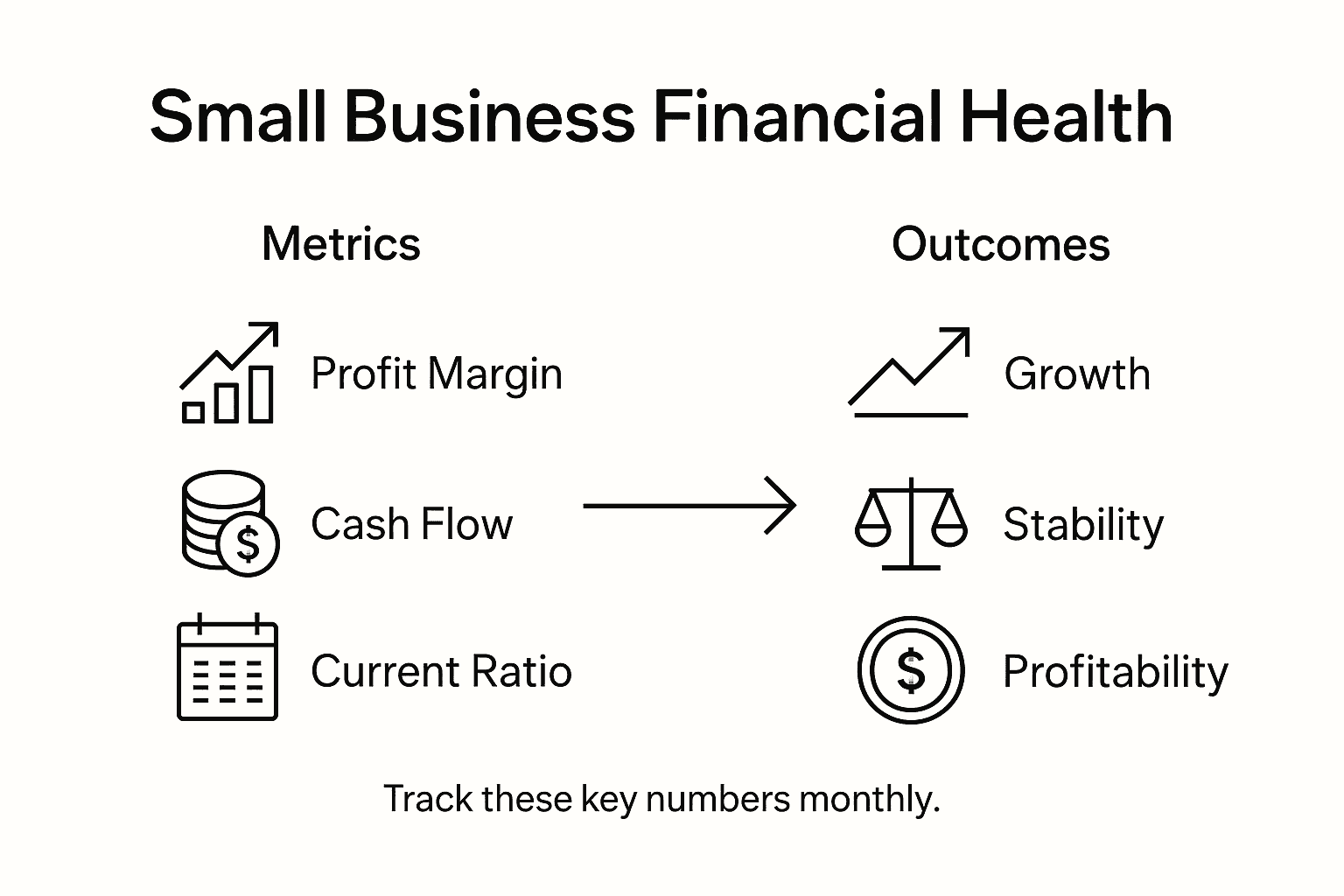
Key financial metrics small businesses should track include gross profit margin, net profit margin, current ratio, debt-to-equity ratio, and accounts receivable turnover. These metrics help business owners understand their company’s financial efficiency, liquidity, and long-term sustainability. By consistently monitoring these indicators through well-prepared financial reports, entrepreneurs can identify potential challenges, optimize financial strategies, and make informed decisions that drive business growth.
Pro tip: Schedule a quarterly financial statement review with your bookkeeper to deeply analyze your business’s performance metrics and identify emerging trends or potential areas for improvement.
How Financial Health Impacts Profitability
Profitability is the lifeblood of any small business, directly influenced by its underlying financial health. Profitability reflects a company’s ability to efficiently convert revenue into earnings and sustain growth, with poor financial health potentially masking deep operational inefficiencies. Small businesses in Kansas City must recognize that financial health is not just about maintaining positive cash flow, but about creating a robust economic foundation that supports consistent and sustainable profit generation.

Financial health supports daily expense management, shock absorption, and goal progression, which are fundamental for business profitability. When businesses maintain strong financial systems, they can strategically allocate resources, invest in growth opportunities, and quickly respond to market changes. This adaptability directly translates to improved profit margins. Critical factors like maintaining low debt levels, managing cash reserves effectively, and understanding key financial health steps can significantly enhance a company’s ability to generate consistent profits.
Key profitability drivers include operational efficiency, cost management, revenue optimization, and strategic financial planning. Small business owners must develop a comprehensive approach that goes beyond simple profit tracking. This involves continuous financial analysis, setting realistic financial goals, monitoring key performance indicators, and being prepared to make data-driven adjustments. By treating financial health as a dynamic, ongoing process, businesses can create a resilient economic framework that supports long-term profitability and sustainable growth.
Pro tip: Develop a monthly financial review routine that compares actual performance against your projected financial goals, allowing you to quickly identify and address potential profitability challenges.
Common Pitfalls and Costly Mistakes
Financial mistakes can quickly derail a small business’s success, transforming promising opportunities into costly setbacks. Small businesses frequently fail due to critical errors like ignoring legal compliance, poor financial management, and lack of comprehensive market research. For Kansas City entrepreneurs, understanding these potential pitfalls is crucial to maintaining financial stability and preventing unnecessary business risks.
Effective money management requires carefully tracking cash flow, setting strategic pricing, cutting unnecessary expenses, and adapting business strategies proactively. Common financial missteps include overestimating net income, neglecting cash flow management, and failing to pay oneself appropriately as a business owner. These errors can create hidden financial vulnerabilities that gradually erode a business’s economic foundation. Entrepreneurs must develop a vigilant approach to financial monitoring, using robust bookkeeping practices and regular financial reviews to identify and address potential issues before they escalate.
Key financial pitfalls small businesses should guard against include inconsistent revenue tracking, poor expense categorization, inadequate emergency funds, and reactive instead of proactive financial planning. Businesses must create systematic approaches to financial management that include detailed record-keeping, realistic budgeting, and continuous performance evaluation. By implementing key financial health steps, entrepreneurs can build resilient financial systems that protect against unexpected challenges and support sustainable growth.
Pro tip: Create a dedicated business emergency fund that covers at least three to six months of operating expenses, providing a critical financial buffer against unexpected economic disruptions.
Modern Tools and Strategies for Improvement
Digital transformation has become a critical strategy for small businesses seeking to enhance their financial health and operational efficiency. Access to modern financial technologies is revolutionizing how small and medium enterprises manage their economic resources, with digital platforms offering unprecedented opportunities for growth and innovation. Kansas City entrepreneurs can now leverage sophisticated tools that were previously accessible only to larger corporations.
Digitization has become essential for improving financial performance, enabling data-driven decision-making and fostering business resilience. Modern small businesses can utilize cloud-based accounting software, automated expense tracking systems, and real-time financial dashboards to gain immediate insights into their financial health. These technological solutions provide granular visibility into cash flow, expense patterns, and revenue streams, allowing business owners to make proactive financial decisions. By implementing key financial health steps, entrepreneurs can transform complex financial data into actionable strategic insights.
Compare digital financial tools commonly used by small businesses:
| Tool Type | Main Benefit | Business Impact |
|---|---|---|
| Cloud Accounting | Real-time access/control | Faster decision-making |
| Expense Tracking Apps | Automated expense sorting | Reduces manual errors |
| Financial Dashboards | Visual KPI analysis | Quick strategic adjustments |
| AI Analytics | Predictive financial trends | Proactive problem solving |
Key modern strategies for financial improvement include embracing artificial intelligence-powered analytics, implementing robust cybersecurity measures, and developing integrated financial management platforms. Small businesses should focus on tools that offer seamless integration, real-time reporting, and predictive financial modeling. These technologies not only streamline bookkeeping processes but also provide strategic forecasting capabilities that can help businesses anticipate financial challenges and opportunities before they arise.
Pro tip: Invest in a cloud-based financial management system that offers automatic bank reconciliation, expense categorization, and customizable reporting to streamline your financial tracking and decision-making processes.
Strengthen Your Small Business Financial Health Today
Managing financial health effectively is one of the biggest challenges small business owners face. This article highlights crucial pain points like balancing cash flow, mastering expense tracking, and preparing for unexpected shocks. If you feel overwhelmed by complex bookkeeping tasks or need clear, accurate reports to measure profitability and make informed decisions, you are not alone. Understanding core financial metrics is vital but can quickly become exhausting without expert help.
Kenworthy Bookkeeping offers tailored solutions designed to restore control over your finances. We specialize in effortless bookkeeping services powered by QuickBooks Online that ensure timely categorization, bank reconciliations, and detailed Profit & Loss reports. Our services help you not only monitor your financial health but also boost your company’s profitability and resilience. Explore how we can simplify your financial management and build a solid foundation for long-term growth.

Empower your business with precision bookkeeping and strategic insights. Don’t let financial confusion hold you back from success. Take the next step now by scheduling a consultation with Kenworthy Bookkeeping and transform your small business financial health into a powerful asset.
Frequently Asked Questions
What is financial health in small businesses?
Financial health refers to a comprehensive assessment of a small business’s monetary stability and growth potential, which includes evaluating effective management of financial resources, strategic planning for future challenges, and opportunities for growth.
How can small businesses measure their financial health?
Small businesses can measure their financial health by tracking key metrics such as profit margins, operating expenses, accounts receivable turnover, debt-to-equity ratio, and working capital through regular monitoring of financial statements and creating a financial dashboard.
Why is financial health important for profitability?
Financial health is crucial for profitability because it supports efficient resource allocation, strategic planning, and the ability to absorb financial shocks, all of which contribute to consistent and sustainable profit generation.
What are common pitfalls small businesses should avoid regarding financial management?
Common pitfalls include poor cash flow management, overestimating net income, neglecting expense categorization, inadequate emergency funds, and failing to conduct regular financial reviews. Avoiding these mistakes can help maintain financial stability and support growth.






3 Comments
Comments are closed.