

Financial Health: Why It Matters for Small Businesses
More than half of American small business owners admit they feel uncertain about their financial health each year. If you run a home service business in Kansas City, unclear finances can block growth and raise stress for your team. By understanding what true financial health means for your unique operation, you can protect your business, maximize profit, and make smarter choices that benefit your future.
Table of Contents
- Defining Financial Health for Businesses
- Key Indicators of Business Financial Health
- Common Misconceptions Small Owners Face
- Benefits of Strong Financial Health
- Risks and Costs of Poor Financial Health
- Steps to Improve Your Business Finances
Key Takeaways
| Point | Details |
|---|---|
| Understanding Financial Health | Financial health encompasses effective resource management, cash flow stability, and strategic planning, essential for long-term business success. |
| Key Indicators | Businesses should focus on cash flow, debt management, and savings capacity to gauge their financial wellness comprehensively. |
| Risks of Poor Financial Health | Weak financial health leads to cash flow issues and limits growth potential, creating vulnerabilities that can jeopardize business continuity. |
| Proactive Improvements | Regular financial reviews and building emergency reserves enhance stability and resilience against economic fluctuations. |
Defining Financial Health for Businesses
Financial health represents a comprehensive assessment of a business’s ability to manage resources, sustain operations, and pursue growth opportunities effectively. Unlike simplistic metrics that focus solely on profitability, financial wellness encompasses strategic financial management across multiple critical dimensions.
At its core, financial health evaluates how well a small business handles its daily monetary systems, including expense management, strategic savings, responsible borrowing, and proactive planning. A financially healthy business can withstand unexpected economic challenges while maintaining the flexibility to capitalize on emerging opportunities. This holistic approach goes beyond traditional financial indicators like credit scores or quarterly profits.
Key components of financial health include maintaining consistent cash flow, building adequate financial reserves, managing debt strategically, and developing sustainable revenue streams. For small home service businesses in Kansas City, this means understanding your precise financial position, tracking expenses meticulously, and creating buffers that protect against unexpected market fluctuations. Effective financial health allows businesses to make informed decisions, invest in growth, and create long-term stability.
Pro tip: Review your financial statements monthly and create a three-month emergency cash reserve to enhance your business’s financial resilience and preparedness.
Key Indicators of Business Financial Health
Financial health for small businesses is not a single metric but a comprehensive assessment involving multiple critical indicators. Experts have identified several key financial soundness measurements that provide insights into a business’s overall economic wellness and potential for sustainable growth.
These key indicators fall into several crucial categories: cash flow management, debt utilization, savings capacity, and financial planning. Cash flow represents the most immediate indicator, measuring how effectively a business generates and manages its money. Consistent positive cash flow suggests the business can cover operational expenses, invest in growth, and maintain financial stability. Debt utilization examines how responsibly a business uses borrowed funds, looking at factors like debt-to-income ratio, repayment consistency, and the strategic purpose of any outstanding loans.

Savings and liquidity are equally critical financial health indicators. Small businesses should aim to maintain emergency funds covering three to six months of operational expenses, providing a buffer against unexpected economic challenges. Additionally, profitability metrics like gross and net profit margins help assess the business’s ability to generate sustainable revenue. Credit scores, while important, are just one piece of the financial health puzzle and should be considered alongside these more comprehensive indicators.
Pro tip: Create a quarterly financial dashboard tracking your key performance indicators to gain real-time insights into your business’s financial trajectory and potential improvement areas.
Common Misconceptions Small Owners Face
Small business owners often navigate their financial journey surrounded by dangerous myths that can critically undermine their success. Financial literacy challenges reveal that many entrepreneurs operate under misconceptions that limit their potential and expose them to unnecessary financial risks.
One prevalent misconception is believing that financial education is optional or a luxury reserved for larger corporations. Small business owners frequently assume they can rely on intuition or past experience to manage their finances. This dangerous mindset overlooks the complexity of modern economic environments, where understanding nuanced financial strategies can mean the difference between survival and bankruptcy. Another critical misunderstanding is the belief that investing is only for wealthy businesses with substantial surplus funds. In reality, strategic investing represents a fundamental tool for growth, even for businesses operating on tight margins.
Additionally, many small business owners mistakenly view financial planning as a static process rather than an ongoing, dynamic strategy. They often neglect continuous financial education, underestimating how rapidly economic conditions and market dynamics can change. This approach leaves businesses vulnerable to unexpected economic shifts, inflation, and competitive pressures. By recognizing these misconceptions, small business owners can develop more robust financial strategies that prioritize learning, adaptability, and proactive management.
Pro tip: Commit to attending at least one financial education workshop or webinar quarterly to consistently upgrade your business financial knowledge and stay ahead of emerging economic trends.
Benefits of Strong Financial Health
Strong financial health represents far more than just a balance sheet metric for small businesses. Strategic business resilience emerges as a critical advantage, enabling businesses to navigate economic uncertainties with confidence and strategic agility. This comprehensive approach to financial management transforms potential vulnerabilities into opportunities for sustainable growth and innovation.
Businesses with robust financial foundations gain multiple strategic advantages. They can invest in talent acquisition, digital infrastructure, and emerging technologies without compromising operational stability. Access to capital becomes more straightforward, with lenders and investors viewing financially healthy businesses as lower-risk opportunities. This enhanced credibility allows small businesses to secure more favorable financing terms, negotiate better vendor contracts, and create strategic partnerships that might otherwise be unavailable to less financially stable enterprises.
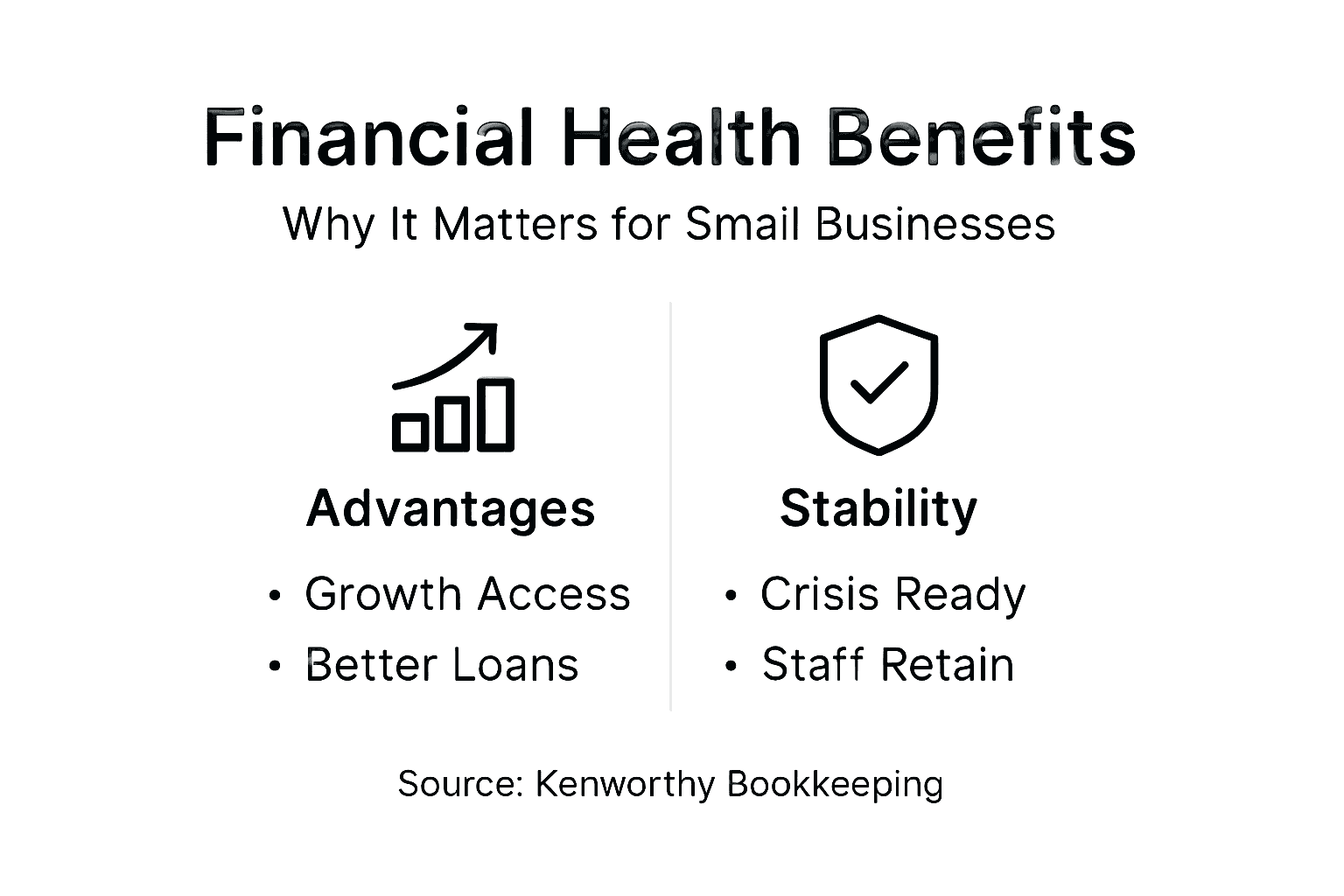
Beyond immediate financial benefits, strong financial health contributes to broader economic impact. Small businesses with solid financial practices become engines of local economic development, creating jobs, driving innovation, and providing stability during economic fluctuations. They demonstrate remarkable resilience, capable of weathering market challenges while continuing to invest in growth, employee development, and community engagement. By maintaining disciplined financial practices, these businesses not only secure their own future but also contribute to the economic ecosystem’s overall health and dynamism.
Pro tip: Develop a quarterly financial review process that tracks key performance indicators, allowing you to proactively identify and address potential financial challenges before they become critical.
Risks and Costs of Poor Financial Health
Poor financial health can transform a promising small business into a potential bankruptcy statistic almost overnight. Small business risk management represents a critical defensive strategy against economic vulnerabilities that can quickly erode years of hard work and investment.
The most immediate and devastating consequence of weak financial health is compromised cash flow. When businesses cannot accurately predict or manage their financial resources, they become increasingly susceptible to unexpected expenses, missed opportunities, and potential operational shutdowns. This instability creates a cascading effect where simple financial challenges transform into existential threats. Credit becomes more difficult to secure, vendor relationships strain, and the business’s reputation suffers, making future recovery exponentially more challenging.
Beyond direct financial risks, poor financial health undermines strategic decision-making and business confidence. Owners trapped in constant financial firefighting mode cannot invest in growth, innovation, or talent development. The psychological toll of perpetual financial uncertainty can lead to burnout, reduced entrepreneurial creativity, and ultimately, business stagnation. Small service businesses in competitive markets like Kansas City face particularly acute risks, where financial missteps can quickly translate into lost market share and diminished customer trust.
Here’s a quick overview of the differences between strong and poor financial health for small businesses:
| Aspect | Strong Financial Health | Poor Financial Health |
|---|---|---|
| Cash Flow Stability | Consistent, predictable | Irregular, vulnerable |
| Access to Financing | Easier, favorable terms | Difficult, high-interest rates |
| Growth Potential | Able to invest and expand | Limited, often stalled |
| Owner Confidence | High, plans for future | Low, stressed by uncertainty |
Pro tip: Implement a monthly financial diagnostic review that tracks cash flow, accounts receivable, and potential financial risks to proactively identify and mitigate potential financial challenges.
Steps to Improve Your Business Finances
Improving business finances requires a strategic and systematic approach that goes beyond simple number crunching. Small business owners can transform their financial trajectory by implementing comprehensive financial strategies that build long-term stability and resilience.
The first critical step involves conducting a thorough financial inventory and establishing clear, measurable goals. This means meticulously documenting current income streams, expenses, assets, and liabilities. Business owners should create realistic budgets that allocate resources strategically, identifying areas where costs can be reduced without compromising operational quality. Tracking expenses becomes crucial, with a focus on differentiating between essential investments and unnecessary spending. Developing multiple income streams can provide additional financial cushioning, reducing vulnerability to market fluctuations.
Building financial reserves represents another fundamental strategy for small businesses. Experts recommend establishing an emergency fund covering three to six months of operational expenses, which provides a critical buffer against unexpected economic challenges. Businesses should also prioritize understanding and optimizing their debt management, focusing on reducing high-interest obligations and improving credit profiles. Regular financial reviews, ideally quarterly, allow business owners to adjust strategies, capitalize on emerging opportunities, and proactively address potential financial risks before they escalate.
Here’s a summary of proactive steps to improve your business finances:
| Step | Purpose | Business Impact |
|---|---|---|
| Financial Inventory | Document income and expenses | Identifies strengths and gaps |
| Create Realistic Budgets | Allocate resources strategically | Reduces wasteful spending |
| Build Emergency Reserves | Cushion against financial shocks | Enhances stability and resilience |
| Regular Financial Reviews | Assess performance quarterly | Enables timely adjustments |
Pro tip: Implement a digital expense tracking system that automatically categorizes and analyzes spending patterns, enabling real-time financial insights and more informed decision-making.
Take Control of Your Business Financial Health Today
Maintaining strong financial health is essential for small businesses aiming to thrive in competitive markets like Kansas City. If you struggle with managing cash flow, tracking expenses, or building the emergency reserves highlighted in the article, you are not alone. These challenges can create stress and uncertainty, but expert bookkeeping tailored to your unique needs can provide clarity and peace of mind. By embracing strategic financial management and accurate bookkeeping, you empower your business to grow confidently and avoid costly setbacks.

Partner with Kenworthy Bookkeeping to streamline your finances with expert services including bank reconciliations and detailed profit and loss reports. We help you implement the critical financial reviews and budgeting techniques that the article identifies as key to long-term stability. Don’t wait until cash flow issues or financial inaccuracies put your business at risk. Visit Kenworthy Bookkeeping consultation today to take the first step toward stronger financial health and sustainable success.
Frequently Asked Questions
What is financial health for small businesses?
Financial health for small businesses refers to a comprehensive assessment of a business’s ability to manage its resources, sustain operations, and pursue growth opportunities effectively. It includes key indicators such as cash flow management, debt utilization, savings capacity, and financial planning.
Why is maintaining strong financial health important for small businesses?
Maintaining strong financial health is crucial for small businesses as it allows them to withstand economic challenges, invest in growth opportunities, and secure better financing terms. Businesses with robust financial practices contribute positively to local economies and can create jobs and drive innovation.
What are common misconceptions about financial health that small business owners face?
Common misconceptions include believing that financial education is optional, that investing is only for wealthy businesses, and that financial planning is a static process. Many small business owners underestimate the importance of continuous financial education and the need for adaptable financial strategies.
How can small businesses improve their financial health?
Small businesses can improve their financial health by conducting thorough financial inventories, establishing realistic budgets, building emergency reserves, optimizing debt management, and conducting regular financial reviews. Implementing these strategies helps enhance stability, resilience, and growth potential.






2 Comments
Comments are closed.