

Streamline financial organization for KC home services
TL;DR:
- Most small home service businesses struggle with cash flow despite good revenue.
- Proper financial organization involves assessing key metrics, choosing suitable bookkeeping systems, and implementing controls.
- Job-level transparency and local expertise are essential for profitability in seasonal, job-based service firms.
Many Kansas City home service business owners work hard, keep crews busy, and still end up short at the end of the month. Revenue looks fine on paper, but the cash just is not there. 82% of small business failures trace back to cash flow problems, and home service firms are especially vulnerable because of seasonal swings, job-based billing, and thin margins. This guide walks you through a practical, step-by-step approach to financial organization built specifically for small home service businesses in Kansas City with fewer than 20 employees. You will come away knowing exactly where to start and what to fix.
Table of Contents
- Assessing your current financial health
- Setting up the right bookkeeping system
- Implementing financial controls and practices
- Monitoring progress and troubleshooting issues
- Why most financial organization advice fails Kansas City home services
- Get tailored help for your Kansas City home service business
- Frequently asked questions
Key Takeaways
| Point | Details |
|---|---|
| Know your starting point | Assess your current financial metrics and systems before making changes. |
| Choose the right system | Select an accounting approach—outsourcing or DIY—that matches your business size and skills. |
| Apply proven controls | Implement routine checks and job-level cost tracking to safeguard cash flow and profit. |
| Troubleshoot effectively | Use regular monitoring and data review to catch and fix issues early. |
| Local expertise pays off | Combining smart tools with guidance from local professionals yields the best results. |
Assessing your current financial health
Before you can fix anything, you need to know what is broken. Most owners have a general sense that something is off, but they cannot point to the exact number or process causing the problem. That vague discomfort is expensive. Start with a few direct questions: Do you know your average margin per job? Can you predict your cash position two weeks out? Are your invoices consistently paid within 30 days?
If you answered no to any of those, you have a gap worth closing. The foundation of streamlining your finances is knowing your baseline. Small service businesses under $100k revenue average just 5.2% profit margins, which means there is very little room for sloppy tracking.
Here are the core records you need to pull together first:
- Bank statements from the last three months
- Invoicing history, including any overdue balances
- Job costing data (what each job actually cost versus what you charged)
- Receipts and expense records, even informal ones
Once you have those in hand, review these key metrics:
| Metric | What to look for | Why it matters |
|---|---|---|
| Net profit margin | Is it above 10%? | Shows overall business health |
| Average invoice size | Trending up or flat? | Signals pricing and scope control |
| Cash flow pattern | Gaps between income and bills? | Reveals timing risk |
| Cost per job | Consistent or unpredictable? | Identifies waste or scope creep |
Watch for these red flags during your review:
- Invoices sitting unpaid past 45 days
- Cash flow gaps that force you to delay vendor payments
- Missing receipts for jobs completed more than 60 days ago
- No clear record of what each job actually cost to complete
Understanding the impact of a bookkeeper on this process can help you decide how much of this you want to manage yourself.
Pro Tip: Set a recurring 15-minute calendar block every month to review just three numbers: cash on hand, outstanding invoices, and your last month’s margin. Consistent small check-ins prevent big surprises.
Setting up the right bookkeeping system
With a clear view of your numbers, it is time to put the right system in place. The biggest decision you face is whether to manage your books yourself or hand them off to a professional. Both paths can work, but they serve different situations.
For context, outsourcing to a local firm like Essistant KC at around $450 per month offers real efficiency gains, while simple platforms like QuickBooks or Jobber fit very small firms that want hands-on control. Reviewing top accounting platforms can help you compare features before committing.
| Method | Cost range | Best for | Watch out for |
|---|---|---|---|
| Local bookkeeping pro | $300-$600/month | Owners with 10+ employees or complex jobs | Requires good communication upfront |
| Cloud software (DIY) | $30-$100/month | Solo operators or very small teams | Time investment is real |
| Hybrid approach | $150-$400/month | Growing firms needing occasional expert review | Needs clear role boundaries |
Once you pick your method, follow these steps to get your system running:
- Select your primary tool (QuickBooks Online is a strong default for most KC home service firms)
- Set up income and expense categories that match your actual job types
- Connect your business bank account and credit card for automatic transaction imports
- Create a standard invoice template with clear payment terms
- Schedule weekly reconciliations (matching your records to your bank statement)
One step many owners skip is separating job costing from general expenses. Job costing means tracking what labor, materials, and subcontractors cost for each specific job. Without that separation, you cannot know which services are actually profitable. Reviewing your monthly bookkeeping workflow can show you how to build this habit without it taking over your week.

Pro Tip: Use your smartphone to photograph every receipt the moment you get it. Store them in a dedicated folder or directly in your accounting app. Missing receipts mean missing write-offs, and those add up fast.
Implementing financial controls and practices
Once you have the framework and tools, applying daily and weekly practices makes the real difference. Controls are not complicated. They are just consistent habits that protect your cash and your profit.
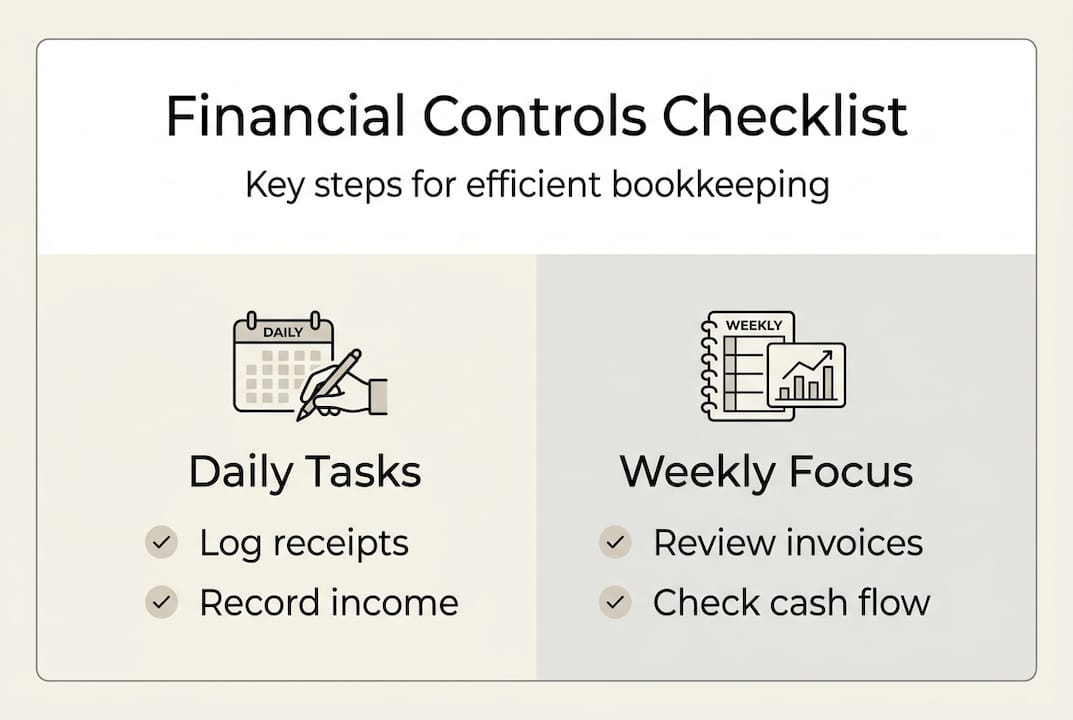
Cost control measures had the largest positive impact on profitability for home service businesses, with a strong statistical effect (β=1.941). That is not a small finding. It means the businesses that actively manage their costs outperform those that just track revenue.
Here are five controls worth building into your routine:
- Scheduled reconciliations: Match your books to your bank every week, not once a quarter
- Invoice follow-up automation: Set automatic reminders for invoices past 14 days unpaid
- Expense review routine: Spend 10 minutes every Friday reviewing the week’s expenses for anything unusual
- Job costing checks: After every completed job, compare actual cost to estimated cost
- Payment collection standards: Require deposits on jobs over $500 and collect balance on completion
Look at effective financial controls for more detail on building these into your workflow without adding hours to your week.
“82% of small business failures stem from basic cash flow issues. Controls prevent surprises and protect profit.”
Digital payments now make up roughly 50% of transactions for small service businesses. They simplify tracking because every transaction is automatically recorded. But they still require discipline. Just because a payment came in does not mean it was coded to the right job or expense category. Always verify, do not just assume the software got it right.
Pro Tip: Flag any job that falls below a 10% margin for a quick review before you close it out. A pattern of low-margin jobs often points to a pricing problem or a scope creep issue you can fix.
Understanding why bookkeeping matters beyond tax season is what separates businesses that grow from those that stay stuck.
Monitoring progress and troubleshooting issues
Setting up good controls makes ongoing monitoring and fixing problems much easier. The goal is to catch issues when they are small, not when they have already damaged your cash position or your relationships with vendors.
Kansas City home service businesses show resilience by increasing per-job invoice size and closely monitoring margins, even when revenue is volatile. That is a practical model worth copying.
Use this numbered checklist to build a regular review rhythm:
- Weekly: Check your cash position and outstanding invoices
- Monthly: Review your net margin against your target (aim for 11-15%)
- Quarterly: Look at trends across job types, seasons, and team members
- As needed: Audit any job that came in significantly over or under budget
When something looks off, use this troubleshooting guide:
| Problem | Likely cause | Recommended fix |
|---|---|---|
| Late payments piling up | No follow-up system in place | Automate invoice reminders at 14 and 30 days |
| Margin dropping month over month | Labor or material costs rising | Review job costing and adjust pricing |
| Cash flow gaps mid-month | Invoicing delayed after job completion | Invoice same day as job completion |
| Expenses creeping up | No weekly review routine | Add a 10-minute Friday expense check |
Job costing is worth a specific call-out here. If you are not reviewing what each service type actually costs versus what you charge, you may be underpricing your most common work. Many KC home service owners discover this only after a detailed review with a professional.
Knowing when to ask for help is a strength, not a weakness. If your DIY tools are not giving you clear answers, or if you are spending more than two hours a week on bookkeeping tasks, it is worth exploring financial reporting tools or getting a professional review. Staying on top of compliance in bookkeeping also protects you from costly errors at tax time.
Why most financial organization advice fails Kansas City home services
Here is the uncomfortable truth: most financial advice for small businesses was written for retail shops or product companies, not for job-based service firms with seasonal swings and crew-dependent margins. Generic profit frameworks assume steady monthly revenue and predictable costs. Home service businesses in Kansas City do not work that way.
A landscaping company in Overland Park sees 60% of its revenue in five months. A plumbing firm in Lee’s Summit deals with unpredictable emergency call volume. Cookie-cutter advice tells these owners to track revenue and control costs. That is not wrong, but it misses the point entirely.
What actually works is job-level transparency paired with local expertise. The firms we see turn things around are the ones that separate their job costing from general expenses, review margins at the job level rather than just the monthly total, and work with local bookkeeping experts who understand the KC market. Pairing a digital tool with a real person who asks the right questions outperforms any automated system every time. “Set and forget” is not a financial strategy. It is how margins quietly disappear.
Get tailored help for your Kansas City home service business
If you have worked through this guide and still feel uncertain about where your money is going, that is a clear sign you need more than a software subscription. Kenworthy Bookkeeping works specifically with small home service businesses in the Kansas City area, handling categorization, reconciliations, P&L reports, and tax preparation so you can focus on running your crews.

A custom bookkeeping consultation gives you a direct look at where your finances stand and what is holding your profitability back. We treat your books like they are our own business, because we know how much is riding on getting this right. Reach out today and get the clarity your business deserves.
Frequently asked questions
What is the best bookkeeping system for a small Kansas City home service business?
Outsourcing to a Kansas City-based firm or using simple platforms like QuickBooks or Jobber are both solid options for firms with fewer than 20 employees. For small home service companies, a local professional or user-friendly software consistently yields the best results.
How much profit should a home service business target in Kansas City?
Aim for an 11 to 15% net profit margin, which aligns with regional benchmarks. Net margin targets are 11.8% for B2C and 15.2% for B2B service businesses.
What are common financial mistakes home service owners make?
Not tracking job-level costs, falling behind on invoicing, and missing early cash flow warnings are the most common issues. Cash flow problems account for 82% of small business failures, making job costing and invoice discipline critical.
How can I troubleshoot negative cash flow in my home service business?
Start by reviewing your weekly cash position, tightening expense controls, and following up immediately on overdue invoices. Routine review and expense control are proven steps to close cash flow gaps before they grow.