

Monthly bookkeeping workflow for Kansas home service businesses
Running a home service business in Kansas means juggling job sites, customer calls, and crew schedules all at once. The last thing you want is a bookkeeping mess waiting for you at the end of the month. Yet mixing personal and business funds is one of the most common errors small business owners make, and it creates real problems when tax season arrives. This guide walks you through a proven monthly bookkeeping workflow built specifically for Kansas home service providers, so you can stay compliant, spot profit leaks early, and stop dreading your finances.
Table of Contents
- Understand Kansas bookkeeping basics
- Prepare your bookkeeping toolkit
- Step-by-step workflow for monthly bookkeeping
- Common mistakes and troubleshooting
- Verification and review: Know when your books are ready
- Get professional bookkeeping help in Kansas
- Frequently asked questions
Key Takeaways
| Point | Details |
|---|---|
| Separate finances | Keep business and personal accounts totally separate to prevent errors and simplify bookkeeping. |
| Track job costs | Record job expenses, vehicle logs, and inventory for accurate profitability and easy tax filing. |
| Monthly workflow | A step-by-step monthly routine saves time, avoids penalties, and supports business growth. |
| Kansas sales tax | Understand local sales tax requirements and filing schedules to avoid costly late penalties. |
| Professional support | Outsourcing or expert review ensures compliance and peace of mind as your business scales. |
Understand Kansas bookkeeping basics
Before you build any monthly routine, you need to know what Kansas requires from your business. Getting this foundation right protects you from penalties and keeps your books clean year-round.
Kansas has specific rules that directly affect home service businesses. Here is what you need to know:
- Sales tax permit: You must register for a sales tax permit if you have a physical presence in Kansas or exceed the $100,000 economic threshold in annual sales.
- Filing frequency: Your filing schedule (monthly, quarterly, or annual) depends on your total sales tax liability. Higher volume businesses file monthly.
- Taxable services: Many repair and maintenance services are taxable in Kansas. Check Kansas sales tax details to confirm which of your services apply.
- Penalties for late filing: Late sales tax filings carry a penalty of 1% per month, up to a maximum of 24%. That adds up fast.
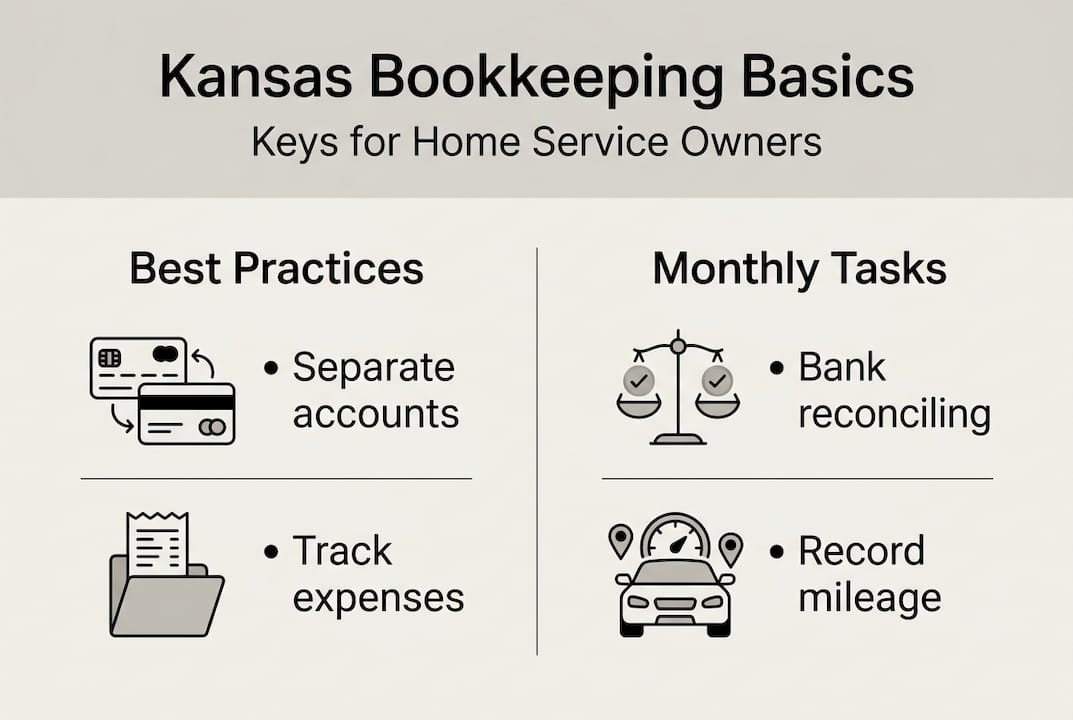
- Separate accounts: Keep business and personal finances completely separate from day one. This is not optional if you want clean, audit-ready books.
Understanding Kansas tax preparation requirements early saves you from scrambling later. Compliance is not complicated once you know the rules.
Pro Tip: Open a dedicated business checking account and a business credit card before you take your first job. This single step eliminates the most common bookkeeping headache for home service owners.
Prepare your bookkeeping toolkit
With a clear picture of Kansas compliance, the next step is assembling the right tools. A solid toolkit makes your monthly workflow faster and far less stressful.
Here are the records and tools every Kansas home service business should have in place:
- Business bank account and credit card statements
- Customer invoices and receipts for all jobs
- Subcontractor agreements and payment records
- Vehicle mileage logs for every business trip
- Tool and parts inventory records
- Payroll records if you have employees
- A reliable accounting platform such as QuickBooks Online
One of the biggest decisions you will face is whether to handle bookkeeping yourself or outsource it. DIY software works well early on, but outsourcing delivers consistency and CPA-ready books as your business grows. Reviewing small business accounting platforms can help you find the right fit for your current stage.
For home service businesses specifically, job costing is critical. You need to track job costs, mileage, and subcontractor invoices separately for each project. Without this, you cannot tell which jobs are actually profitable. Read more home service bookkeeping tips to sharpen your approach.

| Approach | Monthly cost | Best for |
|---|---|---|
| DIY software | $30 to $150 | Solo operators, early stage |
| Part-time bookkeeper | $400 to $800 | Growing teams, 5 to 10 employees |
| Outsourced bookkeeping | $300 to $1,500 | Businesses wanting CPA-ready books |
The cost of bookkeeping varies widely, but the right investment pays for itself in time saved and errors avoided.
Step-by-step workflow for monthly bookkeeping
Now that your tools are in place, here is exactly what to do each month. Follow these steps in order and your books will stay clean, compliant, and ready for any review.
- Capture all transactions. Download bank and credit card statements. Import or manually enter every transaction into your accounting software. Do not let anything slip through.
- Categorize every transaction. Assign each expense and income item to the correct category. Labor, materials, vehicle costs, and subcontractor payments all need their own buckets.
- Reconcile your accounts. Match your software records to your bank statements line by line. Skipping reconciliations is one of the biggest risks small business owners take with their finances.
- Review job costs. Pull a job profitability report for each project completed that month. Compare actual costs to your estimates. This is where you find out if your pricing is working.
- Check accounts receivable. Review all outstanding invoices. Follow up on anything past 30 days. Unpaid invoices are lost cash flow.
- Log vehicle expenses. Confirm mileage logs are complete and match any fuel or maintenance receipts recorded in your books.
- Calculate and file Kansas sales tax. Tally taxable sales for the period and submit your filing by the due date. Monthly close typically takes 2 to 3 hours for businesses with 50 to 100 transactions.
- Run your P&L report. Review your profit and loss statement to see where money came in and where it went. This is your financial scorecard for the month.
For more detail on each step, explore these service owner bookkeeping tips and financial controls for home services.
| Task | Frequency | Time estimate |
|---|---|---|
| Transaction capture | Monthly | 30 to 45 minutes |
| Bank reconciliation | Monthly | 30 to 60 minutes |
| Job cost review | Monthly | 20 to 30 minutes |
| AR follow-up | Weekly | 10 to 15 minutes |
| Kansas sales tax filing | Monthly or quarterly | 15 to 30 minutes |
Pro Tip: Block a recurring two-hour slot on your calendar every month, ideally within the first five business days after month-end. Treat it like a job appointment. This one habit prevents the year-end scramble that costs business owners hours of stress.
Common mistakes and troubleshooting
Even with a solid workflow, mistakes happen. Knowing what to watch for helps you catch problems before they become expensive.
Here are the most common errors Kansas home service owners make and how to fix them:
- Mixing business and personal funds. Mixing personal and business accounts is a major error that distorts your financial picture and complicates tax filing. Fix it by using only dedicated business accounts for all transactions.
- Skipping or delaying reconciliations. When you skip a month, errors compound. Set a firm monthly deadline and stick to it.
- Neglecting accounts receivable. Invoices that go unpaid for 60 or 90 days are often never collected. Track AR weekly and follow up promptly.
- Inventory mismatches. Tools and parts that are not tracked create phantom expenses and inaccurate job costs. Do a quick inventory count monthly.
- Missing Kansas sales tax deadlines. Late filing penalties start at 1% per month and can reach 24%. Set calendar reminders for every filing deadline.
Understanding why small businesses need bookkeeping goes beyond compliance. Clean books give you the data to make better decisions every single month.
“The businesses that grow consistently are the ones that know their numbers. Monthly bookkeeping is not a chore. It is a competitive advantage.”
If you find yourself behind, do not panic. Start with the current month, get it clean, and work backward one month at a time. Catching up is always possible.
Verification and review: Know when your books are ready
Finishing your monthly tasks is not the same as having books that are truly ready. A quick verification step gives you confidence before you close the month.
Use this checklist to confirm your monthly close is complete:
- All bank and credit card accounts are reconciled with zero discrepancies
- Every transaction is categorized correctly
- Accounts receivable aging report is reviewed and follow-ups are sent
- Job profitability has been reviewed for each completed project
- Vehicle mileage logs are complete and match recorded expenses
- Kansas sales tax has been calculated and filed if due
- P&L report has been reviewed and compared to the prior month
- Any inventory discrepancies have been noted and corrected
If any item on this list is incomplete, your books are not ready. Do not move on until each box is checked. Monthly routines like this prevent the year-end rush that drives up CPA costs and causes filing errors.
Once your books are verified, look for one improvement to make next month. Maybe you need a better mileage tracking app. Maybe your invoice follow-up process needs tightening. Small improvements compound over time. Learn how bookkeeping supports business growth and how bookkeeping for small business creates a foundation for long-term success.
Quarterly, use your clean monthly books to prepare estimated tax payments and review year-to-date profitability. Annual filings become straightforward when each month has been handled correctly.
Get professional bookkeeping help in Kansas
If this workflow feels like a lot to manage on top of running your business, you are not alone. Many Kansas home service owners reach a point where the time and mental energy spent on bookkeeping outweighs the cost of getting expert help.

At Kenworthy Bookkeeping, we handle your books like they are our own business. We specialize in QuickBooks Online and serve small businesses across the Kansas City area with categorization, bank reconciliations, P&L reports, and tax season preparation. Our services are tailored to home service providers who need accurate, CPA-ready books without the stress. Discover the professional bookkeeping benefits that come with having an expert in your corner. When you are ready to hand off the numbers and focus on your work, book a bookkeeping consultation and let us show you what effortless bookkeeping looks like.
Frequently asked questions
How much time should a Kansas home service provider budget for monthly bookkeeping?
Most small businesses with 50 to 100 monthly transactions should expect to spend 2 to 3 hours per month on bookkeeping. Complexity, employee count, and job volume can increase that time.
Which records are most important for job costing and vehicle expenses?
Track all job-related expenses, mileage logs, subcontractor invoices, and tool or part inventory separately for each project. This is the only way to accurately measure job profitability and make smart pricing decisions.
What triggers sales tax registration in Kansas?
Kansas requires registration if you have a physical presence in the state or exceed $100,000 in annual sales. Most tangible goods and many repair services are taxable under Kansas law.
Can mixing business and personal funds really cause trouble?
Absolutely. Mixing accounts distorts your financial records, complicates tax filing, and can cause you to miss legitimate deductions. Separate accounts from the start.
How can outsourcing bookkeeping help small Kansas businesses?
Outsourcing keeps your books CPA-ready and consistent, reduces year-end stress, and frees up your time to focus on growing your business rather than managing spreadsheets.