

Tax preparation for Kansas small businesses: 5% penalty risk
Many small business owners believe tax preparation is straightforward. They assume filing is as simple as filling out basic forms and submitting them. The reality involves navigating complex federal and Kansas state requirements, selecting correct forms based on your business structure, and maintaining meticulous records to avoid penalties and maximize deductions. This guide clarifies the tax preparation process for Kansas small businesses in 2026, helping you understand compliance requirements and reduce costly errors.
Table of Contents
- Understanding Federal And Kansas State Tax Requirements
- Federal Tax Filing Requirements And Forms For Small Businesses
- Types Of Taxes Small Businesses Must Prepare And Pay
- Bookkeeping And Recordkeeping For Accurate Tax Preparation
- Comparison Of Tax Forms By Business Entity
- Filing Deadlines And Penalties For Kansas Small Businesses
- Common Misconceptions About Tax Preparation For Small Businesses
- Resources And Assistance For Kansas Small Business Owners
- Simplify Your Tax Preparation With Kenworthy Bookkeeping
- Frequently Asked Questions
Key takeaways
| Point | Details |
|---|---|
| Dual compliance | Kansas small businesses must comply with both federal IRS and Kansas Department of Revenue tax laws. |
| Form selection matters | Your business structure determines which tax forms you file, affecting complexity and obligations. |
| Bookkeeping is critical | Accurate records enable you to claim all eligible deductions and simplify filing. |
| Deadlines are strict | Missing filing or payment deadlines triggers penalties up to 5% monthly of unpaid taxes. |
| Help is available | Free IRS resources, local offices, and professional bookkeeping services support compliance. |
Understanding federal and Kansas state tax requirements
Kansas businesses face the added complexity of dual federal and state requirements. Kansas small businesses must comply with both federal tax laws administered by the IRS and state tax laws overseen by Kansas Department of Revenue, including obtaining necessary business licenses and registrations to operate legally. This dual system means you prepare separate filings for federal income tax and Kansas state tax, each with distinct forms, deadlines, and rules.
Federal tax laws apply uniformly across all states, but Kansas adds specific requirements that impact how you report income, claim deductions, and pay taxes. Understanding both levels prevents compliance issues and helps you avoid penalties. Your business license status affects your tax reporting obligations, so ensure you register properly with both agencies before filing.
Key federal and Kansas state requirements include:
- Registering with the IRS for an Employer Identification Number if you have employees or operate as a corporation or partnership.
- Obtaining Kansas business licenses and registrations through the Kansas Department of Revenue.
- Filing separate federal and state tax returns, each with different forms and calculation methods.
- Tracking bookkeeping’s role in your tax preparation to maintain records that satisfy both federal and state auditors.
Understanding the importance of bookkeeping for Kansas businesses helps you prepare for the documentation demands of dual compliance. Small business accounting in Kansas requires attention to both federal and state rules. IRS Kansas small business tax requirements provide authoritative guidance for navigating this complex landscape.
Federal tax filing requirements and forms for small businesses
Building on federal and state tax obligations, you need to identify which specific IRS forms your Kansas small business must use based on entity type. Small businesses with assets under $10 million and those filing IRS Form 1040 with Schedule C, E, or F must use specific IRS resources tailored for self-employed and small business tax filing. Your business structure determines which forms you file, affecting preparation complexity and time required.
Sole proprietors and single-member LLCs file Schedule C attached to their personal Form 1040. This is the simplest federal tax form for small businesses, reporting business income and expenses directly on your individual return. Partnerships file Form 1065, which reports partnership income and distributes K-1 forms to each partner showing their share of profits or losses.
Corporations face more complex filing requirements. C corporations file Form 1120, while S corporations file Form 1120-S. Both forms require detailed financial statements and separate tax calculations from personal income. Publication 334 provides detailed guidance on federal tax liabilities for small businesses, covering income, expenses, and tax credits relevant for sole proprietors and single-member LLCs.
Key federal tax form considerations:
- Schedule C for sole proprietors reports business profit or loss on personal tax returns.
- Form 1065 for partnerships requires distributing K-1 forms to all partners.
- Form 1120 or 1120-S for corporations involves separate entity tax calculations.
- Assets under $10 million qualify for simplified filing procedures in many cases.
Proper form selection avoids errors that trigger audits or penalties. Understanding bookkeeping for tax season helps you gather the financial data needed for accurate form completion. Basic bookkeeping steps for tax preparation ensure you have organized records when filing. IRS small business tax forms and requirements and IRS Publication 334 guidance offer official instructions for each form type.
Types of taxes small businesses must prepare and pay
After knowing required forms, you need to clarify the specific types of taxes and payments small business owners must make. Small businesses are responsible for multiple types of federal taxes including income tax, estimated tax, self-employment tax, employment taxes, and excise tax, each with specific reporting and payment requirements. Understanding each tax type helps you plan cash flow and avoid surprises at filing time.
Federal income tax applies to all business profits, regardless of structure. If you expect to owe $1,000 or more when filing, you must make estimated quarterly tax payments throughout the year. The self-employment tax covers Social Security and Medicare contributions, with filing required if net earnings exceed $400. This tax applies to sole proprietors, partners, and LLC members who work in the business.
Payroll and employment tax responsibilities require withholding payroll taxes for Social Security, Medicare, and federal income tax, plus paying federal unemployment taxes if you have employees. These obligations are ongoing throughout the year, not just at filing time. Excise taxes apply to specific industries and activities, such as fuel sales, transportation services, or manufacturing certain goods.
Key tax types for Kansas small businesses:
- Federal income tax on business profits, with quarterly estimated payments if applicable.
- Self-employment tax for net earnings over $400, covering Social Security and Medicare.
- Employment taxes for businesses with employees, including withholding and unemployment taxes.
- Excise taxes for specific business activities or industries.
Understanding using bookkeeping to track tax liabilities helps you monitor obligations throughout the year. IRS overview of business tax types and IRS employment tax requirements provide detailed guidance on each tax category.
Bookkeeping and recordkeeping for accurate tax preparation
Having established tax obligations, proper bookkeeping enables compliance and maximizes deductions. Maintaining organized and accurate bookkeeping, including categorizing income and expenses and reconciling bank statements, is essential for accurate tax preparation and maximizing deductions. Without meticulous records, you risk missing valuable deductions or facing problems during an audit.

Categorize every business transaction properly. Income should be recorded by source, while expenses must be classified by type such as supplies, travel, utilities, or professional services. Reconcile your bank accounts at least monthly to catch errors early and ensure your records match actual cash flow. Bookkeeping software like QuickBooks Online helps track income and expenses, streamlining tax preparation and improving accuracy of deductions claimed.
Good records support every deduction you claim on your tax return. The IRS requires documentation for expenses, including receipts, invoices, bank statements, and mileage logs. Without proper records, you may lose deductions during an audit, increasing your tax bill significantly. Organized bookkeeping also simplifies tax filing, reducing the time and cost of preparation.
Pro Tip: Schedule weekly bookkeeping sessions to avoid end-of-year chaos. Consistent record maintenance takes less time overall than scrambling before deadlines.
Essential bookkeeping practices:
- Categorize all income and expenses accurately by transaction type.
- Reconcile bank and credit card statements monthly to ensure accuracy.
- Use bookkeeping software for efficiency and automated tracking.
- Save receipts and documentation for all business expenses.
- Generate profit and loss statements regularly to monitor financial health.
Understanding basic bookkeeping principles establishes a foundation for tax readiness. A streamlined financial reporting process makes tax preparation faster and more accurate. IRS guidelines on bookkeeping and recordkeeping and IRS endorsed bookkeeping software advice offer official recommendations.
Comparison of tax forms by business entity
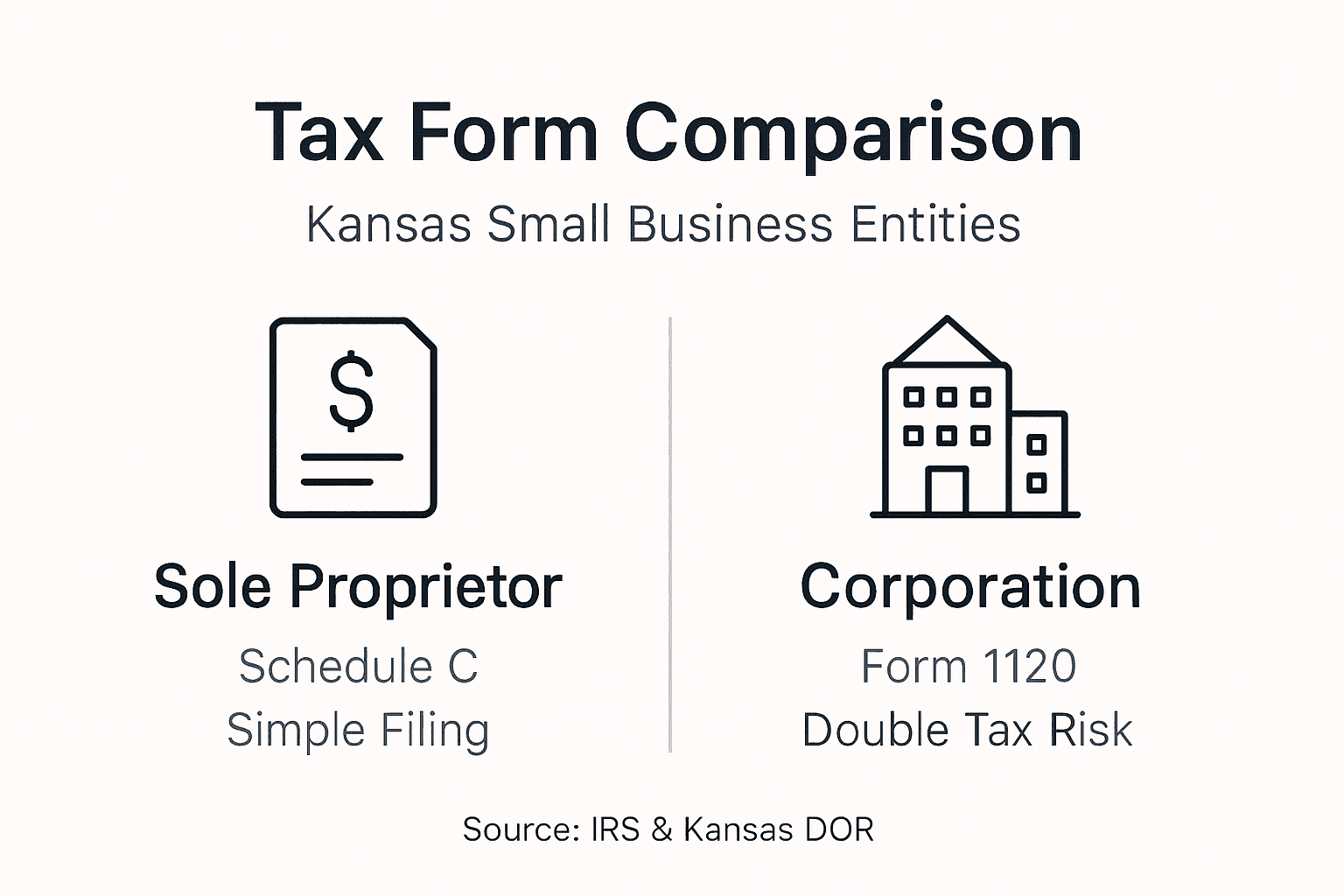
Following the bookkeeping discussion, here is a structured overview of tax forms varying by entity. Comparison of tax filing forms reveals that sole proprietors use Schedule C attached to Form 1040, while partnerships and corporations have distinct filing requirements affecting tax preparation complexity. Choosing the correct form reduces errors and ensures compliance with IRS rules.
| Business Entity | Primary Tax Form | Filing Complexity | Key Features |
|---|---|---|---|
| Sole Proprietor | Schedule C (Form 1040) | Low | Reports business income on personal return; simplest option |
| Partnership | Form 1065 | Medium | Issues K-1 forms to partners; income passes through to partners |
| C Corporation | Form 1120 | High | Separate entity taxation; potential double taxation on dividends |
| S Corporation | Form 1120-S | High | Pass-through taxation; strict eligibility requirements |
Sole proprietorships offer the simplest tax filing process. You report business income and expenses directly on Schedule C, which attaches to your personal Form 1040. This approach means one tax return covers both personal and business income. Partnerships require Form 1065, which calculates partnership income and distributes K-1 forms to each partner showing their share of profits or losses for reporting on personal returns.
Corporations file separate tax returns from their owners. C corporations face potential double taxation because the corporation pays tax on profits, and shareholders pay tax again on dividends received. S corporations avoid this by passing income through to shareholders, but face strict eligibility rules and ongoing compliance requirements. Understanding bookkeeping considerations by business entity helps you maintain records appropriate for your structure. IRS Publication 334 entity filing comparison provides detailed guidance on form selection.
Filing deadlines and penalties for Kansas small businesses
After understanding tax form types, focus on the critical importance of meeting deadlines to prevent penalties. Federal tax filing typically occurs by April 15 for sole proprietors and partnerships, while corporations face March 15 deadlines. Kansas state filing deadlines generally align with federal dates, but confirm annually as they can vary. Quarterly estimated tax payments are due April 15, June 15, September 15, and January 15 of the following year.
Kansas small business owners who fail to file or pay taxes timely may face penalties including failure-to-file penalties up to 5% of unpaid tax per month and failure-to-pay penalties of 0.5% per month. These penalties accumulate separately, meaning you could face both simultaneously. The failure-to-file penalty maxes out at 25% of unpaid taxes, but this represents a significant increase to your tax bill.
Missing deadlines creates cascading problems. Penalties and interest compound monthly, increasing your total tax obligation significantly. Late filing also delays refunds if you are owed money. In extreme cases, persistent non-compliance can trigger audits, liens, or other enforcement actions by tax authorities.
Critical deadline reminder: The failure-to-file penalty of 5% monthly reaches its 25% maximum in just five months, potentially adding thousands of dollars to your tax bill.
Key deadline and penalty considerations:
- Federal filing deadline is typically April 15; extensions are available but do not extend payment deadlines.
- Quarterly estimated tax payments prevent underpayment penalties.
- Failure-to-file penalty: 5% of unpaid tax per month, maximum 25%.
- Failure-to-pay penalty: 0.5% of unpaid tax per month.
- Interest accrues on both unpaid taxes and penalties.
Timely filing avoids these costly penalties entirely. Understanding bookkeeping tips to meet filing deadlines helps you stay organized year round. IRS info on penalties and deadlines provides official guidance on avoiding late filing consequences.
Common misconceptions about tax preparation for small businesses
After explaining deadlines and penalties, clarifying misconceptions improves compliance and encourages use of appropriate resources or professional help. Many small business owners hold beliefs about tax preparation that lead to costly mistakes. Understanding the truth helps you make better decisions and avoid problems.
Misconception: Tax preparation is simple and can be done without professional help. Reality: Tax laws are complex, and using a qualified tax professional reduces errors and improves deductions claimed, saving money and time. Even experienced business owners benefit from expert guidance, especially when tax laws change or business circumstances become more complex.
Misconception: Estimated tax payments are optional. Reality: Estimated tax payments are legally required quarterly if withholding is insufficient, to avoid penalties. If you expect to owe $1,000 or more when filing, you must make quarterly payments throughout the year. Skipping these payments triggers underpayment penalties and interest.
Misconception: Any business expense is deductible without documentation. Reality: Deductible expenses must be ordinary, necessary, and properly documented with receipts and records. The IRS can disallow deductions lacking adequate documentation, increasing your tax bill during an audit. Keep detailed records for every claimed expense.
Pro Tip: Consult a tax advisor early in the year to plan quarterly payments and identify deduction opportunities. Proactive planning saves more money than reactive fixes.
Common misconceptions to avoid:
- Believing tax preparation is simple enough to do alone without professional guidance.
- Assuming estimated quarterly payments are optional when you are self-employed or have business income.
- Thinking all expenses are automatically deductible without proper documentation.
- Ignoring the need for organized bookkeeping throughout the year.
Understanding benefits of professional tax and bookkeeping help clarifies how expert support improves outcomes. IRS guidance on professional tax help and IRS info on estimated tax payments provide authoritative information to correct these misconceptions.
Resources and assistance for Kansas small business owners
Concluding the educational content, knowing where to get help and access tools supports ongoing tax compliance success. IRS provides free online tools and resources specifically tailored to small businesses for tax calendar management, tax form access, and educational webinars. These resources help you stay current on requirements and deadlines without cost.
The IRS offers online tax calendars that provide deadline reminders for filing and payment obligations throughout the year. You can download forms, instructions, and publications directly from IRS.gov. Free educational webinars occur annually during National Small Business Week, covering topics like recordkeeping, deductions, and filing requirements. These sessions provide valuable information from IRS experts.
Local IRS and Kansas Department of Revenue offices provide in-person guidance for complex questions or situations requiring personal assistance. Taxpayer Assistance Centers offer appointments for help with account issues, payment plans, and other matters. The Kansas Department of Revenue website provides state-specific forms, instructions, and contact information for state tax questions.
Consider professional bookkeeping and tax advisory services when your business grows or situations become complex. Professional help saves time, reduces errors, and often identifies deductions you might miss. The cost of professional services typically pays for itself through improved accuracy and optimized deductions.
Available resources for Kansas small business owners:
- IRS online tax calendars and deadline reminder tools.
- Free downloadable forms, instructions, and publications.
- Educational webinars during National Small Business Week and year round.
- Local IRS Taxpayer Assistance Centers for in-person help.
- Kansas Department of Revenue website and local offices.
- Professional bookkeeping and tax advisory services.
Utilize basic bookkeeping and tax preparation resources to build your knowledge foundation. IRS small business tax resources and tools and IRS Kansas tax assistance offer comprehensive support.
Simplify your tax preparation with Kenworthy Bookkeeping
Tax preparation becomes significantly easier when you maintain organized, accurate records throughout the year. Professional bookkeeping eliminates the stress of scrambling to gather documents and receipts when deadlines approach.

Kenworthy Bookkeeping specializes in helping Kansas small businesses navigate tax season with confidence. Our expert team uses QuickBooks Online to categorize transactions, reconcile accounts, and generate the financial reports you need for accurate tax filing. We help you maximize deductions by ensuring every eligible expense is properly documented and classified. Our services reduce costly filing errors and give you peace of mind knowing your books are audit ready. Whether you need ongoing bookkeeping support or focused tax season preparation, we provide personalized solutions tailored to small business needs. Learn more through our bookkeeping basics guide or discover why small businesses need bookkeeping services to streamline tax preparation and focus on growing your business.
Frequently asked questions
What is tax preparation for small businesses?
Tax preparation for small businesses involves gathering financial records, calculating income and expenses, completing required federal and Kansas state tax forms, and filing returns by deadlines. It includes determining which forms your business structure requires, calculating tax liability, identifying eligible deductions, and making required payments. Proper preparation ensures compliance and minimizes tax obligations legally.
How do I know which tax forms my small business in Kansas needs to file?
Your business entity determines which forms you file. Sole proprietors use Schedule C attached to Form 1040, partnerships file Form 1065, and corporations file Form 1120 or 1120-S. Review IRS Publication 334 for detailed guidance or consult a tax professional for complex situations.
What deductions am I eligible for as a small business owner?
Typical deductions include business supplies, equipment, rent, utilities, insurance, professional services, travel, and vehicle expenses. Home office deductions apply if you use part of your home exclusively for business. Maintain receipts and accurate bookkeeping to support all claimed deductions.
What are the consequences of missing tax filing deadlines?
Missing deadlines triggers failure-to-file penalties up to 5% of unpaid taxes monthly, maxing at 25%. Failure-to-pay penalties add 0.5% monthly on unpaid taxes. These penalties accumulate separately and accrue interest, significantly increasing your total tax bill.
Where can I find tax help and resources in Kansas?
Use IRS online tools at IRS.gov for forms, calendars, and educational materials. The Kansas Department of Revenue website provides state-specific resources. Local IRS Taxpayer Assistance Centers offer in-person help. Consider professional bookkeeping and tax services for personalized guidance and ongoing support.