

Why use professional bookkeeping? Save time, money, stress
Running a service business in Missouri means your time is money, literally. Small business owners spend 10 to 20 hours monthly on DIY bookkeeping, costing $500 or more in lost earning potential. That’s time you could spend landing new clients, delivering your service, or simply stepping away from your desk. This guide breaks down exactly what DIY bookkeeping is costing you, what professional bookkeeping actually includes, and how to know when it’s time to make the switch.
Table of Contents
- The true cost of DIY bookkeeping for small businesses
- How professionals prevent costly errors and IRS penalties
- Essential bookkeeping tasks for Missouri service businesses
- What professional bookkeeping includes: Tools, methods, and workflow
- ROI: What does professional bookkeeping really cost and return?
- Is professional bookkeeping right for your business? When to switch
- Ready to simplify your finances? Book a free consult
- Frequently asked questions
Key Takeaways
| Point | Details |
|---|---|
| Eliminate costly errors | Professional bookkeeping reduces IRS penalties and missed deductions that can cost thousands. |
| Save time and refocus | Outsourcing bookkeeping gives you back 10-20 hours monthly for running your business. |
| Ensure compliance | Pros handle Missouri taxes and filings to avoid legal headaches and late fees. |
| Maximize ROI | Most businesses earn back three times their bookkeeping investment in the first year. |
The true cost of DIY bookkeeping for small businesses
Most business owners underestimate what DIY bookkeeping really costs. It’s not just the hours you spend entering transactions. It’s the errors, the stress, and the opportunities you miss while your head is buried in spreadsheets.
The numbers are sobering. DIY bookkeeping carries a 1 to 3% manual error rate, and those errors compound fast. A misclassified expense here, a missed reconciliation there, and suddenly your financial picture is completely distorted.
| Cost category | DIY bookkeeping | Professional bookkeeping |
|---|---|---|
| Monthly time spent | 10 to 20 hours | 0 to 2 hours (review only) |
| Error rate | 1 to 3% | Near zero |
| IRS penalty risk | High | Low |
| Tax deductions captured | Often missed | Maximized |
| Monthly cost | “Free” (but not really) | $500 to $1,500 |
Here’s what makes DIY bookkeeping so deceptive: the direct cost looks like zero. But when you factor in your hourly rate, the picture changes fast.
“If you bill $75 per hour and spend 15 hours monthly on bookkeeping, that’s $1,125 in lost revenue every single month.”
The hidden costs go even deeper. 40% of small businesses face IRS penalties related to bookkeeping errors, losing an average of $3,000 per year. That’s not a rounding error. That’s a real hit to your bottom line.
Common hidden costs include:
- IRS penalties from late or inaccurate filings
- Missed deductions that your tax preparer never sees
- Overdrafts and cash flow surprises from unreconciled accounts
- Stress and decision fatigue from managing finances you weren’t trained for
- Delayed growth decisions because your numbers aren’t trustworthy
Pro Tip: Tally every hour you spend on bookkeeping tasks for one month, multiply by your hourly rate, then add any penalties or missed deductions from last year. That total is your real DIY cost.
Understanding the bookkeeping services advantages for small businesses makes the math much clearer. Once you see the full picture, the decision becomes obvious.
How professionals prevent costly errors and IRS penalties
Accuracy isn’t just a nice-to-have in bookkeeping. It’s the foundation of every financial decision you make. Professional bookkeepers are trained to catch the exact mistakes that cost small business owners the most.

The $3,000 problem: Small businesses lose an average of $3,000 per year to bookkeeping errors and IRS penalties. A professional bookkeeper typically costs far less than that annually, which means the service often pays for itself before you count any other benefit.
Here’s how professionals systematically reduce your penalty risk:
- Monthly transaction review. Every transaction gets categorized correctly the first time, eliminating the misclassifications that trigger audits.
- Bank reconciliations. Accounts are matched to bank statements monthly, catching discrepancies before they become problems.
- Payroll and withholding checks. Payroll taxes are verified against filings so nothing slips through.
- Quarterly estimated tax prep. Professionals flag upcoming tax obligations so you’re never caught off guard.
- Year-end review. A clean set of books means your CPA spends less time (and charges less) at tax time.
Regular bookkeeping reviews are one of the most underrated tools in a small business owner’s arsenal. Most owners only look at their books when something goes wrong. Professionals look at them every month so nothing goes wrong in the first place.
“Proactive bookkeeping isn’t just about recording what happened. It’s about spotting what’s about to happen and giving you time to respond.”
Missed deductions are another silent killer. A professional bookkeeper knows which expenses qualify, how to document them, and how to present them in a way that holds up under scrutiny.
Essential bookkeeping tasks for Missouri service businesses
Federal tax compliance is just one layer. Missouri adds its own set of requirements that catch many small business owners off guard, especially those who moved from another state or started their business without professional guidance.
Missouri businesses must collect sales and use tax at 4.225%, submit Form MO-941 for withholding, and pay state unemployment insurance (SUI) at 2.376%. Each of these has its own filing schedule, its own forms, and its own penalties for non-compliance.
| Missouri obligation | Rate or form | Filing frequency |
|---|---|---|
| Sales and use tax | 4.225% | Monthly or quarterly |
| Withholding tax | Form MO-941 | Monthly or quarterly |
| State unemployment (SUI) | 2.376% | Quarterly |
| Corporate income tax | 4% flat rate | Annual |
For service businesses, the sales tax question alone can be complicated. Some services are taxable in Missouri, some are not, and the rules change depending on what you’re selling and to whom. Getting this wrong means back taxes, interest, and penalties.
A professional bookkeeper handles all of this so you don’t have to become a tax law expert. Key tasks they manage include:
- Sales tax collection and remittance on the correct schedule
- Payroll tax filings including Form MO-941 and federal 941
- Unemployment contribution tracking and quarterly SUI filings
- Contractor and vendor 1099 preparation at year-end
- Profit and loss reporting to support business decisions
Staying on top of Missouri bookkeeping compliance is a full-time job on its own. For Kansas City area businesses, there are also local Kansas City compliance requirements that add another layer to manage.
What professional bookkeeping includes: Tools, methods, and workflow
So what are professionals actually doing with your books each month? It’s more structured than most owners realize.
Professional bookkeeping relies on double-entry accounting, monthly reconciliation, a tailored chart of accounts, cloud software, and a deliberate choice between cash and accrual basis. Each of these elements serves a specific purpose in keeping your finances accurate and audit-ready.
Here’s a typical monthly workflow:
- Import and categorize transactions from all connected accounts.
- Reconcile bank and credit card statements to catch any discrepancies.
- Review accounts payable and receivable to flag overdue invoices or unpaid bills.
- Run a profit and loss (P&L) report so you can see exactly where money came from and where it went.
- Flag unusual items for owner review before they become bigger issues.
- Prepare a summary with key takeaways and any action items for the coming month.
Cloud tools like QuickBooks Online make this streamlining bookkeeping process faster and more reliable. Transactions sync automatically, reducing manual entry and the errors that come with it. Your bookkeeper and your CPA can both access the same data in real time, which eliminates the back-and-forth at tax time.
The monthly reconciliation process is especially important. It’s the single best defense against undetected fraud, duplicate charges, and bank errors.
Pro Tip: Monthly reconciliations are your best safeguard against fraud or error. Even if you do nothing else professionally, reconciling every account every month will save you from some very unpleasant surprises.
ROI: What does professional bookkeeping really cost and return?
Let’s talk numbers. Outsourced bookkeeping costs $500 to $1,500 per month but can deliver a return on investment of 3x or more in the first year alone. That’s not marketing language. That’s what happens when you stop losing money to errors, penalties, and missed deductions.
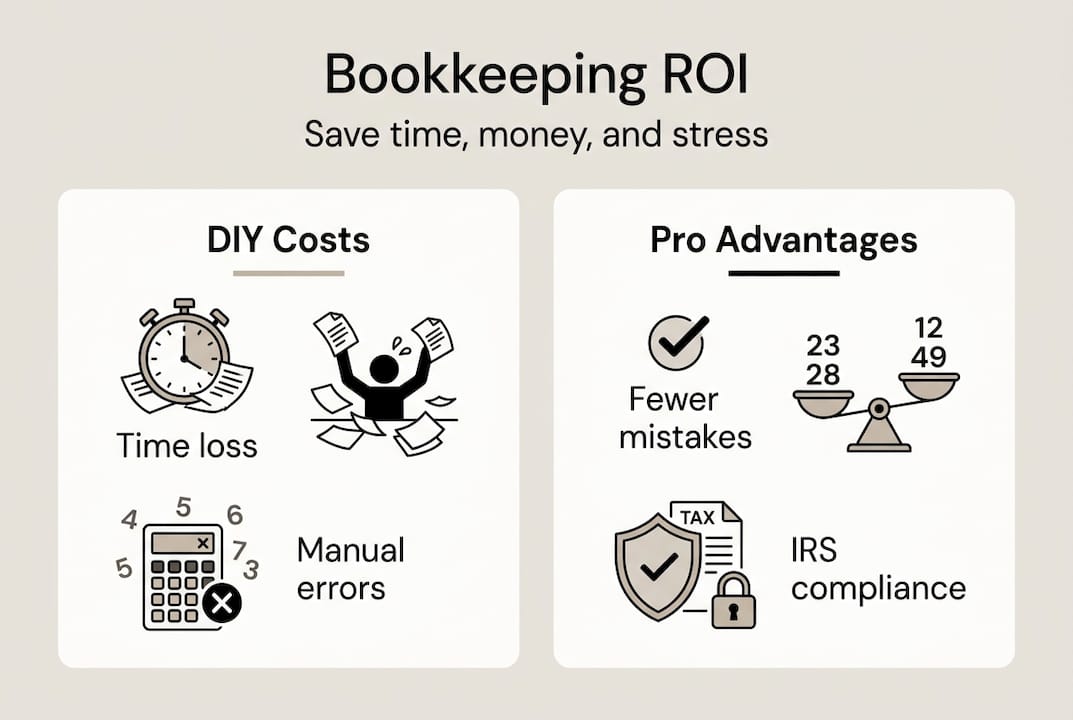
| Business scenario | DIY annual cost | Professional annual cost | Net benefit |
|---|---|---|---|
| 10 hrs/month at $75/hr | $9,000 (time) | $6,000 to $18,000 | Breaks even or better |
| $3,000 in IRS penalties | $3,000 | $0 (prevented) | $3,000 saved |
| Missed deductions | $1,500+ | $0 (captured) | $1,500+ saved |
| Total hidden DIY cost | $13,500+ | $6,000 to $18,000 | Comparable or better |
DIY bookkeeping makes sense in very limited situations. If your annual revenue is under $100,000 and you have fewer than 50 transactions per month, you can probably manage on your own with good software. But once you cross those thresholds, the math shifts quickly.
The ROI of professional bookkeeping comes from multiple directions:
- Time returned to revenue-generating work
- Penalties avoided through accurate, on-time filings
- Tax savings from deductions you would have missed
- Better decisions from clean, reliable financial reports
- Reduced stress and mental bandwidth freed up for your actual business
For growing Missouri service businesses, understanding the bookkeeping for business growth connection is what separates owners who scale from those who stay stuck.
Is professional bookkeeping right for your business? When to switch
Not every business needs to outsource bookkeeping on day one. But most businesses reach a tipping point faster than they expect. DIY bookkeeping scales poorly as transactions grow, and errors multiply in ways that are hard to detect until the damage is done.
Here are the clearest signs it’s time to when to hire a bookkeeper and make the switch:
- You’ve received an IRS notice or state tax letter. This is the most urgent signal. Don’t wait for a second one.
- You’re spending more than 5 hours per month on bookkeeping. That time has a real dollar value.
- You have more than 100 transactions per month. Volume creates complexity that DIY tools don’t handle well.
- You’re not confident in your numbers. If you wouldn’t stake a business decision on your P&L, your books need work.
- You’re planning to grow, borrow, or sell. Lenders and buyers require clean, professional financials.
- Tax season feels like a crisis every year. That’s a sign your year-round process is broken.
Consider a Missouri landscaping company with 12 employees and 200 monthly transactions. The owner was spending 18 hours per month on bookkeeping, had missed two quarterly payroll filings, and had no idea whether the business was actually profitable. After switching to professional bookkeeping, they recovered $4,200 in missed deductions in the first year and cut their tax prep bill in half.
Pro Tip: Even if you can track cash flow right now, you’ll need professional-grade processes before you grow, borrow, or sell. Building good habits early costs far less than cleaning up a mess later.
Ready to simplify your finances? Book a free consult
If any of those warning signs sound familiar, you’re not alone. Most Missouri service business owners reach a point where DIY bookkeeping stops working, and the transition to professional help feels overwhelming. It doesn’t have to be.

At Kenworthy Bookkeeping, we work with small service businesses in the Kansas City area to take bookkeeping completely off your plate. From monthly categorization and bank reconciliations to P&L reports and tax season prep, we use QuickBooks Online to keep your books clean, accurate, and ready when you need them. Book a bookkeeping consult to get started with a free discovery call, no pressure, no commitment. You can also explore our Missouri year-end reporting guide to see exactly what clean books look like at the end of the year.
Frequently asked questions
How does professional bookkeeping save me money?
It reduces costly errors, uncovers missed deductions, and returns your time to revenue-focused work. Most small businesses see a 3x ROI in the first year through reduced penalties and recovered tax savings alone.
When should I switch from DIY bookkeeping to a professional?
Once you exceed 50 to 100 monthly transactions or $100,000 in annual revenue, a professional bookkeeper saves you significant time and reduces your error risk substantially.
What tasks does a professional bookkeeper handle for Missouri businesses?
They manage sales tax at 4.225%, payroll withholdings via Form MO-941, and quarterly SUI filings, making sure every local and state obligation is filed accurately and on time.
Is hiring a bookkeeper worth it for a small service business?
If your time is worth $50 or more per hour and you’re spending 10 or more hours monthly on your books, outsourced bookkeeping delivers clear, measurable value from the very first month.