

Why prepare for tax season: Kansas small business guide
Many Kansas small business owners assume tax season preparation is just about gathering receipts in March, but this misconception can cost thousands in penalties and missed deductions. Proper preparation combines accurate bookkeeping, understanding state-specific tax laws, and strategic planning throughout the year. This guide explains why early preparation matters for Kansas businesses, how to optimize tax outcomes through systematic bookkeeping practices, and what specific compliance requirements you must meet to avoid costly penalties while maximizing deductions.
Table of Contents
- Why Accurate Bookkeeping Is The Foundation For Tax Preparation
- Navigating Kansas-Specific Tax Laws And Regulations
- Tools And Strategies To Optimize Tax Season Preparation
- Common Pitfalls And How To Avoid Costly Mistakes During Tax Season
- Prepare Your Kansas Small Business For Tax Season With Expert Help
- Frequently Asked Questions
Key takeaways
| Point | Details |
|---|---|
| Accurate records reduce risk | Organized bookkeeping decreases audit likelihood by 30% and cuts preparation time significantly |
| Kansas tax compliance saves money | Understanding state income, sales, and local taxes prevents penalties up to 25% of unpaid amounts |
| Professional tools improve outcomes | Accounting software and expert advisors save 15 hours monthly and reduce tax burdens by 20% |
| Monthly reconciliation prevents fraud | Regular account reviews catch errors early and reduce fraud risk by 30% |
| Early preparation maximizes deductions | Strategic planning throughout the year identifies all eligible credits and reduces overall tax liability |
Why accurate bookkeeping is the foundation for tax preparation
Accurate bookkeeping creates a detailed financial record that supports every number on your tax return. When you maintain organized records of income, expenses, assets, and liabilities, you build a defensible position against potential audits while ensuring you claim every deduction you legally deserve. Businesses with organized financial records are 30% less likely to face audits and penalties, making systematic record keeping your first line of defense against costly tax problems.
The efficiency gains from proper bookkeeping extend beyond audit protection. Organized bookkeeping practices reduce tax preparation time by 15-20% while decreasing potential penalties by 10-15%. This means your CPA spends less time reconstructing transactions and more time identifying strategic tax advantages specific to your business situation. Clean records also enable faster responses to IRS inquiries, reducing the stress and expense of extended correspondence.
Common bookkeeping mistakes create unnecessary tax complications for Kansas small businesses. Mixing personal and business transactions tops the list, followed by inconsistent categorization of expenses, delayed bank reconciliations, and incomplete documentation of cash transactions. Each error compounds during tax preparation, potentially triggering red flags or causing you to overpay because you cannot substantiate legitimate deductions.
Pro Tip: Separate business and personal finances completely by maintaining dedicated business bank accounts and credit cards. This separation simplifies bookkeeping, strengthens audit defense, and ensures you capture every business expense for potential deduction.
The IRS requires specific record retention periods depending on transaction types, generally three to seven years for most business records. Maintaining organized digital and physical files according to these guidelines protects you if questions arise years after filing. Understanding why bookkeeping matters in Kansas City helps you build systems that serve both immediate tax needs and long-term business planning.
“The difference between tax avoidance and tax evasion is documentation. Accurate bookkeeping transforms legitimate business expenses into defendable deductions.”
Your bookkeeping system should capture transaction details at the source, categorize expenses consistently using a chart of accounts aligned with tax forms, and reconcile all accounts monthly. This foundation enables strategic tax planning rather than reactive scrambling when deadlines approach.
Navigating Kansas-specific tax laws and regulations
Kansas imposes a corporate income tax structure that differs significantly from federal requirements, creating compliance obligations many small business owners overlook. The state charges a flat 4% corporate income tax rate, plus a 3% surtax on taxable income exceeding $50,000, effectively creating a 7% rate for profitable businesses. Understanding these rates helps you estimate quarterly payments and avoid underpayment penalties that accrue throughout the year.

Sales tax compliance presents particular challenges for Kansas businesses, especially those selling online or across state lines. Economic nexus rules require remote sellers to collect sales tax if they exceed $100,000 in annual gross sales to Kansas customers, regardless of physical presence. This threshold means even home-based businesses shipping products nationwide may trigger Kansas collection obligations, requiring registration, monthly filing, and remittance of collected taxes.
Local tax requirements add another compliance layer for businesses operating in specific Kansas municipalities. Kansas City, Missouri (which extends into Kansas) imposes a 1% earnings tax on income earned within city limits, affecting both residents and non-residents working there. Businesses must withhold this tax from employee wages and file quarterly returns, creating additional bookkeeping and reporting responsibilities beyond state and federal obligations.
Kansas Tax Type Comparison
| Tax Type | Rate | Filing Frequency | Key Requirement |
|---|---|---|---|
| Corporate Income | 4% + 3% surtax over $50K | Annual (quarterly estimates) | Form K-120 by April 15 |
| Sales Tax | 6.5% state + local | Monthly or quarterly | Registration required at $100K threshold |
| Franchise Tax | Varies by entity | Annual | Based on net capital or property |
| Kansas City Earnings | 1% | Quarterly | Withhold from employee wages |
Filing deadlines create pressure points throughout the tax year. Corporate income tax returns follow the federal calendar, typically due April 15 for calendar-year businesses, with quarterly estimated payments due April 15, June 15, September 15, and January 15. Failure to comply with Kansas tax laws results in penalties of up to 25% of unpaid tax plus interest, making timely filing essential even when you cannot pay the full amount owed.
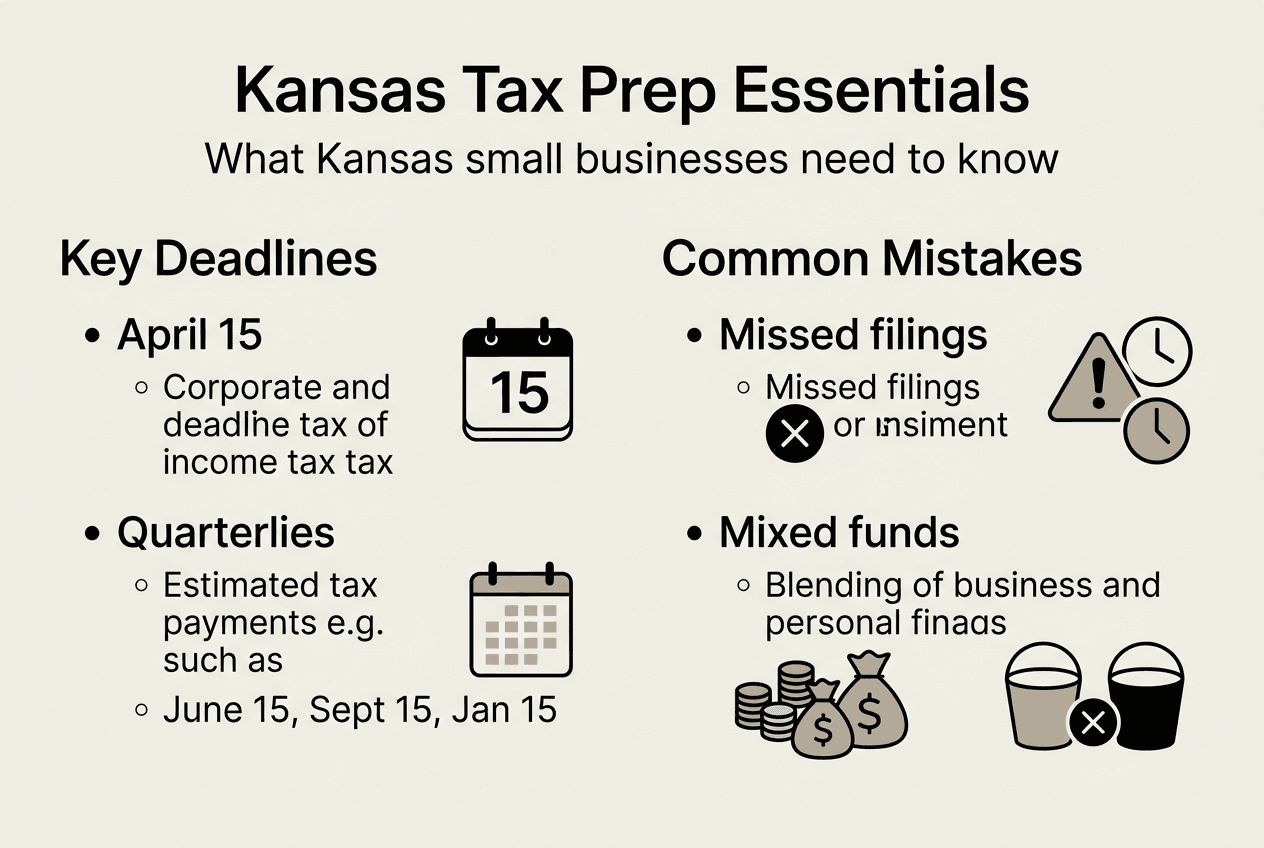
Pro Tip: Mark all Kansas tax deadlines in your calendar system with two-week advance reminders. This buffer allows time to gather documentation, resolve discrepancies, and file accurately rather than rushing last-minute submissions that increase error risk.
Kansas offers various tax incentives and credits that reduce your overall tax burden when properly claimed. The High Performance Incentive Program (HPIP) provides income tax credits for qualifying businesses making significant capital investments. The Rural Opportunity Zones program offers income tax waivers and student loan repayment assistance for individuals moving to designated counties. Researching tax preparation strategies for Kansas small businesses reveals opportunities many owners miss simply because they focus solely on federal obligations.
The Kansas Department of Revenue website provides detailed guidance on registration requirements, filing procedures, and available credits. Familiarizing yourself with these resources or working with Kansas-focused tax professionals ensures you meet all obligations while capturing every available benefit.
Tools and strategies to optimize tax season preparation
Accounting software transforms tax preparation from a dreaded annual event into a manageable ongoing process. Modern platforms automatically categorize transactions, reconcile bank accounts, generate financial reports, and track mileage and receipts through mobile apps. Businesses using accounting software save 15 hours monthly on bookkeeping tasks, freeing time for strategic planning and revenue generation while maintaining the detailed records tax preparation demands.
QuickBooks Online leads the small business accounting market with features specifically designed for tax readiness. The platform integrates with bank accounts and credit cards for automatic transaction import, offers customizable categorization rules that learn your business patterns, and generates profit and loss statements that map directly to tax form line items. This integration means your bookkeeping system becomes your tax preparation system, eliminating duplicate data entry and reducing error opportunities.
Finding the right tax professional amplifies your software investment. Look for CPAs or Enrolled Agents with specific Kansas small business experience who understand both state and federal requirements. Ask potential advisors about their familiarity with your industry, their approach to tax planning versus tax preparation, and their availability for year-round questions rather than just seasonal filing support.
- Schedule monthly bookkeeping reviews to reconcile all accounts and identify discrepancies while memories are fresh and documentation is readily available
- Maintain separate bank accounts and credit cards for business use only, simplifying transaction categorization and strengthening audit defense
- Digitize receipts immediately using mobile scanning apps that integrate with your accounting software, preventing lost documentation for legitimate deductions
- Meet with your tax advisor quarterly to review financial performance, estimate tax obligations, and adjust estimated payments to avoid penalties
- Submit organized financial records to your CPA by February 1st, allowing adequate time for thorough review and strategic planning before filing deadlines
Pro Tip: Create a shared folder with your tax professional where you deposit monthly financial statements, major receipts, and transaction explanations throughout the year. This ongoing collaboration prevents the February scramble and enables proactive tax planning.
Tax planning differs fundamentally from tax preparation. Planning involves strategic decisions throughout the year about equipment purchases, retirement contributions, entity structure, and expense timing to legally minimize tax obligations. Proper tax planning reduces small business tax burdens by up to 20% compared to reactive preparation that simply reports what already happened. Understanding bookkeeping’s role in tax season helps you shift from passive compliance to active optimization.
The IRS provides extensive resources for small business tax planning, including publications on depreciation strategies, retirement plan options, and deduction eligibility. Combining these federal resources with Kansas-specific guidance creates a comprehensive framework for year-round tax optimization rather than April anxiety.
Common pitfalls and how to avoid costly mistakes during tax season
Mixing personal and business finances creates accounting nightmares that complicate tax preparation and weaken audit defense. When you use business accounts for personal expenses or vice versa, you must later reconstruct which transactions qualify as business deductions, often missing legitimate write-offs or accidentally claiming personal expenses that trigger penalties. This commingling also suggests to auditors that you lack proper financial controls, inviting deeper scrutiny of all claimed deductions.
Missing filing deadlines triggers immediate penalties regardless of whether you owe additional tax. The IRS charges a failure-to-file penalty of 5% of unpaid taxes per month, up to 25% maximum, plus a separate failure-to-pay penalty and interest on outstanding balances. Kansas assesses similar penalties, meaning a single missed deadline can cost thousands in avoidable fees even when your actual tax liability is modest or zero.
Monthly account reconciliation catches errors and fraud before they compound into major problems. Businesses that reconcile accounts monthly experience 30% less fraud because regular reviews reveal unauthorized transactions, duplicate charges, and data entry mistakes while correction is still straightforward. This practice also ensures your financial reports accurately reflect business performance, enabling better decisions about hiring, purchasing, and expansion.
- Neglecting available deductions because you lack proper documentation or awareness of eligibility requirements
- Failing to track mileage for business travel, losing one of the most valuable deductions for service businesses
- Missing quarterly estimated tax payments, resulting in underpayment penalties even when you pay the full amount by April 15
- Ignoring retirement contribution opportunities that reduce current tax while building future security
- Delaying bookkeeping until tax season, creating rushed work prone to errors and omissions
Common Tax Season Mistakes
| Mistake | Consequence | Prevention Strategy |
|---|---|---|
| Mixed personal/business funds | Lost deductions, audit risk | Dedicated business accounts only |
| Missed filing deadlines | 25% penalty plus interest | Calendar reminders two weeks early |
| No monthly reconciliation | Undetected fraud, inaccurate reports | Schedule first week of month reviews |
| Incomplete expense documentation | Disallowed deductions | Digital receipt capture at purchase |
| Skipped quarterly estimates | Underpayment penalties | Work with CPA for accurate projections |
Pro Tip: Set up automatic monthly transfers to a dedicated tax savings account based on your estimated tax rate. This practice ensures funds are available when quarterly payments come due and prevents the cash flow crisis many businesses face at tax time.
Inaccurate record keeping leads to tax audits and penalties because it creates discrepancies between reported income and third-party documentation like 1099 forms and bank deposits. The IRS matching system automatically flags returns where reported amounts differ from information returns, triggering correspondence or full audits that consume time and money even when you ultimately owe nothing additional.
Understanding why maintaining financial records matters helps you appreciate that bookkeeping serves purposes beyond tax compliance. Accurate records enable business performance analysis, support loan applications, facilitate partnership agreements, and provide evidence in legal disputes. The systems you build for tax preparation deliver value across every aspect of business operations.
Prepare your Kansas small business for tax season with expert help
Navigating Kansas tax requirements while running your business stretches your time and expertise thin. Professional bookkeeping services handle the detailed record keeping, account reconciliation, and financial reporting that tax preparation demands, freeing you to focus on revenue generation and customer service. Expert support also ensures you meet all compliance deadlines while identifying deductions and credits you might otherwise miss.

Kenworthy Bookkeeping specializes in helping Kansas small businesses streamline their finances and prepare for tax season with confidence. Our QuickBooks Online expertise, combined with deep knowledge of Kansas tax requirements, means your books stay organized year-round and ready for efficient tax filing. We handle categorization, bank reconciliations, and P&L reports so you have clear financial visibility and documentation that withstands scrutiny. Schedule a professional bookkeeping consultation to discover how expert support transforms tax season from stressful scramble to smooth process, or explore our comprehensive guide on bookkeeping for tax season to learn more about preparation best practices.
Frequently asked questions
What are the key deadlines Kansas small businesses must meet for tax season?
Kansas corporate income tax returns follow the federal calendar, typically due April 15 for calendar-year businesses, with quarterly estimated payments due April 15, June 15, September 15, and January 15. Sales tax filing frequency depends on your volume, ranging from monthly to annual, while Kansas City earnings tax requires quarterly filing. Starting preparation in January rather than March gives adequate time to gather documentation, resolve discrepancies, and file accurately without rushing.
How can small businesses ensure they claim all eligible tax deductions in Kansas?
Maintain detailed, organized records of all business expenses throughout the year, categorizing them consistently in your accounting software. Work with a tax professional familiar with Kansas-specific deductions and credits who can identify opportunities beyond standard federal write-offs. Review your bookkeeping practices for tax season regularly to ensure you capture receipts, mileage, and documentation that substantiate every claimed deduction.
What are common bookkeeping mistakes that increase audit risk for Kansas small businesses?
Mixing personal and business finances tops the list because it creates transaction confusion and suggests poor financial controls to auditors. Failing to reconcile bank and credit card accounts monthly allows errors and discrepancies to accumulate undetected. Incomplete or inaccurate documentation of expenses, particularly cash transactions, makes it impossible to defend claimed deductions during an audit. These mistakes are entirely preventable through systematic bookkeeping practices and dedicated business accounts.
Recommended
- Tax preparation for Kansas small businesses: 5% penalty risk
- Role of Bookkeeping for Tax Season – Impact on Small Businesses
- Why Maintain Financial Records for Small Businesses
- Small Business Accounting: Streamlining Your Kansas City Finances
- Important Changes For 2021 Tax Season To Be Aware Of – xpath.global