

Role of Bookkeeping in Growth for Home Services
Running a home service business in Kansas City can feel like a balancing act when it comes to managing money. Without a reliable system for recording every transaction, your financial health quickly becomes unclear, making it tough to plan ahead or understand true profitability. Bookkeeping gives you the accurate insight needed to make smart decisions, stay compliant, and set your company up for real, sustainable growth.
Table of Contents
- Defining Bookkeeping In Small Businesses
- Types Of Bookkeeping Methods Explained
- How Bookkeeping Drives Business Growth
- Financial Reporting And Profitability Insights
- Reducing Errors And Ensuring Compliance
- Common Bookkeeping Pitfalls To Avoid
Key Takeaways
| Point | Details |
|---|---|
| Importance of Bookkeeping | Bookkeeping is essential for small businesses to track financial performance and make informed decisions. |
| Choosing a Method | Select between single-entry and double-entry systems based on business size and complexity for optimal financial management. |
| Financial Visibility for Growth | Accurate financial records provide insights into profitability, investment planning, and risk management, driving business growth. |
| Common Pitfalls | Avoid mixing personal finances and inconsistent record-keeping to prevent long-term financial complications. |
Defining Bookkeeping in Small Businesses
Bookkeeping is the systematic process of recording, tracking, and organizing a business’s financial transactions. For home service businesses in Kansas City, it represents the essential foundation for understanding financial performance and making strategic growth decisions. Bookkeeping transforms complex financial data into clear, actionable insights that drive business success.
At its core, bookkeeping involves several critical activities:
- Recording daily financial transactions
- Categorizing expenses and income
- Tracking cash flow
- Maintaining accurate financial records
- Preparing financial statements
Small businesses require bookkeeping to understand financial transaction fundamentals. Without a clear picture of income and expenses, home service business owners risk making uninformed decisions that could potentially harm their company’s financial health.
The primary goal of bookkeeping is providing transparent financial visibility. By meticulously documenting every financial movement, businesses create a reliable roadmap for understanding their economic landscape. This includes tracking revenue streams, monitoring operational costs, and identifying potential areas for financial optimization.
Accurate bookkeeping transforms financial data from mere numbers into strategic business intelligence.
Financial records serve multiple critical purposes beyond simple tracking. They become essential tools for tax preparation, securing business loans, attracting potential investors, and making data-driven strategic decisions.

Here’s how bookkeeping empowers home service business leaders at different stages:
| Business Stage | Bookkeeping Focus | Typical Decisions Enabled |
|---|---|---|
| Startup | Set financial foundation | Pricing, basic tax prep |
| Early Growth | Track cash flow, expenses | Service expansion, first hires |
| Established | Analyze profitability trends | Optimize service mix, major buys |
| Scaling | Prepare audited statements | Seek funding, enter new markets |
Pro tip: Implement a consistent bookkeeping routine from day one to establish solid financial management practices for your home service business.
Types of Bookkeeping Methods Explained
Home service businesses have multiple bookkeeping approaches available, each with unique advantages and complexities. Understanding these methods is crucial for maintaining accurate financial records and making informed business decisions. The two primary bookkeeping methods for small businesses are single-entry and double-entry systems.
Single-Entry Bookkeeping represents the most straightforward approach:
- Tracks income and expenses in a simple ledger
- Ideal for very small businesses with minimal transactions
- Requires minimal accounting knowledge
- Lower cost and complexity
- Best for businesses with straightforward financial activities
Double-Entry Bookkeeping offers a more comprehensive financial tracking method. This system requires recording each transaction twice – once as a debit and once as a credit – ensuring complete financial transparency and accuracy.
Key differences between these methods include:
- Transaction Recording
- Single-Entry: One-time recording
- Double-Entry: Two-time recording (debit and credit)
- Complexity
- Single-Entry: Simple
- Double-Entry: More complex
- Financial Insight
- Single-Entry: Basic overview
- Double-Entry: Comprehensive financial understanding
Choosing the right bookkeeping method can significantly impact your business’s financial management and growth potential.
For home service businesses in Kansas City looking to scale, the double-entry system provides more robust financial tracking. It enables detailed financial statement preparation, helps identify potential inefficiencies, and supports strategic decision-making.
Use this comparison to quickly identify the best bookkeeping method for your needs:
| Feature | Single-Entry System | Double-Entry System |
|---|---|---|
| Accuracy level | Basic error detection | High reliability, full balance |
| Suitable business size | Solo or microbusiness | Growing or complex companies |
| Audit readiness | Limited, less compliant | Fully audit-ready |
| Typical software required | Spreadsheet or simple app | Advanced accounting software |
Pro tip: Consider consulting a professional bookkeeper to determine the most suitable bookkeeping method for your specific home service business needs.
How Bookkeeping Drives Business Growth
Bookkeeping is far more than just tracking numbers – it’s a strategic tool that propels home service businesses toward sustainable growth. By maintaining accurate financial records, businesses gain critical insights that transform financial data into actionable strategic decisions.
Financial Visibility enables growth through several key mechanisms:
- Identifying profitable service lines
- Tracking expense patterns
- Highlighting potential cost-cutting opportunities
- Revealing cash flow trends
- Supporting strategic investment decisions
The primary growth drivers facilitated by robust bookkeeping include:
- Performance Analysis
- Measure service profitability
- Compare revenue against expenses
- Identify high-margin services
- Investment Planning
- Understand financial capacity
- Determine equipment upgrade potential
- Plan strategic hiring
- Risk Management
- Detect financial irregularities
- Ensure tax compliance
- Prevent cash flow disruptions
Precise financial tracking transforms bookkeeping from a compliance requirement into a powerful business growth engine.
Businesses that leverage comprehensive bookkeeping can more effectively secure funding, make informed expansion decisions, and maintain competitive pricing strategies. By understanding every financial nuance, home service businesses can develop targeted growth plans that minimize risk and maximize potential.
Pro tip: Invest in monthly financial statement reviews to continuously refine your business growth strategy.
Financial Reporting and Profitability Insights
Financial reporting serves as the critical compass guiding home service businesses toward strategic growth and profitability. Comprehensive profitability analysis enables business owners to decompose financial performance and understand the intricate mechanisms driving their company’s financial health.
Financial Reports provide invaluable insights through multiple strategic documents:
- Balance Sheets
- Income Statements
- Cash Flow Statements
- Profit and Loss Statements
- Accounts Receivable Reports
Key profitability metrics home service businesses should track include:
- Gross Profit Margin
- Reveals revenue after direct costs
- Indicates service pricing effectiveness
- Helps identify most profitable services
- Net Profit Margin
- Shows overall business profitability
- Accounts for all operational expenses
- Demonstrates long-term financial sustainability
- Operating Expense Ratio
- Measures operational efficiency
- Compares expenses to total revenue
- Highlights potential cost-cutting opportunities
Financial reporting transforms raw numbers into strategic roadmaps for business growth and optimization.
By systematically analyzing these reports, home service businesses can make data-driven decisions, optimize service offerings, and create targeted strategies for sustainable expansion. Understanding financial nuances allows business owners to proactively address challenges and capitalize on emerging opportunities.
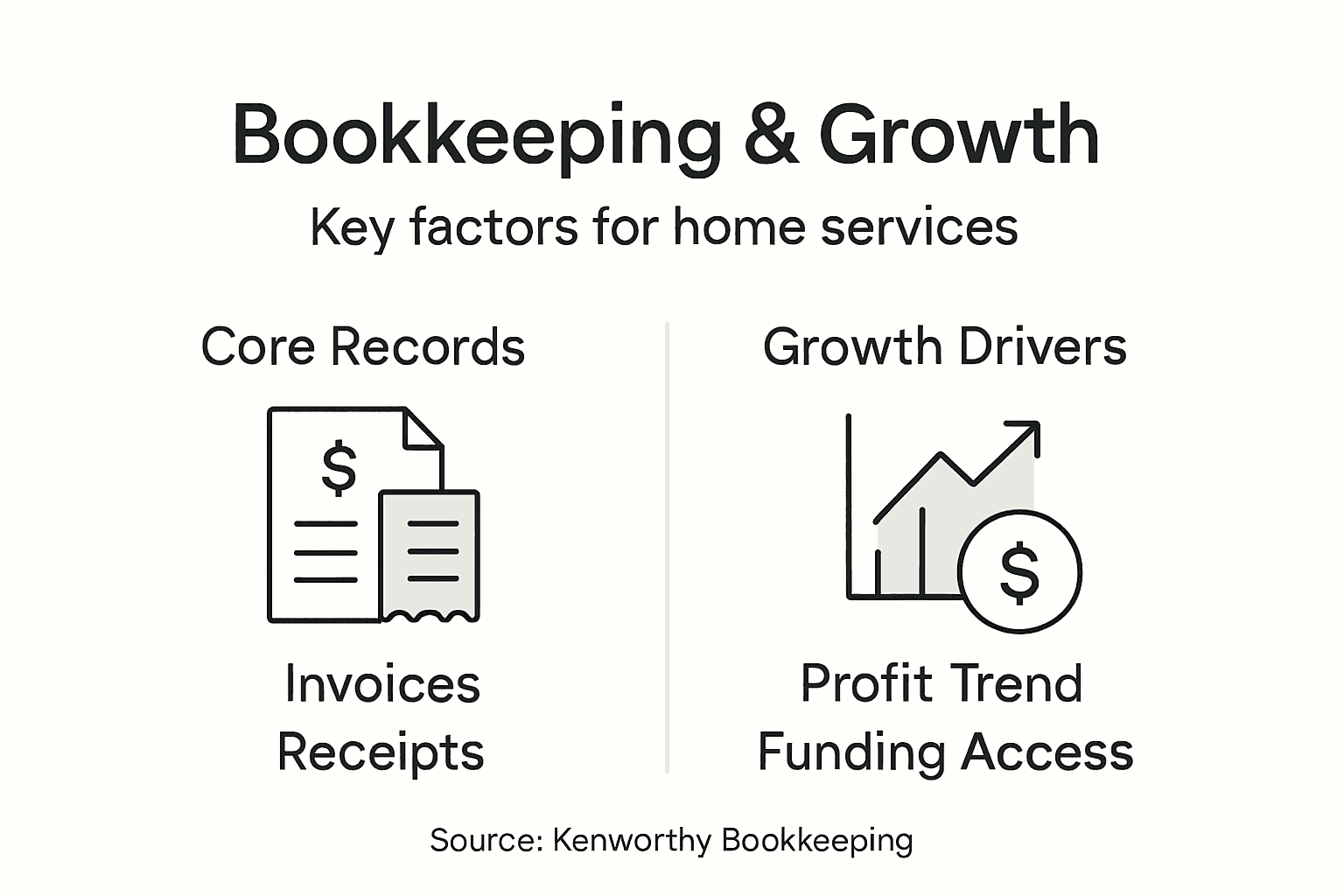
Pro tip: Schedule quarterly deep-dive financial review sessions to identify trends, opportunities, and potential improvements in your business performance.
Reducing Errors and Ensuring Compliance
For home service businesses, maintaining financial accuracy is not just a best practice—it’s a critical survival strategy. Compliance risk management provides a structured approach to identifying, assessing, and mitigating potential financial reporting risks that could undermine business integrity.
Error Prevention requires a comprehensive approach involving multiple strategic elements:
- Implementing robust internal controls
- Conducting regular financial audits
- Training staff on compliance procedures
- Utilizing advanced bookkeeping technologies
- Creating standardized documentation processes
Key strategies for reducing financial reporting errors include:
- Documentation Management
- Maintain clear, consistent records
- Use standardized documentation templates
- Archive financial documents systematically
- Technology Integration
- Leverage automated accounting software
- Implement real-time error detection systems
- Use cloud-based financial tracking tools
- Regular Review Processes
- Schedule monthly reconciliation reviews
- Cross-check financial statements
- Validate transactions and expense records
Proactive compliance management transforms potential risks into opportunities for financial optimization.
By developing a structured approach to error prevention, home service businesses can minimize financial risks, maintain regulatory compliance, and build a foundation of trust with stakeholders, investors, and financial institutions.
Pro tip: Develop a comprehensive compliance checklist and review it quarterly to ensure ongoing financial accuracy and risk mitigation.
Common Bookkeeping Pitfalls to Avoid
Home service businesses frequently encounter financial challenges that can derail their growth and profitability. Bookkeeping mistakes can create significant long-term complications if not addressed promptly and strategically.
Financial Tracking Errors often emerge through several common missteps:
- Mixing personal and business finances
- Inconsistent record-keeping
- Neglecting regular reconciliation
- Poor expense categorization
- Failing to track small transactions
Critical bookkeeping pitfalls home service businesses must avoid include:
- Informal Financial Management
- Using personal bank accounts
- Handling cash transactions without documentation
- Ignoring minor expenses
- Inadequate Documentation
- Missing receipts
- Incomplete invoice records
- Poorly organized financial paperwork
- Technology Misuse
- Resisting digital bookkeeping tools
- Manual data entry errors
- Infrequent software updates
Proactive error prevention is significantly more cost-effective than reactive financial corrections.
By understanding and addressing these common pitfalls, home service businesses can develop robust financial practices that support sustainable growth and minimize potential compliance risks.
Pro tip: Implement a monthly financial review routine to catch and correct potential bookkeeping errors before they become significant problems.
Take Control of Your Home Service Business Growth with Expert Bookkeeping
Managing detailed financial records and ensuring compliance can feel overwhelming for Kansas City home service businesses striving to grow. The challenges of maintaining accurate bookkeeping, avoiding costly errors, and extracting actionable insights from your financial data require time and expert attention—a critical need to sustain profitability and make informed decisions as highlighted in the Role of Bookkeeping in Growth for Home Services.
At Kenworthy Bookkeeping, we specialize in easing these burdens by providing effortless, expert bookkeeping services tailored for small businesses. From comprehensive bank reconciliations and profit and loss reports to tax preparation, we use QuickBooks Online to deliver transparent financial visibility and accuracy. Our trusted services empower you to focus on expanding your business while we help you uncover financial opportunities and prevent compliance risks identified in the article.
Enhance your business’s financial foundation today. Schedule a consultation with us and start turning your bookkeeping challenges into growth opportunities.

Ready to streamline your finances and boost profitability? Connect with Kenworthy Bookkeeping now to regain control and confidently drive your home service business forward. Visit Kenworthy Bookkeeping Consult and see how our expertise can transform your bookkeeping from a burden into your most valuable business asset.
Frequently Asked Questions
What is bookkeeping, and why is it important for home service businesses?
Bookkeeping is the systematic process of recording, tracking, and organizing financial transactions. It is crucial for home service businesses as it provides transparency into financial performance, informs strategic growth decisions, and helps maintain a clear picture of income and expenses.
What are the main types of bookkeeping methods available for small businesses?
The two primary bookkeeping methods are single-entry and double-entry bookkeeping. Single-entry is simpler and ideal for very small businesses with minimal transactions, while double-entry offers comprehensive tracking by recording each transaction twice, providing greater accuracy and insight into financial health.
How can accurate bookkeeping drive growth for home service businesses?
Accurate bookkeeping transforms financial data into actionable insights, enabling businesses to identify profitable services, track expense patterns, highlight cost-cutting opportunities, and support strategic investment decisions. It helps optimize operations and enhances overall business performance.
What common bookkeeping mistakes should home service businesses avoid?
Common bookkeeping pitfalls include mixing personal and business finances, inconsistent record-keeping, neglecting regular reconciliation, poorly categorizing expenses, and failing to track small transactions. Avoiding these mistakes helps in maintaining accurate financial records and supporting business growth.






One Comment
Comments are closed.