

How to Control Business Spending for Small Biz Owners
Every home service owner in Kansas City knows the frustration of seeing hard-earned dollars vanish through unnoticed expenses each month. Understanding where your money is actually going is the first move toward protecting your business’s future. By focusing on honest expense assessment, setting clear limits, and staying organized, you create real opportunities for savings and growth. Bold steps like these help small teams control costs and keep their business on solid financial ground.
Table of Contents
- Step 1: Assess Current Business Expenses
- Step 2: Set Clear And Realistic Spending Limits
- Step 3: Categorize And Track All Business Costs
- Step 4: Implement Smart Cost-Saving Strategies
- Step 5: Review Results And Adjust As Needed
Quick Summary
| Key Insight | Explanation |
|---|---|
| 1. Gather all expense records | Collect three to six months of expense data to understand spending patterns effectively. |
| 2. Set realistic spending limits | Establish clear limits based on your assessment to control costs without stifling growth. |
| 3. Categorize expenses accurately | Organize expenses into detailed categories for better tracking and decision-making. |
| 4. Identify cost-saving opportunities | Regularly review expenses for waste or inefficiencies to optimize spending without sacrificing quality. |
| 5. Monthly expense reviews ensure accountability | Regularly compare spending against limits to identify areas needing adjustment and reinforce good financial habits. |
Step 1: Assess current business expenses
Before you can control what you’re spending, you need to know exactly where your money is going. This assessment step is your foundation for making real changes to your bottom line. You’ll gather all your expense information, categorize it, and get a clear picture of your current financial reality.
Start by collecting every expense you’ve incurred over the past three to six months. Pull together bank statements, credit card statements, invoices you’ve paid, receipts, and any other records showing money leaving your business. This includes regular bills like utilities and insurance, supplies for your home service work, vehicle expenses, and employee costs if you have staff. Don’t worry about being perfectly organized yet; just get everything in one place.
Once you have your records gathered, categorize your expenses into logical groups. The IRS recognizes that ordinary and necessary business expenses directly connected to your trade help define what counts for tax purposes. For your home service business, this might mean grouping expenses like equipment purchases, labor costs, fuel and vehicle maintenance, supplies, insurance, and marketing separately. You can also break these into one-time costs versus monthly recurring expenses, which helps you see your fixed obligations versus variable spending.
Add up what you’re spending in each category. Be realistic about estimates if you don’t have exact numbers. Your goal is to see the total picture, not just individual transactions. Many home service owners find they’re surprised by how much certain categories add up to when they’re totaled for the quarter. This honest assessment reveals where your spending patterns actually are, not where you think they are.
As you complete this assessment, you’ll also want to identify which expenses are truly necessary for running your business and which ones might be worth questioning. This critical evaluation becomes your roadmap for the next steps in controlling your spending.
Here’s how typical business expense categories differ by frequency and budget control opportunities:
| Expense Category | Frequency | Budget Control Opportunities |
|---|---|---|
| Equipment & Tools | One-time/Occasional | Plan purchases, compare vendors |
| Labor/Payroll | Recurring Monthly | Adjust hours, optimize schedules |
| Fuel & Vehicle | Recurring Monthly | Maintain regularly, review vendor rates |
| Supplies | Recurring Monthly | Buy in bulk, reduce waste |
| Insurance | Annually/Monthly | Shop for better rates, review coverage |
| Marketing | Variable/Seasonal | Test channel effectiveness, set caps |
Pro tip: Use your bank and credit card statements as your primary source documents, since they provide an objective record of exactly what you spent and when, making categorization faster and more accurate than trying to reconstruct expenses from memory.
Step 2: Set clear and realistic spending limits
Now that you know where your money is going, it’s time to set boundaries. Clear spending limits give your business structure and prevent unnecessary spending from creeping back in. Think of these limits as guardrails that keep your business finances on track without restricting you from necessary investments.

Start with your highest spending categories from the assessment you just completed. If vehicle maintenance is running $800 monthly, set a realistic limit around that amount or slightly lower if you identify waste. Setting spending limits aligned with priorities helps ensure your resources go toward what actually matters for your home service business. Don’t slash numbers dramatically in hopes of instant savings. Aggressive cuts often fail because they’re unsustainable.
Break your limits into monthly and quarterly targets. Monthly limits help you catch overspending quickly, while quarterly reviews let you see patterns and adjust for seasonal variations in your business. If you run a landscaping or HVAC service, you know spending fluctuates with seasons. Your winter budget looks different from summer. Build that reality into your limits.
Write these limits down and share them with anyone who controls spending in your business. Whether you’re the only decision maker or you have a small team, everyone needs to know what the boundaries are. Post them somewhere visible, maybe in your office or your accounting software. Out of sight means out of mind.
Your limits should be flexible enough to handle genuine business needs but firm enough to stop impulse purchases. A good test is asking yourself if an expense helps you serve clients better or if it’s just convenience spending. Most home service owners find this clarity actually reduces stress because decisions become easier.
Pro tip: Set your limits 10 to 15 percent below your current spending in each category so you have breathing room for unexpected costs without blowing your budget.
Step 3: Categorize and track all business costs
Categorizing your expenses transforms scattered receipts and transactions into actionable financial information. When costs are organized by type, you can spot patterns, identify waste, and make smarter spending decisions. This step builds directly on your assessment and spending limits by creating a system you’ll use going forward.
Start by establishing the expense categories that match your home service business. Common categories include labor or payroll, equipment and tools, fuel and vehicle maintenance, supplies, insurance, marketing, utilities, and professional services. You might also have categories specific to your trade like chemicals for pest control or parts for plumbing work. The key is making categories detailed enough to be useful but not so granular that tracking becomes burdensome.
As you organize your expenses, distinguish between one-time startup costs and recurring monthly expenses so you understand your baseline spending versus irregular purchases. A new piece of equipment is different from your regular supply orders. Tracking them separately helps you forecast cash flow and understand what your true operating costs are month to month.
Set up a simple tracking system using a spreadsheet, accounting software, or whatever method fits your workflow. The IRS requires systematic record-keeping including expense categories for tax compliance and maximizing deductions. You don’t need anything fancy. Your system just needs to capture the date, amount, category, and brief description of each expense. Many home service owners find tracking cash flow regularly helps them stay on top of their spending patterns.
As transactions happen, immediately assign them to categories. Waiting until month-end creates backlog and makes you more likely to misremember details. Take two minutes when you pay an invoice or swipe your card to note where it goes. This real-time discipline keeps your numbers accurate and current.
Pro tip: Use color-coding or tags in your accounting system to flag expenses that approach or exceed your spending limits, making it instantly visible when you need to pump the brakes on a particular category.
Step 4: Implement smart cost-saving strategies
Now comes the practical work of actually reducing your spending without compromising your business quality. Smart cost-cutting isn’t about slashing budgets randomly or doing less for your clients. It’s about finding inefficiencies and redirecting resources toward what truly matters for growth.
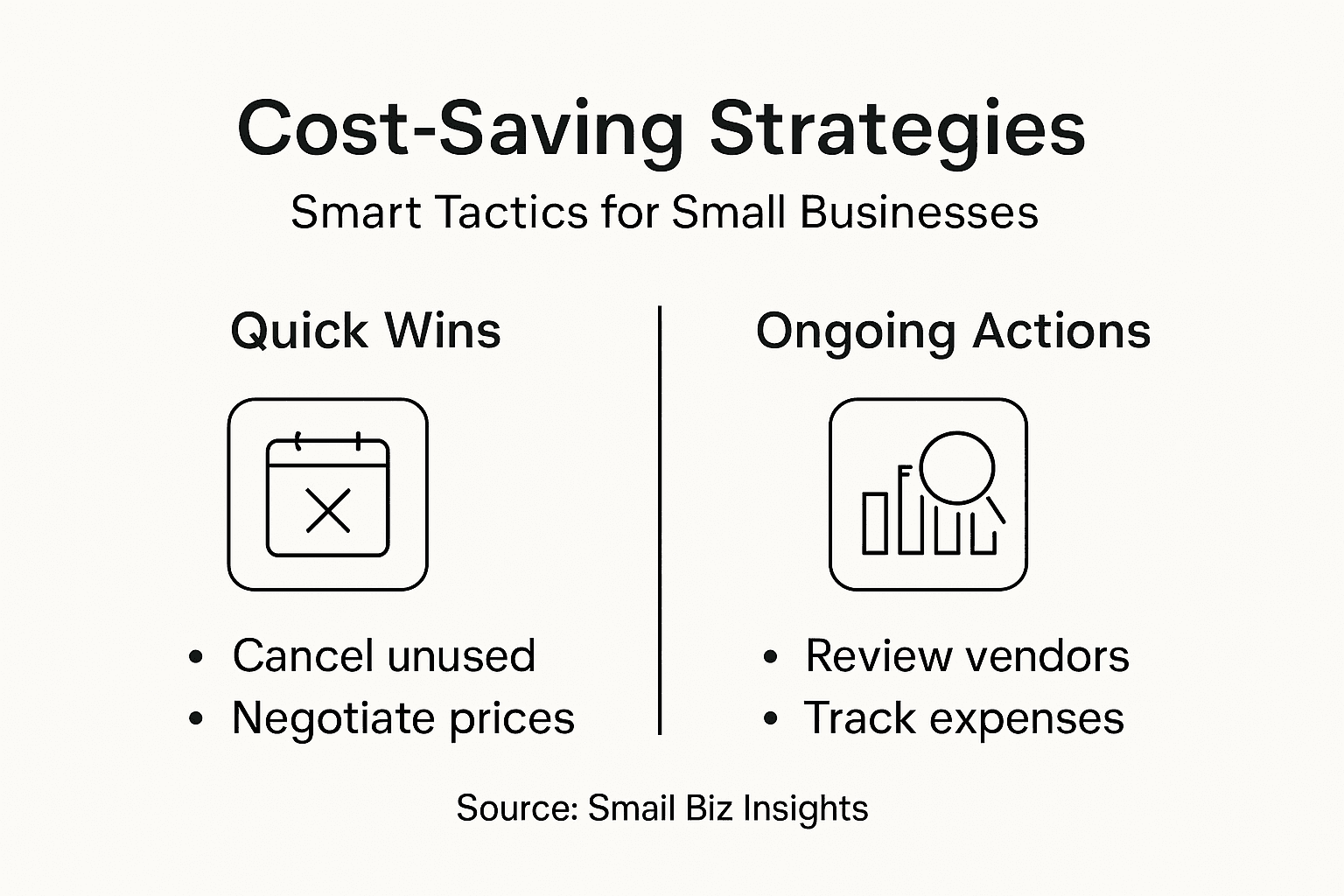
Start by examining your highest spending categories for waste or redundancy. Are you paying for software subscriptions you don’t use? Ordering supplies from multiple vendors when consolidating could save you money? Paying rush fees because you didn’t plan ahead? These inefficiencies don’t require major changes, just awareness and adjustment. Most home service owners find 5 to 10 percent in easy savings just by tightening up purchasing habits.
Strategic cost-cutting should make your business stronger, not weaker. When evaluating potential cuts, ask yourself whether reducing that expense will hurt your ability to serve clients or your team’s morale. Cutting corners on vehicle maintenance to save money might backfire when your truck breaks down on a job. Instead, look for savings that actually improve efficiency. Can you negotiate better rates with current vendors? Buy supplies in bulk? Reduce overtime by scheduling more efficiently?
Consider vendor relationships carefully. You might have been with the same supplier for years out of habit. Reach out to competitors and ask for quotes on the same items. You’d be surprised how often vendors will match or beat prices when they know they’re competing for your business. Even small percentage reductions add up across a year.
Involve your team if you have employees. They often see waste and inefficiency that you miss. Tell them you’re looking for smarter ways to work and ask for ideas. People support what they help create, and employee suggestions often lead to the best cost-saving discoveries.
Pro tip: Schedule a quarterly cost-cutting review where you examine each spending category, identify one specific waste to eliminate, and track the savings to celebrate your progress and stay motivated.
This table summarizes practical cost-saving strategies and their direct business benefits:
| Strategy | Implementation Method | Business Benefit |
|---|---|---|
| Consolidate vendors | Negotiate bulk deals | Lower purchase costs |
| Review subscriptions | Cancel unused accounts | Reduce ongoing expenses |
| Schedule reviews | Quarterly category audit | Identify new savings opportunities |
| Employee input | Collect suggestions | Spot inefficiencies |
| Price comparison | Request alternative quotes | Improve supplier competitiveness |
Step 5: Review results and adjust as needed
Controlling your spending isn’t a one-time project. It’s an ongoing process where you measure what’s working, identify what isn’t, and make adjustments. Regular reviews keep your spending aligned with your business priorities and catch problems early.
Schedule a monthly review of your tracked expenses against your spending limits. Pull up your categorized expenses and compare them to the targets you set in Step 2. Did you stay within budget in each category? Where did you exceed your limits? Understanding the why matters as much as the numbers. Did you overspend because of poor planning, unexpected costs, or changes in your business needs? The answer changes how you respond.
Systematic spending reviews help evaluate expenditures against your priorities and identify where resources could be reallocated more effectively. If you notice you’re consistently overspending on supplies but underspending on marketing, that tells you something about where your actual business needs are. Maybe your priorities shifted or your estimates were off. Use this information to adjust your limits for the next month.
Be flexible with your limits as your business changes. A slow winter season might require different spending patterns than summer. New equipment purchases or adding a team member changes your expense baseline. Your spending plan should evolve with your business, not fight against reality. The goal isn’t rigid perfection but responsive, intentional spending.
Regular monitoring and feedback mechanisms ensure your adjustments align with strategic objectives, helping you stay on course. If a cost-saving strategy isn’t working, try a different approach. If certain categories consistently stay within budget, congratulate yourself and maintain those practices. Celebrate wins to keep yourself motivated through the ongoing work of spending control.
Pro tip: Set a recurring calendar reminder for the same day each month, creating a habit of reviewing your numbers so you catch spending drift before it becomes a problem.
Take Control of Your Business Spending with Expert Bookkeeping Support
Managing your business expenses can feel overwhelming when you are trying to balance detailed tracking, setting realistic spending limits, and identifying cost-saving opportunities. This article highlights common challenges like categorizing expenses accurately and reviewing spending patterns regularly to avoid surprises. If you want to stop guessing and gain clear, timely insights into where every dollar goes in your home service business, Kenworthy Bookkeeping is here to help.

Our effortless bookkeeping services specialize in detailed expense categorization, seamless bank reconciliations, and straightforward P&L reporting using QuickBooks Online. With our trusted partnership, you gain peace of mind from knowing your financial data is accurate and organized so you can make confident spending decisions. Ready to reduce financial stress and improve your business profitability? Schedule a consultation today at Kenworthy Bookkeeping Consultation and start transforming your spending management now.
Frequently Asked Questions
How can I assess my current business spending?
To assess your current business spending, gather all expense records from the past three to six months, including bank and credit card statements, invoices, and receipts. Categorize these expenses into logical groups like labor, supplies, and marketing, then calculate totals for each category to understand your spending patterns.
What steps should I take to set spending limits for my small business?
To set spending limits, first identify your highest spending categories from your assessment. Establish realistic monthly and quarterly limits that reflect your actual needs, aiming to reduce each limit by about 10 to 15 percent to allow for unexpected expenses without overspending.
How do I categorize and track all of my business costs effectively?
Categorize your business costs by establishing specific categories such as payroll, equipment, and supplies to create a clear tracking system. Use a simple spreadsheet or accounting software to record expenses in real time, noting the date, amount, category, and description for better financial analysis.
What are some smart strategies for reducing business expenses?
To reduce business expenses, examine your highest spending categories for inefficiencies, such as unused subscriptions or redundant supply purchases. Implement strategies like negotiating bulk deals with suppliers and collecting employee input for cost-saving ideas, aiming for a savings target of 5 to 10 percent in these areas.
How often should I review my spending results, and what should I adjust?
You should review your spending results monthly, comparing your actual expenses against the limits you set. Identify any areas where you exceeded your budget and adjust spending limits as needed based on changing business conditions or priorities to remain aligned with your financial goals.
How can I involve my team in controlling business expenses?
Involve your team by discussing your spending goals and encouraging them to suggest cost-saving measures. When employees contribute their ideas, you’re likely to discover new efficiencies, and this collaborative approach also boosts morale and engagement within your team.






One Comment
Comments are closed.