

Role of Documentation in Bookkeeping: Impact on Taxes
Running a small home service business in Kansas City often means juggling client projects while handling stacks of receipts and invoices. Effective bookkeeping is more than just recording numbers—it creates a clear financial picture, supports legal compliance, and keeps tax season stress-free. This article delivers practical guidance for maintaining organized records, avoiding common mistakes, and adopting processes that make tax preparation easier and more reliable.
Table of Contents
- Core Concepts Of Bookkeeping Documentation
- Essential Types Of Financial Records
- Legal Compliance For Small Businesses
- Streamlining Tax Preparation And Audits
- Avoiding Common Documentation Mistakes
Key Takeaways
| Point | Details |
|---|---|
| Effective Documentation is Crucial | Systematic bookkeeping ensures accurate tracking of financial transactions, pivotal for understanding business health. |
| Maintain Essential Records | Businesses must keep critical documents like income statements and payroll records for legal compliance and financial insights. |
| Streamline Tax Preparation | Organized financial documentation simplifies tax preparation and reduces audit stress through proactive practices. |
| Avoid Common Mistakes | Focused attention on detail and systematic review can prevent frequent documentation errors and enhance financial oversight. |
Core Concepts of Bookkeeping Documentation
Bookkeeping documentation represents the systematic recording and organization of a business’s financial transactions. These records serve as the critical foundation for understanding a company’s financial health and performance. Accounting records store critical financial transaction information that helps businesses track money flow, comply with legal requirements, and control financial assets.
Effective bookkeeping documentation involves several key components that ensure accuracy and reliability:
- Transaction records documenting every financial event
- Income and expense tracking for comprehensive financial visibility
- Ledger maintenance capturing detailed financial interactions
- Source document preservation supporting transaction verification
The primary objectives of robust bookkeeping documentation include supporting tax preparation, enabling financial analysis, and providing transparent financial reporting. Systematic bookkeeping processes form the foundation for preparing financial statements and supporting critical business decision-making.
Professional bookkeepers focus on creating documentation that is not just accurate, but also structured to provide meaningful insights. This means categorizing expenses, reconciling bank statements, and maintaining a clear audit trail that can withstand potential scrutiny from tax authorities.
Pro tip: Implement a consistent digital filing system for your financial documents to streamline record-keeping and simplify future tax preparation.
Essential Types of Financial Records
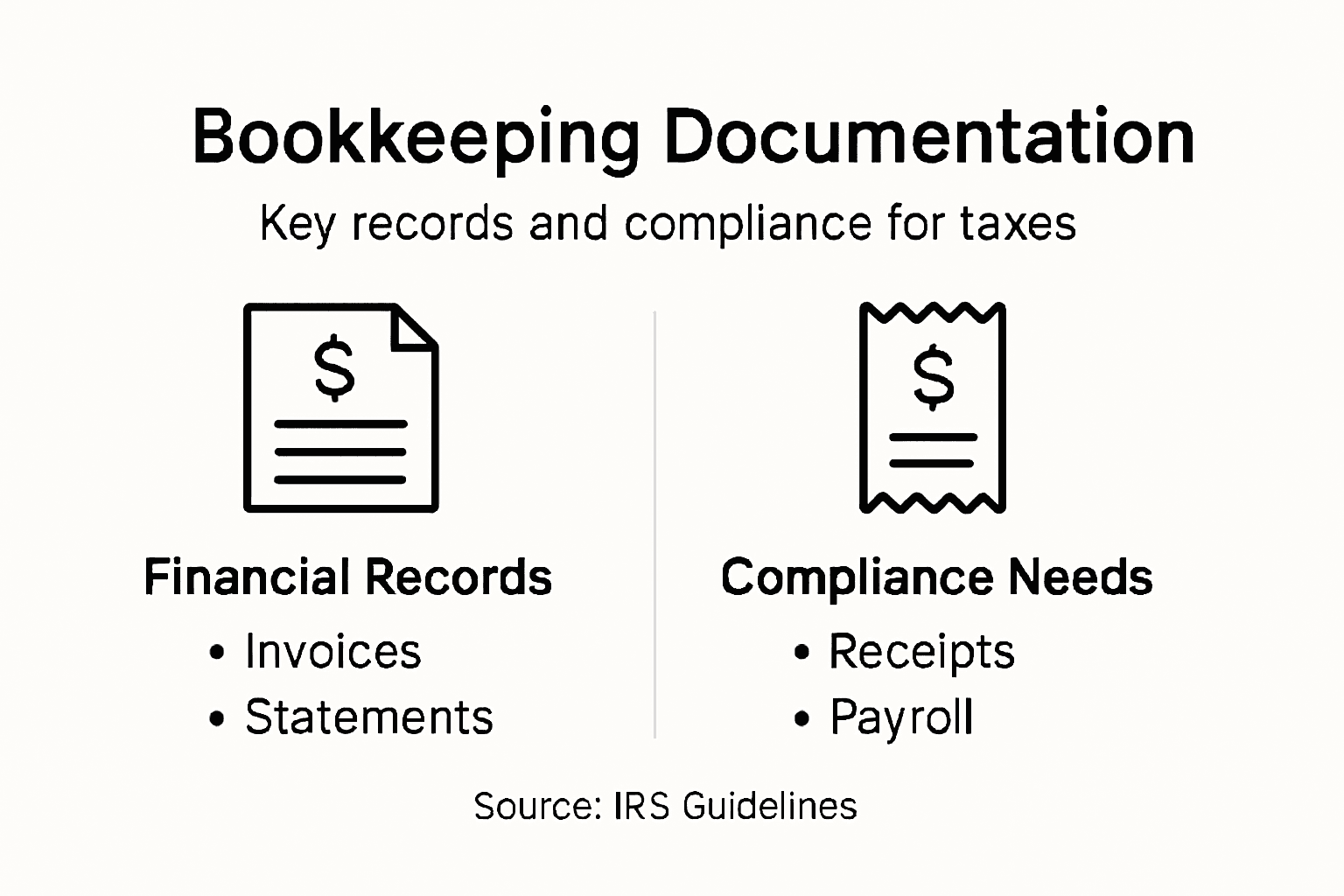
Small businesses must maintain several critical financial records to ensure accurate tax reporting and financial management. Businesses must maintain records that clearly show income and expenses, including supporting documents that validate financial transactions and tax deductions.
The most important financial records for small businesses include:
- Gross receipts documenting all income sources
- Purchase records tracking business expenses
- Expense documentation with detailed receipts and invoices
- Payroll records showing employee compensation
- Bank statements reflecting financial transactions
- Asset registers tracking business equipment and investments
Key financial documents provide crucial insights into business performance. Financial statements offer detailed perspectives on business health and help entrepreneurs make informed decisions. These documents typically include the income statement, balance sheet, cash flow statement, and accounts receivable aging report.
Organizing and preserving these financial records is not just a best practice—it’s a legal requirement. Business owners should develop a systematic approach to document storage, ensuring all records are easily accessible, securely maintained, and retained for the appropriate duration specified by tax regulations.

Pro tip: Digitize your financial documents and implement a cloud-based backup system to ensure long-term preservation and easy retrieval of critical business records.
Legal Compliance for Small Businesses
Small businesses face complex legal requirements that demand careful attention and systematic documentation. Small businesses must comply with federal, state, and local laws covering numerous aspects of business operations, from tax filings to employment regulations.
Key legal compliance areas for small businesses include:
- Tax reporting with accurate financial documentation
- Employment law adherence tracking employee records
- Business structure documentation maintaining official company records
- Permit and license management ensuring current regulatory credentials
- Environmental regulation compliance documenting required standards
Recordkeeping plays a critical role in legal compliance. Maintaining accurate records helps businesses prove financial transactions and supports potential tax audits or legal reviews. Proper documentation demonstrates a company’s commitment to transparency and regulatory standards.
Businesses must develop comprehensive record management strategies that include systematic document storage, regular review processes, and secure preservation of critical financial and operational information. This approach not only ensures legal compliance but also provides valuable insights into business performance and potential areas of improvement.
Here’s a quick reference for legal compliance document types and their business impact:
| Compliance Area | Key Document Example | Business Impact |
|---|---|---|
| Tax Reporting | Tax return forms | Ensures timely IRS filings |
| Employment Law | Employee contracts | Reduces risk of labor disputes |
| Business Structure | Incorporation certificates | Demonstrates legal entity status |
| Permit Management | Current business licenses | Avoids penalties and business closure |
| Environmental Compliance | Regulatory audit reports | Supports green certifications |
Pro tip: Create a dedicated compliance calendar that tracks all regulatory deadlines, renewal dates, and documentation requirements for your specific business structure and industry.
Streamlining Tax Preparation and Audits
Successful tax preparation requires meticulous documentation and strategic financial record management. IRS Audit Techniques Guides provide detailed procedures for evaluating business income, deductions, and compliance with tax regulations.
Key strategies for streamlining tax preparation include:
- Consistent record organization with digital and physical backups
- Comprehensive transaction documentation including receipts and invoices
- Quarterly financial reconciliation to identify potential issues early
- Systematic expense categorization for accurate tax reporting
- Secure document retention following IRS recommended timelines
Audit readiness demands proactive documentation practices. The IRS auditing process examines available books and records to verify financial transactions and ensure regulatory compliance. Small businesses can significantly reduce audit stress by maintaining transparent, well-organized financial documentation.
Implementing robust bookkeeping systems that automate record tracking, generate detailed financial reports, and provide clear audit trails can transform tax preparation from a stressful event into a straightforward administrative task. The goal is creating a comprehensive financial narrative that demonstrates fiscal responsibility and operational transparency.
Below is a summary of best practices for audit readiness and their benefits:
| Practice | Why It Matters | Benefit to Small Businesses |
|---|---|---|
| Regular Reconciliation | Detects errors promptly | Minimizes audit adjustments |
| Digital Record Keeping | Enhances organization | Speeds up document retrieval |
| Expense Categorization | Increases tax accuracy | Maximizes eligible deductions |
| Document Backup | Prevents loss from disasters | Protects against data misplacement |
Pro tip: Develop a standardized digital filing system that automatically tags and categorizes financial documents, making tax preparation and potential audits significantly more manageable.
Avoiding Common Documentation Mistakes
Small businesses frequently encounter documentation challenges that can compromise their financial integrity and tax reporting. Common bookkeeping documentation mistakes can significantly increase audit risks, making proactive error prevention crucial for long-term financial health.
Most prevalent documentation mistakes include:
- Neglecting small receipts under $75
- Inconsistent expense tracking for reimbursable costs
- Misclassifying workers as employees or contractors
- Poor communication with bookkeeping professionals
- Irregular bank reconciliation processes
- Incomplete record preservation
Documentation requires meticulous attention to detail. Good documentation practices emphasize maintaining attributable and accurate records that demonstrate financial transparency and compliance. Businesses must develop systematic approaches to recording, storing, and verifying financial transactions to minimize potential errors.
Establishing robust documentation protocols involves creating standardized processes, leveraging digital tracking tools, and implementing regular review mechanisms. By developing a disciplined approach to financial record management, small businesses can transform potential documentation pitfalls into opportunities for improved financial oversight.
Pro tip: Implement a monthly documentation audit where you systematically review and validate all financial records, catching potential errors before they become significant problems.
Take Control of Your Bookkeeping Documentation Today
Accurate documentation is the backbone of effective bookkeeping and tax preparation. If you are struggling with maintaining consistent records, categorizing expenses correctly, or organizing your financial documents for audit readiness, you are not alone. Many small business owners find themselves overwhelmed by the detailed demands of bookkeeping and tax compliance. At Kenworthy Bookkeeping, we specialize in transforming these challenges into streamlined solutions by leveraging QuickBooks Online to manage your financial records with precision and care.

Ready to regain control and reduce tax season stress? Discover how our expert team can handle your bank reconciliations, generate clear P&L reports, and prepare your documents for smooth tax filing. Don’t wait until the last minute. Take the first step toward effortless bookkeeping by scheduling your personalized consultation at Kenworthy Bookkeeping today. Learn more about our comprehensive services and how we help Kansas City small businesses stay compliant and confident at Consult Our Experts.
Frequently Asked Questions
What is the role of documentation in bookkeeping?
Documentation in bookkeeping serves as the systematic recording and organization of a business’s financial transactions, critical for understanding financial health and performance.
How does bookkeeping documentation impact tax preparation?
Accurate bookkeeping documentation supports tax preparation by providing proper records of income and expenses, which facilitates compliance with tax regulations and helps maximize eligible deductions.
What are the essential types of financial records needed for bookkeeping?
Essential financial records include gross receipts, purchase records, expense documentation, payroll records, bank statements, and asset registers, all of which are vital for accurate tax reporting.
How can small businesses avoid common documentation mistakes?
Small businesses can avoid documentation mistakes by establishing systematic processes for recording, storing, and reviewing financial transactions, ensuring that all records are accurate and complete.