

Role of Bookkeeping in Forecasting Business Growth
Running a small service business in Kansas City means every financial decision counts. Without a clear record of past income and expenses, financial forecasting often feels like guesswork rather than strategy. Solid bookkeeping practices give you a real foundation for predicting your company’s future, helping you make smarter choices about hiring, budgeting, or navigating unexpected challenges. This guide highlights how accurate records turn confusion into clarity, making planning for growth more practical for businesses like yours.
Table of Contents
- Bookkeeping Basics For Financial Forecasting
- Key Forecasting Methods Used By Bookkeepers
- How Accurate Data Enables Reliable Forecasts
- Common Pitfalls And Mistakes To Avoid
- Practical Steps For Small Business Success
Key Takeaways
| Point | Details |
|---|---|
| Accurate Bookkeeping is Essential | A systematic bookkeeping process is crucial for reliable financial forecasting and strategic decision-making. |
| Utilize Multiple Forecasting Techniques | Combining various methods enhances the accuracy and robustness of financial projections, leading to better business strategies. |
| Regular Financial Review is Critical | Implementing routine audits of financial records and forecasts helps catch errors early and refine strategic planning. |
| Invest in Financial Training | Continuous learning in bookkeeping and financial management practices is vital for adapting to changing business dynamics. |
Bookkeeping Basics for Financial Forecasting
Financial forecasting transforms historical financial data into strategic roadmaps for business growth. At its core, accurate bookkeeping serves as the foundational framework that enables precise predictions about a company’s financial trajectory. By systematically recording and categorizing financial transactions, small businesses create a reliable data infrastructure essential for making informed strategic decisions.
The process of financial forecasting relies heavily on meticulously maintained financial records. Businesses utilize historical financial data to project future revenue, anticipate potential expenses, and develop comprehensive financial strategies. This approach allows entrepreneurs to:
- Understand current financial performance
- Identify potential growth opportunities
- Predict cash flow challenges
- Make informed budgeting decisions
- Evaluate financial risks proactively
Successful financial forecasting requires more than just number tracking. It demands a strategic approach that transforms raw financial data into actionable insights. Small business owners must develop a systematic bookkeeping process that captures every financial transaction with precision, creating a clear narrative of their business’s financial health.
Accurate bookkeeping isn’t just about recording numbers – it’s about creating a financial roadmap for sustainable business growth.
Businesses can leverage different forecasting techniques, including trend analysis, regression modeling, and comparative methods. Each technique relies on comprehensive, well-organized financial records that provide a transparent view of past performance. Budgeting and forecasting techniques help businesses optimize operations by transforming historical data into predictive models.

Pro tip: Invest in a consistent bookkeeping system that automatically categorizes transactions and generates regular financial reports to streamline your forecasting process.
The following table summarizes essential features to look for in a small business bookkeeping system:
| Feature | Why It Matters | Business Benefit |
|---|---|---|
| Automated Categorization | Enhances accuracy and saves time | Reduces human error |
| Regular Reporting | Ensures up-to-date financial status | Better decision-making |
| Cloud Integration | Enables real-time access | Supports remote collaboration |
| Audit Trail | Tracks all edits or changes | Ensures transparency |
Key Forecasting Methods Used by Bookkeepers
Bookkeepers employ sophisticated techniques to transform raw financial data into predictive insights that drive strategic business decisions. Financial forecasting is a critical skill that requires mastery of multiple analytical approaches, each designed to uncover different aspects of a company’s potential financial trajectory.
One of the most powerful forecasting techniques is time series analysis and forecasting, which allows bookkeepers to identify patterns and trends in financial data over specific time periods. This method helps businesses understand:
- Seasonal revenue fluctuations
- Consistent expense patterns
- Potential growth trajectories
- Cyclical financial behaviors
- Emerging market trends
Professional bookkeepers leverage multiple sophisticated methods to generate accurate financial predictions. Dynamic factor models and nowcasting represent advanced techniques that allow for complex financial analysis, enabling businesses to develop nuanced understanding of their potential financial future.
Effective forecasting transforms historical numbers into strategic roadmaps for business growth.
The most common forecasting techniques include ARIMA modeling, exponential smoothing, and regression analysis. Each method offers unique insights, helping bookkeepers provide comprehensive financial projections that support critical business planning and decision-making processes.
Here’s a comparison of common financial forecasting methods and their business applications:
| Method | Main Purpose | Best For |
|---|---|---|
| Time Series Analysis | Identifying patterns over time | Seasonal sales or expenses |
| Regression Modeling | Predicting variable impact | Forecasting sales influences |
| Exponential Smoothing | Smoothing out short-term noise | Short-term, stable projections |
| ARIMA Modeling | Modeling complex trends | Long-term trend forecasting |
Pro tip: Combine multiple forecasting methods to create more robust and reliable financial predictions, cross-referencing results to enhance accuracy.
How Accurate Data Enables Reliable Forecasts
Financial forecasting is fundamentally a data-driven process where the quality of predictions directly correlates with the accuracy and comprehensiveness of underlying financial records. Small businesses must recognize that their bookkeeping practices serve as the critical foundation for generating trustworthy financial projections.
Data collection techniques play a pivotal role in creating reliable forecasts. Accurate bookkeeping involves capturing financial information with precision, ensuring that every transaction is:
- Recorded systematically
- Categorized correctly
- Dated precisely
- Validated against source documents
- Tracked consistently
The integrity of financial data determines the reliability of forecasting models. Improvements in data processing have dramatically enhanced the ability of businesses to generate more accurate predictions, much like how technological advancements have improved scientific forecasting techniques.
The reliability of a financial forecast is only as strong as the data foundation it is built upon.
Businesses must implement rigorous data validation processes to ensure the accuracy of their financial records. This involves cross-referencing bank statements, maintaining detailed transaction logs, and developing systematic approaches to documenting financial activities.
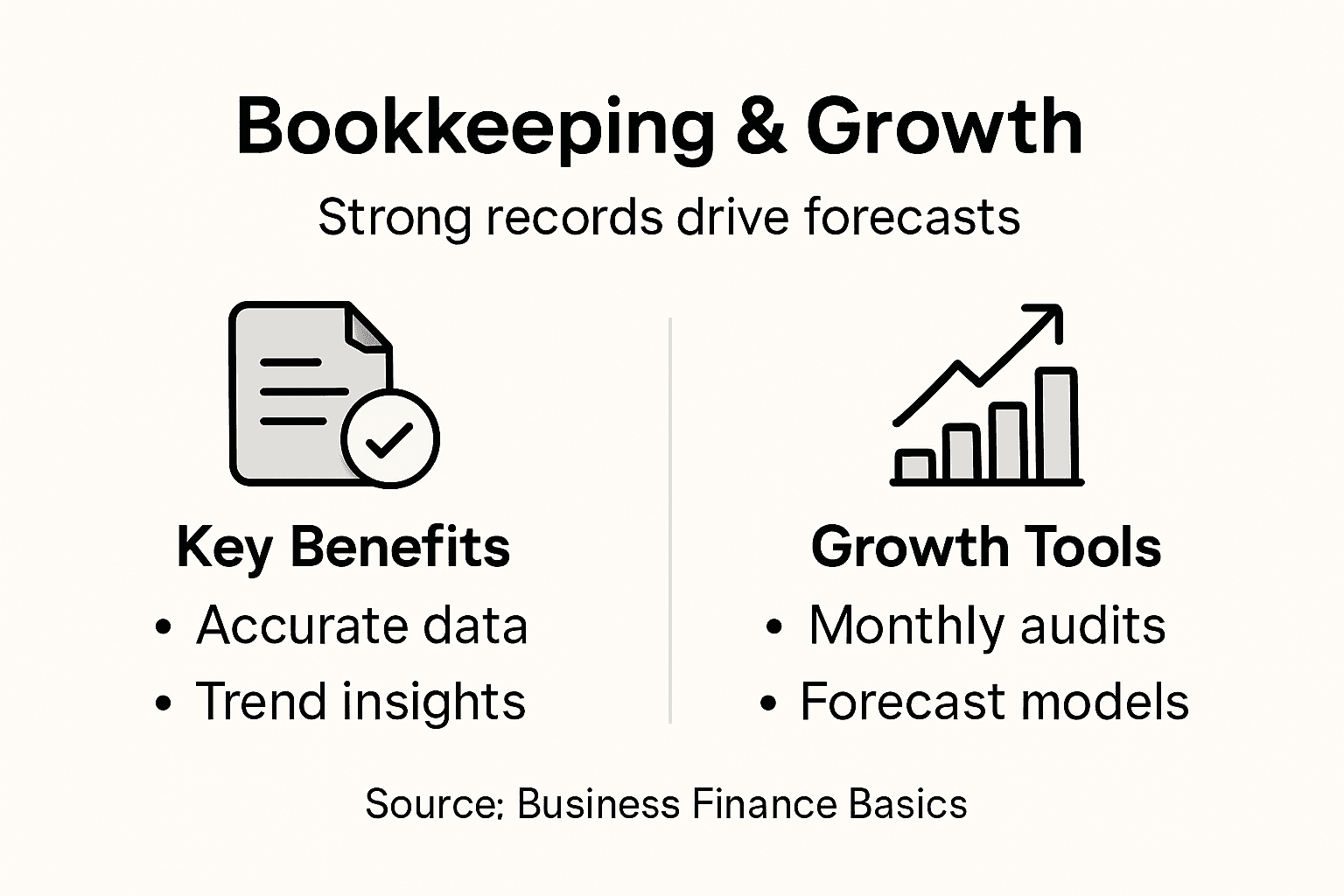
Pro tip: Implement a monthly data audit process to verify the accuracy and completeness of your financial records, catching potential errors before they impact forecasting.
Common Pitfalls and Mistakes to Avoid
Financial forecasting can quickly become a minefield of potential errors that undermine a small business’s strategic planning. Understanding and anticipating these common mistakes is crucial for maintaining accurate financial projections and making informed business decisions.
Small business recordkeeping challenges often emerge from several critical areas of weakness. Businesses frequently encounter pitfalls such as:
- Mixing personal and business finances
- Inconsistent transaction categorization
- Neglecting regular account reconciliation
- Failing to maintain comprehensive documentation
- Overlooking minor financial discrepancies
Recordkeeping compliance requirements highlight the importance of systematic documentation. Many businesses inadvertently compromise their financial integrity by failing to establish robust tracking mechanisms that capture every financial transaction with precision and clarity.
Small financial errors today can translate into significant strategic miscalculations tomorrow.
Forecasting mistakes often stem from unrealistic assumptions, outdated data, and a lack of regular review and adjustment. Successful businesses develop a proactive approach to financial management, continuously validating their assumptions and updating their predictive models based on current market conditions and internal performance metrics.
Pro tip: Create a quarterly financial review process that includes a comprehensive audit of your bookkeeping records and forecasting assumptions to catch and correct potential errors early.
Practical Steps for Small Business Success
Financial management is the backbone of sustainable business growth, requiring strategic planning and systematic approaches to bookkeeping and forecasting. Small business owners must develop a comprehensive financial strategy that transforms raw data into actionable insights.
Developing detailed business plans involves implementing key financial management practices that create a solid foundation for success. Entrepreneurs should focus on critical areas including:
- Establishing robust bookkeeping systems
- Creating accurate financial projections
- Implementing regular financial reviews
- Setting realistic budget targets
- Tracking key performance indicators
The U.S. Small Business Administration recommends strategic financial management approaches that help businesses navigate complex financial landscapes. This involves selecting appropriate accounting methods, maintaining organized records, and developing a proactive approach to financial planning.
Success in small business is not about predicting the future perfectly, but about creating flexible financial strategies that adapt to changing conditions.
Effective financial management requires continuous learning and adaptation. Business owners must remain committed to improving their financial literacy, leveraging available resources, and developing a deep understanding of their company’s financial dynamics.
Pro tip: Invest in quarterly financial training or consulting to stay updated on the latest bookkeeping techniques and forecasting strategies that can drive your business growth.
Strengthen Your Financial Forecasting with Expert Bookkeeping Support
Accurate bookkeeping is the backbone of reliable financial forecasting and sustainable business growth. If you struggle with maintaining consistent transaction categorization or need assistance with bank reconciliations and P&L reports, these challenges can undermine your ability to create actionable financial projections. Kenworthy Bookkeeping understands these pain points and offers specialized services tailored to small businesses striving to transform raw data into strategic roadmaps.

Take control of your business finances today by partnering with experts who prioritize precision and care. With our QuickBooks Online expertise and a commitment to boosting your profitability, you can overcome common pitfalls and ensure your forecasts are built on a solid data foundation. Get started with a personalized consultation at Kenworthy Bookkeeping and discover how streamlined bookkeeping empowers confident decision-making.
Frequently Asked Questions
How does bookkeeping impact financial forecasting?
Accurate bookkeeping provides the foundational data necessary for reliable financial forecasts. By systematically recording financial transactions, businesses can identify trends and make informed decisions about future growth.
What are the common pitfalls in financial forecasting?
Common pitfalls include mixing personal and business finances, inconsistent transaction categorization, neglecting regular account reconciliations, and failing to maintain comprehensive documentation, which can lead to inaccurate forecasts.
Which forecasting methods are beneficial for small businesses?
Some beneficial forecasting methods for small businesses include time series analysis, regression modeling, and exponential smoothing, as these techniques help provide valuable insights into future financial performance.
Why is data accuracy important for forecasting?
Data accuracy is crucial because the reliability of a financial forecast depends on the quality and completeness of financial records. Inaccurate data can lead to misguided business decisions and strategic errors.