

Role of Bookkeeping in Audits: Boosting Small Business Readiness
Juggling job sites and customer calls across Kansas City leaves little time for tracking receipts or matching up records. Still, skipping reliable bookkeeping can turn tax filings and audits into a high-stress scramble for any home service company owner. Effective bookkeeping builds the solid foundation that keeps your business organized, supports clean audit results, and protects your bottom line. This guide highlights how consistent, complete, and documented bookkeeping leads directly to fewer audit headaches and stronger financial control.
Table of Contents
- Bookkeeping Basics For Home Service Companies
- How Accurate Records Support Audit Processes
- Key Bookkeeping Tasks That Influence Audits
- Risks Of Poor Bookkeeping During Audits
- Best Practices For Audit-Ready Bookkeeping
Key Takeaways
| Point | Details |
|---|---|
| Importance of Accurate Bookkeeping | Maintaining clear and precise financial records is crucial for home service companies to avoid complications during audits. Regular documentation ensures that you can produce necessary proofs quickly and efficiently. |
| Bookkeeping Method Choice | Small home service businesses often benefit from using the cash basis method for its simplicity, while growth-oriented companies may prefer accrual accounting for a more comprehensive view of financial performance. |
| Regular Reviews and Reconciliation | Conducting monthly bank reconciliations and consistent bookkeeping reviews helps identify inconsistencies early, protecting against potential audit issues and ensuring financial clarity. |
| Establishing Internal Controls | Implementing internal control systems helps catch errors before they escalate, making your bookkeeping process more reliable and increasing audit readiness. |
Bookkeeping Basics for Home Service Companies
If you run a plumbing, electrical, HVAC, or lawn care business out of Kansas City, you already know that time is money. Every hour spent wrestling with spreadsheets is an hour you’re not on the job or bringing in revenue. Yet bookkeeping isn’t optional for home service companies. It’s the foundation that separates businesses that stay in control from those that spiral into financial chaos when audit season arrives.
Think of bookkeeping as the daily maintenance for your business finances. Just like you wouldn’t skip checking your truck’s oil and tires before heading out on calls, you can’t skip recording your income and expenses. Recording financial transactions accurately from day one means you’re not scrambling weeks later trying to piece together receipts and memory. For home service companies specifically, this includes tracking service revenues by customer, recording labor costs, and documenting materials used on each job. If you work from home and claim a home office deduction, you’ll need to track home expenses too. The IRS provides detailed guidance on business use of your home, including what qualifies as a deductible business expense.
Here’s what your bookkeeping fundamentals should cover:
Here’s how cash and accrual bookkeeping methods compare for home service companies:
| Aspect | Cash Basis | Accrual Basis |
|---|---|---|
| Timing of Recording | When money is exchanged | When revenue/expense is earned |
| Complexity | Simple to manage | Requires more tracking |
| Common Users | Small home service businesses | Larger or growing businesses |
| Tax Reporting | Matches cash flow | Matches economic activity |
| Financial Insight | Shows cash position | Shows total financial performance |
- Choosing your method: You can track expenses using cash basis (recording when money changes hands) or accrual basis (recording when you earn the revenue, not when you get paid). Most small home service companies use cash basis because it’s simpler and more intuitive
- Setting up ledgers: Create separate categories for income sources, vehicle expenses, equipment purchases, supplies, labor costs, and home office expenses if applicable
- Regular reconciliation: Match your bank statements and credit card statements against what you’ve recorded weekly or twice monthly. This catches errors before they compound
- Organizing receipts: Keep digital or physical copies of every expense receipt, invoice, and payment record. For audit purposes, you need proof of what you spent
- Tracking by job or project: If you bill customers individually, track which expenses belong to which job. This gives you real data about your actual profit per service call
The reality is that auditors don’t ask for a perfectly organized system. They ask for consistency, completeness, and proof. If you recorded your January expenses in one way and your February expenses in another way, you’ve created problems. If you claimed deductions but can’t produce receipts, you’ve created bigger problems. If you can’t explain why a $500 charge appears in your records, you’ve created the biggest problem.
When you work with QuickBooks Online or a similar system designed for small businesses, you’re already ahead. These platforms create an automatic trail of what was recorded, when it was recorded, and by whom. That transparency is exactly what auditors want to see. It also means you can pull up your profit and loss statement any time you need to make a business decision, rather than guessing based on how busy you feel.
Many home service owners put off bookkeeping thinking they’ll deal with it during tax season. That approach guarantees stress. Instead, the goal is to master weekly bookkeeping tasks so that fifteen minutes a week keeps everything current. By the time an audit notice arrives, your books are already clean and ready.
Pro tip: Set up a recurring weekly reminder to reconcile your bank account and record any pending expenses every Friday afternoon. Fifteen minutes of consistency now saves you fifteen hours of scrambling during audit season.
How Accurate Records Support Audit Processes
When an auditor walks into your office, they’re not coming to judge you. They’re coming to verify. Their job is to examine your financial records and determine whether your business is reporting income and expenses accurately. This is where the bookkeeping you’ve been maintaining becomes either your greatest asset or your worst nightmare. Accurate records transform an audit from a stressful investigation into a straightforward verification process.

Think about what an auditor actually needs to do their job. They need to examine transactions, verify amounts, trace expenses back to supporting documents, and confirm that your financial statements match reality. Accurate record examination allows them to perform these tasks efficiently and confidently. Without detailed, organized records, an auditor has to dig through months of chaos trying to piece together what happened. They’ll ask for the same document five times. They’ll request bank statements, credit card statements, invoices, and receipts. They’ll spend hours on work that could have taken minutes if your books were clean from the start. That wasted time adds up, and it increases the chance they’ll find discrepancies simply because everything is confusing. When your records are accurate and well organized, auditors can quickly verify that your income matches your bank deposits, your expenses are properly supported by receipts, and your account balances are correct.
Here’s what accurate records enable during an audit:
- Risk assessment: Auditors can identify unusual transactions or patterns quickly when records are clear and consistent
- Substantive testing: They can select transactions to examine in detail and trace them from your records back to supporting documents without friction
- Internal control evaluation: They can assess whether your bookkeeping system has built in safeguards against errors and fraud
- Efficient documentation: They spend less time hunting for information and more time analyzing what you’ve already documented
- Reduced audit scope: When records are reliable, auditors may not need to test as many transactions or ask as many questions
The relationship between record accuracy and audit reliability works both ways. Sufficient, appropriate evidence from your financial records gives auditors confidence in their conclusions. If your bank reconciliations are accurate and up to date, they can trust your cash balance. If your expense receipts are organized and matched to your ledger entries, they can trust your deductions. If your job tracking shows which materials and labor went into each service call, they can trust your profit calculations by project. This confidence protects you because it means the audit report will reflect the true financial picture of your business.
Many small business owners think accurate records are mainly a tax issue. They’re not wrong, but they’re also missing the bigger picture. Accurate records during an audit protect you by showing that you’ve been responsible and intentional about your finances. They demonstrate that you’re not hiding anything, that you haven’t been sloppy, and that you take your business seriously. When auditors see organized, detailed records, they see a business owner who knows what’s happening in their own company. When they see a mess, they start wondering what you’re trying to hide, even if you’re not.
One practical reality: if you work with a bookkeeper or accounting service that maintains your records using systems like QuickBooks Online, you’ve already positioned yourself for audit success. These platforms create automatic audit trails. They track who recorded what, when it was recorded, and whether anything was changed. They generate reconciliation reports and transaction details on demand. When an auditor requests to see your sales journal or your expense ledger, you can pull it up in seconds. Account reconciliation becomes a documented process rather than a guess. This level of transparency and detail is exactly what auditors are looking for.
The cost of fixing problems after an audit finds them is always higher than the cost of maintaining accurate records from the start. If an auditor discovers that you’ve been misclassifying expenses or that your cash balance doesn’t match your records, you’re facing corrections, potential penalties, and questions about your credibility. If an auditor finds everything in order, the audit closes cleanly and you can move forward with confidence.
Pro tip: Keep a folder (digital or physical) labeled “Audit Ready” where you store your bank statements, account reconciliations, and year to date P&L statements. Updating this folder monthly takes thirty minutes and means you can produce an audit ready package in less than an hour if needed.
Key Bookkeeping Tasks That Influence Audits
Not all bookkeeping tasks carry equal weight when an auditor shows up. Some activities are audit critical, meaning they directly determine whether an auditor can verify your financial statements or will instead uncover problems. Understanding which tasks matter most helps you prioritize your bookkeeping efforts and position your business for a smooth audit. The good news is that the tasks that matter most for audits are the same ones that keep your business running smoothly throughout the year.
Start with transaction recording, the foundation of everything. Every invoice you send, every bill you pay, every transfer between accounts needs to be recorded accurately and on time. This isn’t busywork. When auditors examine your financial statements, they’re looking at summaries of thousands of individual transactions. If those transactions are recorded incorrectly or incompletely, the summaries are wrong. Recording all financial transactions with precision and consistency is the first step. For home service companies, this means capturing service revenue when you perform work, recording material costs when you purchase supplies, and logging labor expenses when you pay your crew. If you’re sloppy here, everything downstream suffers. A transaction recorded in the wrong account, or recorded twice, or recorded with an incorrect amount creates a cascade of problems that auditors will notice.
Bank reconciliations come next. This is where you match your accounting records to what actually happened in your bank account. Once a month, your bank statement arrives showing deposits, withdrawals, and the ending balance. You take that statement and compare it to your records. They should match. If they don’t, you investigate and find the difference. For auditors, bank reconciliations are a massive red flag detector. If your records don’t match your bank statement, there’s a problem. Maybe you recorded a deposit that never actually hit the account. Maybe you forgot to record a check you wrote. Maybe someone withdrew money you didn’t authorize. Whatever the issue, an auditor can’t trust your cash balance if your reconciliation is incomplete or inaccurate. Home service companies with multiple crew members, multiple payment methods, and irregular income need especially diligent reconciliation. One unreconc iled bank statement creates doubt about everything else.
Here’s what auditors focus on with bookkeeping tasks:
- Account reconciliations: Beyond just your bank account, auditors check whether your credit card accounts, loan balances, and other accounts match between your records and the actual statements from lenders or card companies
- Payroll accuracy: If you have employees, your payroll records must be complete and correct, including gross wages, taxes withheld, and payments to tax authorities
- Documentation trails: Auditors want to see that you can trace any transaction from your financial statements back to the original supporting document (invoice, receipt, bank statement, etc.)
- Journal entries: Any adjustments you made to your records need clear explanations and supporting documentation
- Account classifications: Expenses must be categorized consistently in the same accounts every time, so auditors can understand what each account represents
The reality is that auditors evaluate internal controls and accuracy of financial documents during the audit process. They’re checking whether your bookkeeping system caught errors before they became big problems. If you have monthly reconciliations that caught discrepancies, that’s good. If you catch and correct entries regularly, that’s good. If you maintain organized documentation for every transaction, that’s good. These practices show that your bookkeeping system works.
Many business owners think they can do basic bookkeeping and outsource the rest. That approach works if you’re recording transactions consistently and maintaining complete documentation. But if you’re recording haphazardly and skipping reconciliations, outsourcing just spreads the problem. A bookkeeper can’t fix sloppy transaction entry. They can organize and clean up, but prevention is always better. The role of bookkeeping for your business goes beyond tax preparation. It directly impacts your audit readiness, your business decision making, and your financial control.
One practical insight: the bookkeeping tasks that take the most time are usually the ones that matter most for audits. Bank reconciliation takes time. Documentation organization takes time. Transaction recording done carefully takes time. But that time investment protects you during an audit. When auditors see meticulous reconciliations and organized documentation, they spend less time questioning your numbers and more time wrapping up the audit. The business owner who invests in proper bookkeeping throughout the year pays less for audits, gets cleaner audit results, and sleeps better knowing their books are in order.
Pro tip: Schedule your bank reconciliations for the same day each month, immediately after your bank statements arrive. Reconciling while the transactions are fresh in your mind takes half the time and catches errors faster than waiting weeks.
Risks of Poor Bookkeeping During Audits
Poor bookkeeping doesn’t just make your audit harder. It creates actual financial and legal risks that can damage your business long after the audit ends. When your records are messy, incomplete, or inaccurate, you’re not just inconveniencing an auditor. You’re exposing yourself to audit findings that can trigger penalties, damage your credibility with lenders and customers, and create questions about whether you’re even in control of your own business.
Start with the most obvious risk: audit adjustments and corrections. If your bookkeeping is sloppy, auditors will find errors. When they find errors, they document them. Sometimes they adjust your financial statements to reflect the correct numbers. Other times they note the errors and ask you to correct them. Either way, you’re now on record as having made mistakes. For home service companies, this is particularly dangerous because your profit margins are often tight. An auditor who finds that you’ve been misclassifying expenses might conclude you’ve been overstating profits by thousands of dollars. You then have to either agree to the correction or argue against it. Both options are bad. The correction makes your business look less profitable than you thought. Arguing against it makes you look evasive.
Then there’s the issue of audit opinion risk. Auditors issue opinions about whether your financial statements are accurate and presented fairly. If your bookkeeping is so poor that auditors can’t determine the true numbers, they can’t issue a clean opinion. Instead, they issue a qualified opinion (meaning “we found problems”) or worse, a disclaimer (meaning “we can’t form an opinion at all”). A qualified or disclaimed opinion is a red flag to anyone reading your financial statements. Lenders see it and worry about lending to you. Potential business partners see it and question whether they can trust your numbers. Customers see it and wonder if you’re financially stable. Poor bookkeeping increases risks of errors during audits that can lead auditors to issue incorrect opinions.
Here’s where poor bookkeeping creates specific audit risks:
- Material misstatements go undetected: When your records are disorganized, errors hide in plain sight. An auditor might miss a significant problem because they’re overwhelmed by the chaos of your records
- Internal control failures: Auditors specifically look for whether your bookkeeping system catches errors automatically. Poor bookkeeping means you have no controls. Auditors will document this as a significant deficiency
- Increased audit scope and cost: When auditors encounter disorganization, they have to test more transactions and ask more questions. Your audit takes longer and costs more money
- Fraud vulnerabilities: Sloppy bookkeeping makes it easier for someone to steal from your business without detection. Auditors will flag this risk in their audit report
- Compliance violations: If you’ve been missing tax filings or misreporting to regulatory agencies because your records are poor, auditors will discover this
One critical reality that many business owners don’t understand: material weaknesses and significant deficiencies in internal controls identified during audits have consequences beyond just the audit itself. These findings get reported to management and sometimes to governing bodies or regulators. They create a paper trail showing that your business has control problems. If you’re ever audited again, auditors will look at your previous audit findings and assume you still have the same problems unless you can prove you fixed them. You’ve essentially created ongoing scrutiny that follows your business.
For small business owners, there’s also the issue of lending and financing risk. Banks and lenders require financial statements before they’ll extend credit. If your most recent audit shows problems or has a qualified opinion, you’re going to have a much harder time getting approved for loans. The bank sees audit findings as a sign that you’re either incompetent or dishonest. Either way, you’re riskier to lend to. This matters when you need to finance equipment, vehicles, or expansion. Poor bookkeeping that causes audit problems can literally prevent you from growing your business.
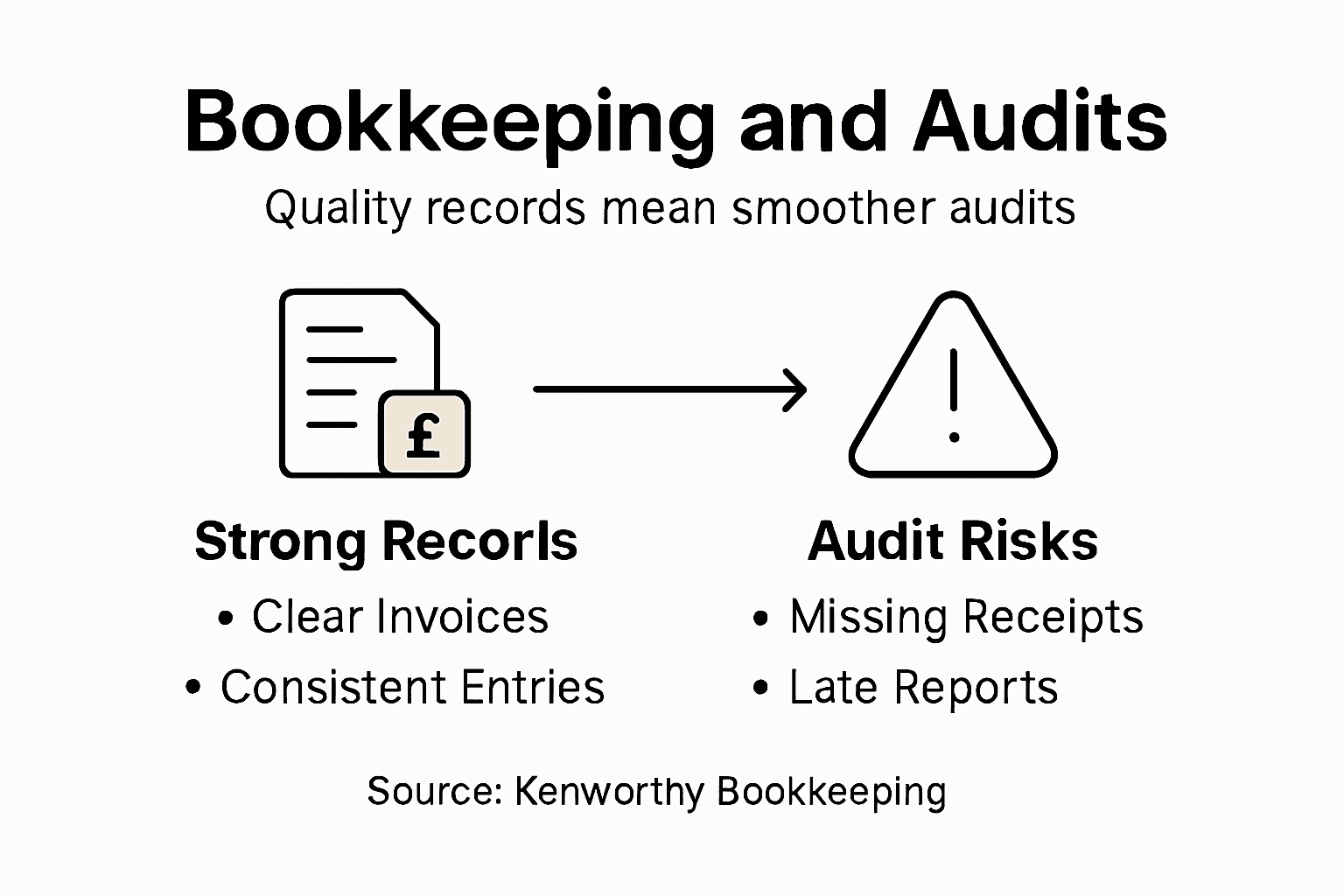
Then there’s the psychological and reputational impact that often gets overlooked. An audit that reveals problems is stressful. It puts you in a defensive position. You spend time explaining failures instead of focusing on your business. Employees wonder if the company is in trouble. You lose credibility internally. Owners of home service companies are often hands on and detail oriented. When an audit reveals that your bookkeeping is a mess, it feels like a personal failure. That emotional toll adds up. The business owner who maintains good bookkeeping avoids this entirely. They walk into an audit confident that their records are clean.
One final risk that ties everything together: audit costs skyrocket when bookkeeping is poor. A clean set of books might result in a twenty hour audit. Messy books might result in a fifty hour audit. That’s three times longer, which means three times the cost. And you’re paying for those extra hours while an auditor is digging through your chaos trying to figure out what you actually spent or earned. Over a business lifetime, the cost difference between maintaining good bookkeeping and fixing it after audits is substantial. Good bookkeeping is not an expense. It’s an investment in avoiding much larger expenses later.
The following table summarizes consequences of poor vs. good bookkeeping during audits:
| Bookkeeping Quality | Audit Outcome | Financial Impact |
|---|---|---|
| Good | Quick, clean audit; few corrections | Lower costs, fewer penalties |
| Poor | Long, difficult audit; many findings | Higher costs, possible fines |
| Good | Auditor has high confidence | Easier loan approval |
| Poor | Auditor questions accuracy | Can lose lender trust |
Pro tip: Before your audit starts, pull together a summary of any known issues or changes in your bookkeeping from the past year. Tell your auditor upfront about problems you found and corrected. Transparency reduces surprises and often reduces audit scope because auditors can focus on what actually matters rather than hunting for hidden issues.
Best Practices for Audit-Ready Bookkeeping
Building an audit-ready bookkeeping system isn’t complicated, but it does require intention. You’re not trying to create something perfect. You’re trying to create something consistent, complete, and traceable. When you follow best practices from the start, audits become routine events rather than stressful investigations. Your business stays in control of its finances, and auditors can do their job efficiently.
Start with documentation and organization. Comprehensive and accurate documentation is the foundation of audit readiness. This means every transaction has supporting evidence. When you record a $500 expense, you keep the receipt. When you record revenue from a service call, you keep the invoice or proof of payment. When you make a journal entry to adjust something in your records, you document why you made that adjustment. For home service companies, this looks like keeping organized files of invoices sent to customers, receipts from supply purchases, payroll records, vehicle maintenance receipts, and anything else that proves what money came in and what money went out. Digital storage works fine. Physical folders work fine. What matters is that if an auditor asks “show me proof of this $800 expense,” you can produce it in less than five minutes. No hunting. No excuses. Just proof.
Internal controls are your second foundation. These are the systems and processes that catch errors before they become audit problems. A simple example: before you pay a bill, someone other than the person who received the invoice verifies that the amount is correct and the service was actually provided. Another example: your bank reconciliation is done by someone other than the person who records transactions. These controls don’t have to be elaborate. They just have to exist. Establishing internal controls demonstrates that your bookkeeping system has built-in safeguards. Auditors specifically look for this. When they see controls, they see a business owner who takes finances seriously. When they don’t see controls, they wonder what you’re trying to hide.
Here’s what audit-ready bookkeeping looks like in practice:
- Monthly reconciliations: Reconcile your bank account, credit card accounts, and loan balances every month. Match your records to the actual statements from your financial institutions. Document any differences and resolve them immediately
- Chart of accounts consistency: Use the same account categories month after month. Never randomly move an expense to a different category. If you need to change your chart of accounts, do it intentionally and document the change
- Transaction dating accuracy: Record transactions on the date they occurred, not the date you got around to entering them. Accurate dating helps auditors understand cash flow and timing
- Journal entry documentation: Any adjusting entries get explained in writing. You don’t just move $500 from one account to another. You document why you did it
- Backup and retention: Keep copies of your records for at least seven years. Digital backups, printed statements, organized folders. You need to be able to produce historical records if questions come up
One practice that separates audit-ready businesses from unprepared ones is the audit liaison appointment. Appointing an audit liaison who handles all communication with auditors makes the process smoother. This person knows your books, understands your business, and can answer questions quickly. For small home service companies, this might be you, or it might be your bookkeeper or accountant. Either way, designate one person as the point of contact. Auditors will send questions to this person. This person gathers the information and responds promptly. No back and forth between multiple people. No missed communications. Just clear, direct contact.
Responding promptly to auditor requests matters more than most business owners realize. When an auditor asks for information, they’re on a timeline. They’ve scheduled your audit for specific dates. If you delay providing information, you either compress their work into less time (which increases the chance they’ll find problems) or you push the audit timeline back (which costs you more money). Audit-ready businesses keep documents organized so they can provide what auditors ask for in days, not weeks. This speed demonstrates preparedness and often leads to a more focused, efficient audit.
One additional best practice that ties everything together: regular bookkeeping reviews. Don’t wait until audit season to look at your financial statements. Regular bookkeeping reviews throughout the year catch problems early when they’re easier to fix. Pull your profit and loss statement quarterly. Look at your expense categories. Does anything seem wrong? Are you categorizing similar expenses in different accounts? Did revenue drop unexpectedly? Are certain expenses higher than they should be? These quarterly reviews keep you on top of your finances and prevent surprises during audits. You catch your own problems before auditors do.
The cumulative effect of these practices is significant. A business owner who maintains clean records, establishes controls, appoints a clear audit liaison, responds quickly to requests, and reviews finances regularly walks into an audit with confidence. The audit happens smoothly. The auditor finds no material problems. The business gets a clean opinion. Financing becomes easier. Lender relationships strengthen. The business owner sleeps well knowing everything is in order. That’s what audit-ready bookkeeping delivers.
Pro tip: Create a simple one page checklist of your key bookkeeping practices and review it monthly. Include items like “reconciliation completed,” “receipts organized,” “no unreconciled transactions,” and “P&L reviewed.” Check off each item monthly. This fifteen minute exercise keeps you on track and ensures nothing slips through.
Take Control of Your Audit Readiness with Expert Bookkeeping Support
Managing accurate, organized bookkeeping can feel overwhelming for home service business owners, especially when audit season looms. The article highlights key pain points like staying consistent with transaction recording, conducting timely bank reconciliations, and maintaining an audit-ready documentation trail. These challenges can create costly audit delays, frustrated business owners, and increased risk of financial penalties. If you want to eliminate the stress that poor bookkeeping causes during audits and gain clear financial insight, expert help is the answer.
Kenworthy Bookkeeping specializes in making your bookkeeping effortless and audit-ready, with hands-on services designed for small businesses in Kansas City using QuickBooks Online. Our team handles everything from categorization to reconciliation and profit and loss reporting so you can focus on growing your company with confidence. Stop worrying about last-minute audit scrambles and start experiencing the benefits of a clean, transparent bookkeeping system that auditors trust.
Explore our expert bookkeeping services

Ready to boost your audit confidence and regain control of your finances today Discover how working with Kenworthy Bookkeeping can simplify your bookkeeping and prepare your business for any audit Get started by scheduling your personal consultation now at Kenworthy Bookkeeping Consultations and make your bookkeeping worries a thing of the past.
Frequently Asked Questions
What is the role of bookkeeping in preparing for an audit?
Bookkeeping helps ensure accurate and organized financial records, which makes the audit process more efficient. Consistent and complete bookkeeping allows auditors to verify your financial statements quickly and reduces the likelihood of errors or discrepancies.
How can accurate records influence the audit process?
Accurate records provide auditors with a clear view of your financial situation, allowing them to verify income and expenses easily. This transparency can lead to a smoother and quicker audit process, minimizing adjustments and reducing potential penalties.
What are some best practices for maintaining audit-ready bookkeeping?
Best practices include regular bank reconciliations, consistent account classifications, thorough documentation of transactions, and establishing internal controls. Appointing an audit liaison to handle communication with auditors can also streamline the process.
What are the consequences of poor bookkeeping during audits?
Poor bookkeeping can lead to longer audits, increased costs, potential penalties, and a negative impact on your business’s credibility. Disorganized records may result in misstatements and issues with loan approvals, which can hinder business growth.