
Why monitor accounts receivable for cash flow success
Nearly 49% of B2B sales involve late payments, creating cash flow problems that threaten small business survival. Many Kansas City business owners don’t realize the damage until they can’t make payroll or pay suppliers. The solution lies in consistent accounts receivable monitoring, a practice that transforms financial uncertainty into predictable cash flow. This article explains why monitoring accounts receivable is essential for your business health and shows you exactly how to implement effective tracking systems that protect profitability.
Table of Contents
- Key takeaways
- Understanding accounts receivable and its impact on small businesses
- Core tools for monitoring accounts receivable: aging reports and metrics
- Common accounts receivable challenges and practical solutions
- How effective accounts receivable monitoring boosts profitability and financial stability
- Practical steps for Kansas City small business owners to monitor accounts receivable effectively
- Improve your accounts receivable management with expert bookkeeping support
- FAQ
Key Takeaways
| Point | Details |
|---|---|
| Improve cash flow | Regular accounts receivable monitoring identifies overdue invoices early and preserves predictable cash flow. |
| Aging reports guide collections | The AR aging report categorizes invoices by age to prioritize actions and estimate potential bad debts. |
| Track DSO weekly | Weekly tracking of days sales outstanding signals rising collection risk before cash shortfalls appear. |
| Use automation | Automation tools like QuickBooks or Excel generate aging reports quickly and support consistent weekly reviews. |
Understanding accounts receivable and its impact on small businesses
Accounts receivable represents money customers owe your business for goods or services you’ve already delivered. When you invoice a client with payment terms like Net 30, that outstanding amount sits in your AR until payment arrives. This waiting period directly affects your available cash for daily operations and growth investments.
Delays in collecting AR create immediate problems for small businesses. You might struggle to pay suppliers, miss payroll deadlines, or pass up growth opportunities because cash sits trapped in unpaid invoices. Monitoring accounts receivable is essential to maintain healthy cash flow by identifying overdue invoices early, preventing bad debts, and enabling timely collections.
Poor AR monitoring leads to serious consequences:
- Cash crunches that force you to choose between paying vendors or employees
- Increased bad debt write-offs as aging invoices become uncollectible
- Damaged supplier relationships when you can’t pay on time
- Reduced creditworthiness that limits financing options
- Lost opportunities to reinvest in marketing or inventory
With nearly half of business payments arriving late, waiting passively for customers to pay guarantees cash flow problems. Proactive AR management gives you control over when money enters your business. Understanding why monitoring cash flow matters helps you see AR tracking as part of your broader financial health strategy.
Core tools for monitoring accounts receivable: aging reports and metrics
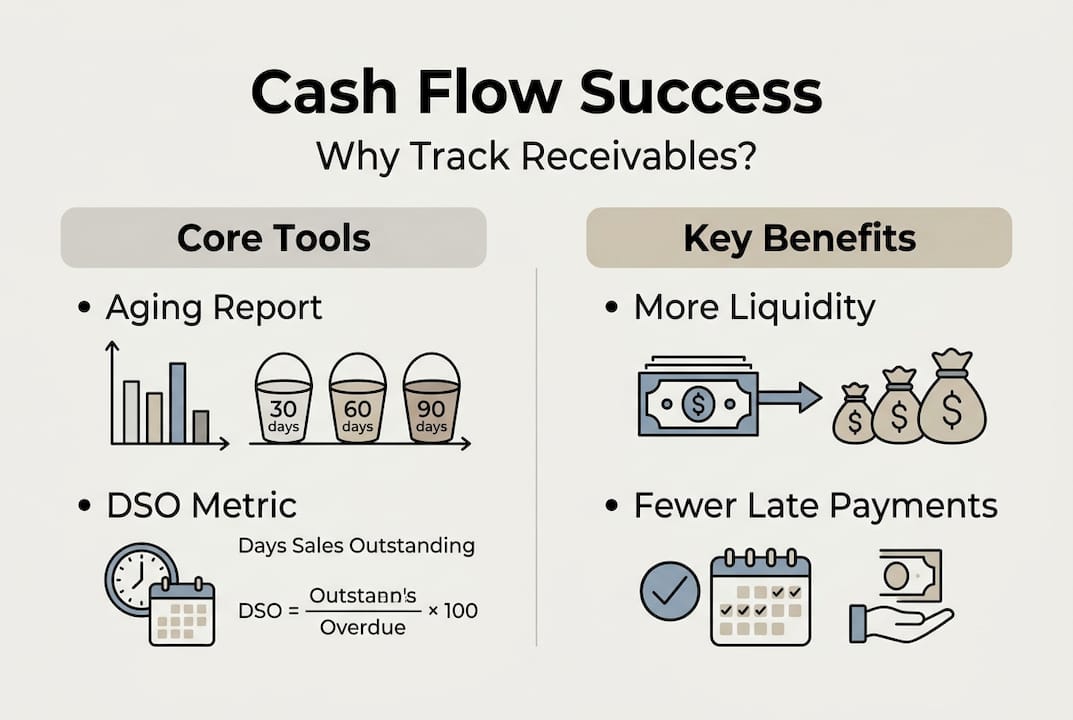
The AR aging report categorizes unpaid invoices into buckets for prioritizing collections and estimating bad debts. This report becomes your roadmap for collection efforts, showing exactly which customers need immediate attention and which invoices pose the highest risk.
A typical aging report divides invoices into these categories:
- 0 to 30 days past due
- 31 to 60 days past due
- 61 to 90 days past due
- Over 90 days past due
Each aging bucket carries different risk levels for non-payment:
| Aging Bucket | Estimated Bad Debt Percentage | Collection Priority |
|---|---|---|
| 0-30 days | 1-2% | Low |
| 31-60 days | 5-8% | Medium |
| 61-90 days | 15-20% | High |
| 90+ days | 35-50% | Critical |
Days Sales Outstanding (DSO) measures how long it takes to collect payment after a sale. Calculate DSO by dividing accounts receivable by total credit sales, then multiplying by the number of days in the period. For example, if you have $15,000 in AR and $45,000 in quarterly credit sales, your DSO is 30 days: (15,000 / 45,000) × 90 = 30.
Small businesses target DSO between 15 and 30 days; anything over 60 days signals serious collection issues. Industry median DSO hovers around 45 days, but efficient operations consistently beat this benchmark.
Use these tools to prioritize collection efforts:
- Focus first on invoices in the 31 to 60 day bucket where bad debt risk jumps significantly
- Contact customers with 90+ day balances immediately to salvage what you can
- Track DSO weekly to spot upward trends before they become crises
- Compare your DSO to industry benchmarks to gauge collection effectiveness
Pro Tip: Automation tools like QuickBooks or Excel formulas generate aging reports instantly, making weekly reviews effortless. Regular monitoring combined with prompt follow-up can cut your DSO below 30 days, dramatically improving cash availability. Learn how to track cash flow systematically to integrate AR monitoring into your broader financial management.
Common accounts receivable challenges and practical solutions
Kansas City small businesses face predictable AR obstacles that drain cash and profitability. 54% of businesses face late payments, with 33% of invoices overdue more than a month and collection rates below 90% signaling serious trouble. Understanding these challenges helps you implement targeted solutions.
Typical AR problems include:
- Late payments that delay your ability to pay suppliers and employees
- Disputed invoices caused by billing errors or service disagreements
- Minor balances under $100 that accumulate because they seem too small to pursue
- Staff turnover disrupting collection follow-up processes
- Inconsistent customer payment behavior creating unpredictable cash flow
These issues create cascading effects. When customers pay late, you can’t pay your own bills on time, damaging supplier relationships and potentially losing early payment discounts. Disputed invoices sit unresolved for months while both parties avoid confrontation. Small balances add up to thousands of dollars in trapped working capital.
Practical solutions address each challenge:
- Schedule weekly minor balance reviews to decide whether to pursue collection or write off amounts strategically
- Resolve invoice disputes within 48 hours by contacting customers immediately when questions arise
- Document collection procedures so any team member can follow up consistently despite turnover
- Use reconciliation processes to catch discrepancies between your records and customer accounts early
- Link AR and accounts payable analysis to understand how customer payment patterns affect your own payment capabilities
Pro Tip: E-invoicing and automated payment reminders reduce invoice errors by 60% and speed collections by sending gentle nudges before invoices become seriously overdue. QuickBooks vs DDD Invoices compares automation options for streamlining your invoicing workflow.
Balance firm collection policies with customer relationships by offering incentive programs like 2/10 Net 30, which gives customers a 2% discount for paying within 10 days while maintaining strict follow-up on overdue balances. This approach rewards good payment behavior without compromising your cash flow needs. Understanding account reconciliation basics helps you maintain accurate AR records that support effective collection efforts.
How effective accounts receivable monitoring boosts profitability and financial stability
Timely AR collection improves liquidity and customer satisfaction, directly boosting profitability. Monitoring accounts receivable limits bad debt write-offs by catching problems when invoices first become overdue rather than waiting until they’re uncollectible. This proactive approach protects your bottom line and frees capital for growth.

Compare the financial impact of active versus passive AR management:
| Metric | Without AR Monitoring | With Active AR Monitoring |
|---|---|---|
| Bad debt write-offs | 8-12% of revenue | 2-4% of revenue |
| Supplier discounts captured | 0-20% of available | 60-80% of available |
| Growth capital available | Limited, unpredictable | Consistent, plannable |
| Average DSO | 55-75 days | 20-35 days |
| Emergency borrowing needs | Frequent | Rare |
Freed working capital from efficient AR collection delivers multiple benefits:
- Capture supplier early payment discounts of 2% to 5%, adding directly to profit margins
- Invest in marketing campaigns or inventory expansion when opportunities arise
- Improve creditworthiness by demonstrating consistent cash management to lenders
- Build cash reserves that protect against unexpected expenses or economic downturns
- Fund equipment upgrades or technology investments without external financing
Lower Days Sales Outstanding through consistent monitoring strengthens your entire financial position. When you collect receivables in 25 days instead of 60, you free up working capital equal to a full month of sales. For a business with $30,000 in monthly credit sales, cutting DSO from 60 to 25 days releases $17,500 in trapped cash.
This improved liquidity creates a virtuous cycle. You pay suppliers early and capture discounts, reducing costs. Lower costs improve margins, generating more profit to reinvest in growth. Growth increases revenue, and efficient AR collection ensures that revenue quickly converts to usable cash. The bookkeeping role in cash control extends beyond simple record keeping to actively managing these cash conversion cycles.
Small businesses with strong AR monitoring maintain stable operations even during slow periods because they’ve built cash reserves from efficient collection. They invest in future growth from operating cash flow rather than expensive debt. This financial stability attracts better customers, improves employee retention, and positions the business for long-term success.
Practical steps for Kansas City small business owners to monitor accounts receivable effectively
Kansas City small businesses should prioritize weekly AR aging reviews using QuickBooks or Xero automation to cut DSO below 30 days, focusing on invoices 31+ days past due first. Implementing these practices transforms AR monitoring from occasional crisis management to routine financial control.
Follow these steps to establish effective AR monitoring:
- Set weekly AR aging report reviews every Monday morning to start your week with clear collection priorities
- Focus collection efforts on the 31 to 60 day overdue bucket where bad debt risk increases sharply but recovery remains likely
- Use accounting automation tools like QuickBooks or Xero to generate aging reports instantly and send automated payment reminders
- Train staff on standardized follow-up processes including when to call, email, or escalate overdue accounts to management
- Implement early payment incentive programs like 2/10 Net 30 that reward prompt payment while maintaining firm policies for overdue balances
Pro Tip: Combine lenient and firm policies by offering attractive early payment discounts but enforcing strict overdue account handling. This balance maintains positive customer relationships while protecting your cash flow.
Integrate AR monitoring into your broader sales and bookkeeping workflow for continuous improvement. When sales teams understand how payment terms affect cash flow, they negotiate better terms upfront. When bookkeepers track AR metrics weekly, they spot problems before they escalate. Learn how to track cash flow systematically to connect AR monitoring with overall financial management.
Monitor key performance indicators weekly to track progress:
- Days Sales Outstanding trending down toward your 15 to 30 day target
- Percentage of invoices in each aging bucket shifting toward current
- Bad debt write-offs declining as percentage of revenue
- Collection effectiveness index measuring cash collected versus cash owed
Kansas City small business owners can access local resources for bookkeeping and advisory help to implement these practices. Professional support accelerates results by setting up automation correctly and training your team on best practices. The small business sales workflow guide offers additional context for integrating AR management into your sales process.
Avoid common setup mistakes by ensuring your accounting software categories match your business needs and your chart of accounts supports detailed AR tracking. Understanding how to fix bookkeeping mistakes in QuickBooks helps you correct errors that might distort your AR reports and lead to poor collection decisions.
Improve your accounts receivable management with expert bookkeeping support
Implementing the AR monitoring practices outlined in this article delivers immediate cash flow improvements, but professional bookkeeping services accelerate your results. Kenworthy Bookkeeping helps Kansas City small businesses set up automated AR aging reports, establish efficient collection workflows, and integrate receivables management into comprehensive financial systems.

Expert guidance ensures you’re not just tracking numbers but interpreting them correctly and taking the right actions. Personalized advice addresses your specific industry challenges, customer payment patterns, and growth goals. Professional bookkeepers configure QuickBooks Online to generate the exact reports you need and train your team on consistent follow-up procedures that maintain customer relationships while protecting cash flow.
Contact Kenworthy Bookkeeping for a consultation to discover how expert support can transform your accounts receivable management from a source of stress into a competitive advantage. This step extends the practical knowledge you’ve gained here with hands-on implementation support tailored to your Kansas City business.
FAQ
What is the best frequency for reviewing accounts receivable?
Weekly reviews are recommended to quickly identify overdue invoices and prevent cash flow issues. This frequency catches problems early when collection remains straightforward. Automation through QuickBooks or similar tools makes frequent review effortless by generating aging reports instantly.
How does an accounts receivable aging report help in collections?
It categorizes unpaid invoices by how long they’re overdue, helping you prioritize which customers to contact first. The report focuses your limited time on accounts with the highest risk and recovery potential. It also helps estimate risk of non-payment based on aging buckets for better financial planning and reserve setting.
Should I offer discounts for early payments on my invoices?
Offering early payment discounts like 2/10 Net 30 can improve cash flow by encouraging timely payment. Many customers appreciate the savings and will adjust their payment schedules to capture the discount. Balance these incentives with firm overdue policies to maintain good customer relations without compromising liquidity or training customers to ignore payment terms.
How can I handle minor AR balances that accumulate and hurt cash flow?
Regularly review minor balances and decide on pursuing collection or write-off policies based on cost-benefit analysis. A $25 invoice might cost $50 in staff time to collect, making write-off the smarter choice. Use account reconciliation processes to catch and address these balances early before they accumulate into significant trapped capital.