

Bookkeeping cycles for small business success in Kansas
Many Kansas small business owners believe bookkeeping only happens at year end, missing the powerful benefits of regular cycles. A bookkeeping cycle is a systematic series of steps to record, verify, and report financial transactions repeatedly throughout the year. Understanding and implementing monthly or quarterly cycles transforms your financial clarity, improves cash flow management, and simplifies tax preparation, helping you make smarter business decisions and boost profitability.
Table of Contents
- Understanding Bookkeeping Cycles: Definition And Importance
- The Step-By-Step Bookkeeping Cycle Process
- The Importance Of Bookkeeping Cycles For Small Businesses
- Common Misconceptions And Mistakes In Bookkeeping Cycles
- How Bookkeeping Cycles Support Tax Season And Compliance
- Practical Benefits Of Bookkeeping Cycles
- Implementing Bookkeeping Cycles In Your Small Business
- How Kenworthy Bookkeeping Can Help Small Businesses In Kansas
- Frequently Asked Questions
Key takeaways
| Point | Details |
|---|---|
| Bookkeeping cycles are ongoing | They systematically manage all financial transactions through repeated steps, not just annual tasks. |
| Monthly cycles improve accuracy | Regular cycles reduce costly errors and provide timely financial insights for better decisions. |
| Cycles simplify tax compliance | Accurate, up-to-date records make tax filing easier and keep you compliant with Kansas and federal laws. |
| Regular cycles boost profitability | Timely tracking improves cash flow visibility and helps you identify profit opportunities quickly. |
| Tools streamline the process | QuickBooks Online and similar software automate steps, maintain organization, and save you valuable time. |
Understanding bookkeeping cycles: definition and importance
A bookkeeping cycle is a series of recurring steps to record, verify, and report all financial transactions systematically. It starts when you identify a transaction and ends with preparing financial statements and closing your books for that period. Each cycle’s accuracy and completeness directly impact your business’s financial health, tax compliance, and ability to make informed decisions.
Adjusting entries ensure revenue and expenses match the correct period, maintaining accurate financial statements over time. Without these adjustments, your profit and loss reports would show distorted results, leading to poor business decisions. Systematic bookkeeping cycles help small businesses avoid errors and maintain clear financial visibility throughout the year.
The importance of this process cannot be overstated for Kansas small businesses. When you follow consistent cycles, you gain real-time insights into your financial position rather than waiting until year end to discover problems. This proactive approach helps you spot cash flow issues early, track profitability trends, and prepare confidently for tax season.
Key components of effective bookkeeping cycles include:
- Transaction identification and collection from all sources
- Chronological recording in journals with proper documentation
- Posting to general ledger accounts by category
- Regular reconciliation to verify accuracy
- Timely adjusting entries for accruals and deferrals
- Financial statement preparation for decision making
- Systematic closing process to reset for the next cycle
With this foundation, let’s walk through the detailed step-by-step process of a bookkeeping cycle.
The step-by-step bookkeeping cycle process
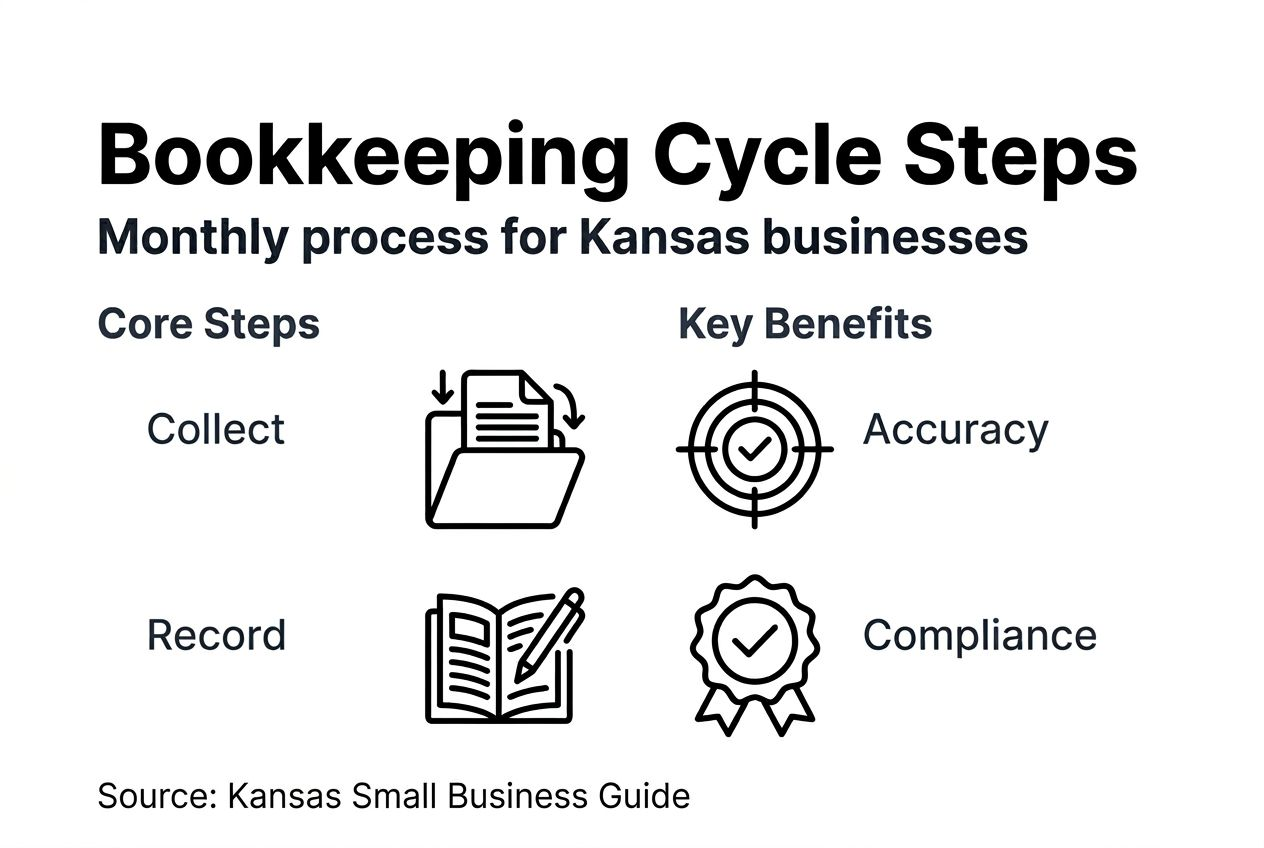
Every bookkeeping cycle follows eight essential steps that build on each other to create accurate financial records. Understanding these stages helps you appreciate why skipping steps or delaying work creates problems down the line.
- Identify and collect transactions: Gather all receipts, invoices, bank statements, and financial documents for the period.
- Record journal entries: Log transactions chronologically with dates, amounts, accounts affected, and brief descriptions.
- Post to general ledger: Transfer journal entries to specific accounts like revenue, expenses, assets, and liabilities.
- Prepare trial balance: List all accounts with their balances to verify total debits equal total credits.
- Make adjusting entries: Record accrued revenues, accrued expenses, deferred revenues, and deferred expenses to match the correct period.
- Prepare adjusted trial balance: Create a new trial balance after adjustments to confirm accuracy before financial statements.
- Generate financial statements: Produce your income statement, balance sheet, and cash flow statement from adjusted balances.
- Close temporary accounts: Reset revenue and expense accounts to zero for the next cycle while permanent accounts carry forward.
The bookkeeping cycle steps ensure accurate recording, forming the basis for complete tax filing and financial reporting. This systematic approach prevents the chaos of scrambling to piece together information at tax time.
Pro Tip: Record transactions within 48 hours of occurrence to prevent backlog and memory gaps that lead to errors.
The following table shows typical timeframes for each step in a monthly cycle:
| Step | Typical Duration | Critical Actions |
|---|---|---|
| Transaction collection | 1-2 days | Gather all receipts and statements |
| Journal entries | 2-3 days | Record with proper documentation |
| General ledger posting | 1-2 days | Categorize accurately by account |
| Trial balance | 1 day | Verify debits equal credits |
| Adjusting entries | 1-2 days | Match revenue and expenses to period |
| Financial statements | 1 day | Generate reports for review |
| Account closing | 1 day | Reset temporary accounts |
Consistent execution of these steps creates reliable financial data. For practical guidance on maintaining these habits, explore our bookkeeping basics guide and bookkeeping checklist to keep your cycles on track.
Now that you know the bookkeeping cycle steps, discover why following these cycles regularly is crucial for your small business.
The importance of bookkeeping cycles for small businesses
Regular bookkeeping cycles transform your financial management from reactive to proactive. Monthly cycles improve financial visibility and cash flow management, helping you avoid surprises and plan strategic growth. This timely approach gives you the data needed to make confident business decisions rather than guessing your financial position.

Timely bookkeeping reduces the risk of errors that could harm profitability or trigger IRS scrutiny. When you wait months to record transactions, memory fades and documents get lost. Monthly or quarterly rhythms prevent this accumulation of chaos, making tax season straightforward instead of stressful. You’ll have organized, verified records ready when your accountant needs them.
Clean, accurate records reduce audit risk and increase confidence from lenders or investors. Financial institutions want to see systematic bookkeeping that demonstrates your business operates professionally. When you apply for loans or seek investment, well-maintained cycles prove you understand your finances and manage them responsibly.
Key benefits of consistent bookkeeping cycles:
- Real-time visibility into profit margins and expense trends
- Early detection of cash flow problems before they become crises
- Simplified tax preparation with organized, year-round documentation
- Better pricing decisions based on accurate cost analysis
- Stronger relationships with banks and potential investors
- Reduced stress during tax season and financial reviews
- Improved ability to forecast and budget for future periods
Regular bookkeeping cycles create a financial foundation that supports every business decision you make, from hiring employees to launching new products.
Consistent cycles also support your profitability strategies by revealing which products, services, or customers generate the best margins. This insight helps you focus resources where they deliver the highest returns.
Even with benefits known, many small businesses make common mistakes with bookkeeping cycles, let’s clear those up next.
Common misconceptions and mistakes in bookkeeping cycles
Many Kansas business owners believe bookkeeping cycles are only necessary annually, missing the substantial benefits monthly or quarterly cycles provide. This misconception costs businesses valuable insights and increases error risk. The reality is that waiting until year end creates overwhelming workloads, increases mistakes, and eliminates opportunities for course correction.
Delayed transaction recording leads to confusion, errors, and incomplete data. When you wait weeks or months to enter transactions, you forget context, lose receipts, and struggle to categorize items correctly. This backlog creates a cascade of problems that compromises your financial accuracy.
Skipping regular bank reconciliation causes errors and possible discrepancies that compound over time. Monthly reconciliation catches bank errors, identifies fraudulent charges, and verifies every transaction has been recorded. Without this verification step, your books slowly drift away from reality.
Ignoring or delaying adjusting entries distorts your financial results significantly. Revenue might appear in the wrong period, expenses get mismatched to the income they generated, and your profit calculations become meaningless. These timing issues make it impossible to understand your true financial performance.
Common mistakes that undermine bookkeeping cycles:
- Recording personal and business expenses in the same accounts
- Failing to save and organize supporting documentation
- Using cash basis accounting when accrual basis is more appropriate
- Neglecting to review financial statements after each cycle
- Skipping the closing process for temporary accounts
- Inconsistent categorization of similar transactions
- Waiting until problems are obvious instead of catching them early
Pro Tip: Set calendar reminders for closing dates and use bookkeeping software with automated prompts to maintain consistent cycles without relying on memory.
For guidance on correcting errors when they occur, review our article on how to fix bookkeeping mistakes in QuickBooks. The key is catching and addressing issues quickly before they multiply. Following accounting cycle best practices helps you avoid these pitfalls entirely.
Understanding these pitfalls prepares you to see how thorough bookkeeping cycles support tax season and compliance.
How bookkeeping cycles support tax season and compliance
Accurate bookkeeping cycles form the foundation for compliant tax filing and financial reporting. When you maintain systematic records throughout the year, tax preparation becomes a straightforward process of compiling existing data rather than a frantic scramble to reconstruct the past. This organized approach reduces filing errors that could trigger audits or penalties.
Bookkeeping cycles reduce chances of IRS audit flags by maintaining organized, verifiable documentation. The IRS looks for consistency, completeness, and reasonableness in tax returns. When your cycles produce clear audit trails showing how you calculated every number, you demonstrate professionalism and reduce suspicion. Missing or contradictory records raise red flags.
Consistent cycles ease end-of-year stress by having up-to-date, verified financial statements ready when you need them. Instead of spending January through April reconstructing your finances, you simply close your final cycle and review annual totals. This efficiency saves money on accounting fees and lets you file earlier, potentially receiving refunds faster.
Preparedness through cycles supports compliance with Kansas state and federal tax regulations. Different tax obligations have different deadlines and requirements. Monthly cycles ensure you’ve captured all necessary information and can meet any filing deadline confidently. You’ll have the data needed for quarterly estimated payments, annual returns, and any special filings your business requires.
Tax benefits of systematic bookkeeping cycles:
- Complete expense documentation maximizes deductible amounts
- Organized records support deductions if questioned by tax authorities
- Timely financial data enables accurate estimated tax payments
- Clear separation of business and personal expenses prevents disallowed deductions
- Proper classification of income types ensures correct tax treatment
- Ready access to prior year data simplifies year-over-year comparisons
Understand how bookkeeping contributes to business success by providing the foundation for tax compliance and strategic planning. The small business accounting cycle creates documentation that satisfies both tax authorities and your own management needs.
Knowing these tax benefits, let’s see the practical business advantages bookkeeping cycles bring.
Practical benefits of bookkeeping cycles
Monthly bookkeeping cycles provide real-time financial insights and better cash flow management compared to less frequent cycles. When you close your books monthly, you see current profit margins, expense trends, and cash positions that inform immediate decisions. Quarterly cycles offer moderate benefits but delay insights, while annual cycles leave you flying blind most of the year.
Better cash flow control arises from timely transaction tracking and reconciliation. Monthly cycles reveal patterns like seasonal slowdowns, late-paying customers, or expense spikes that need attention. You can adjust collections, negotiate payment terms, or cut discretionary spending before cash problems become critical. This proactive management prevents the cash crunches that sink many small businesses.
Accurate profit and loss information allows smarter pricing, expense management, and investment decisions. When you know your true costs and margins by product or service, you can price competitively while protecting profitability. You’ll identify which offerings deliver the best returns and which might need adjustment or elimination.
Pro Tip: Choose cycle frequency based on your transaction volume and business complexity; high-volume businesses benefit most from monthly cycles, while low-volume operations might manage with quarterly cycles.
The following table compares different cycle frequencies:
| Cycle Type | Effort Required | Financial Insight | Error Risk | Best For |
|---|---|---|---|---|
| Monthly | High | Excellent, real-time | Low | High transaction volume, complex operations |
| Quarterly | Moderate | Good, slightly delayed | Moderate | Moderate volume, stable operations |
| Annual | Low initially, high at year-end | Poor, outdated | High | Very low volume, simple operations only |
Monthly cycles require more frequent effort but deliver proportionally greater value through timely insights and error prevention. The work distributes evenly across the year instead of creating year-end crises. Quarterly cycles balance effort and insight for businesses with moderate complexity.
Explore practical ways to streamline small business finances and implement bookkeeping profitability strategies that leverage regular cycle data. The investment in systematic cycles pays dividends through better decisions and stronger financial health.
Finally, let’s explore practical steps to implement bookkeeping cycles effectively in your business.
Implementing bookkeeping cycles in your small business
Choose your bookkeeping cycle frequency based on transaction volume and complexity. Businesses processing dozens of daily transactions need monthly cycles for accuracy and control. Moderate transaction volumes work well with quarterly cycles. Only the simplest, lowest-volume businesses should consider annual cycles, and even then, monthly is safer.
Use accounting software like QuickBooks Online to automate transaction recording and report generation. Digital tools reduce manual entry errors, categorize transactions consistently, and produce financial statements instantly. Cloud-based software lets you access your books anywhere and enables real-time collaboration with bookkeepers or accountants.
Set fixed dates for closing books and reconciliation every cycle to build routine habits. Choose dates that align with your business rhythm, like the last day of each month or specific quarterly dates. Calendar these sessions as non-negotiable appointments. Consistency transforms bookkeeping from an occasional chore into a manageable routine.
Organize receipts, invoices, and statements both digitally and physically for quick access during each cycle. Create folders by month and category. Scan paper documents immediately and file originals systematically. This organization prevents the frantic searches that waste time during closing processes.
Regularly review financial records to catch errors early and adjust entries promptly. Don’t just produce statements; actually read and analyze them. Look for unusual patterns, unexpected changes, or numbers that don’t match your business reality. Early detection prevents small errors from becoming major problems.
Implementation steps for successful bookkeeping cycles:
- Select appropriate cycle frequency for your business size and complexity
- Invest in reliable accounting software with automation features
- Create a closing checklist covering all eight cycle steps
- Schedule dedicated time blocks for bookkeeping tasks
- Establish digital and physical filing systems for all documentation
- Set up automatic bank feeds to reduce manual data entry
- Review financial statements immediately after each cycle closes
- Adjust processes based on what works and what creates friction
Pro Tip: Outsource bookkeeping or consult with professionals if cycles feel overwhelming; expert help often costs less than the mistakes and missed opportunities from poor bookkeeping.
Develop strong bookkeeping habits that support consistent cycles. Implement proven bookkeeping organization tips and learn effective methods for tracking income and expenses to make your cycles efficient and accurate.
With these tips, you can confidently implement efficient bookkeeping cycles to grow your Kansas small business.
How Kenworthy Bookkeeping can help small businesses in Kansas
Managing bookkeeping cycles consistently requires time, expertise, and attention to detail that many Kansas small business owners struggle to maintain while running daily operations. That’s where professional support makes the difference between financial clarity and costly confusion.

Kenworthy Bookkeeping offers tailored services designed specifically for Kansas small businesses using QuickBooks Online. Our experts handle every step of your bookkeeping cycles, from transaction categorization through bank reconciliations to financial statement preparation. We ensure your cycles are accurate, timely, and compliant with all tax requirements.
Professional support eliminates the stress of maintaining bookkeeping cycles yourself. You gain clearer financial reports for better business decisions, improved profitability tracking, and confidence during tax season. Our team becomes your financial partner, helping you understand what your numbers mean and how to use them for growth.
Ready to transform your bookkeeping from a burden into a business advantage? Schedule a consultation to learn how Kenworthy Bookkeeping can streamline your finances, save valuable time, and help you regain control of your business success.
Frequently asked questions
What is a bookkeeping cycle and why is it important?
A bookkeeping cycle is a systematic series of steps to collect, record, verify, and report financial transactions repeatedly throughout an accounting period. It’s important because it keeps financial data organized, accurate, and current, which supports tax preparation, cash flow management, compliance, and informed business decisions. Without consistent cycles, businesses lose financial visibility and increase error risk.
How often should small businesses perform bookkeeping cycles?
Most small businesses benefit from monthly bookkeeping cycles for timely insights and better control. Quarterly cycles work for businesses with moderate transaction volumes and stable operations. Annual cycles are least recommended because they create higher error risk, outdated information, and overwhelming year-end workloads that compromise accuracy.
What common mistakes should be avoided in bookkeeping cycles?
Delaying transaction recording beyond the cycle period, skipping regular bank reconciliations, and ignoring adjusting entries are critical mistakes. Also avoid mixing personal and business expenses, inconsistent categorization, and failing to review financial statements after each cycle. Consistent, timely updates and thorough reconciliation prevent errors and maintain reliable records.
Can bookkeeping software help manage bookkeeping cycles effectively?
Yes, software like QuickBooks Online automates transaction recording, organizes data systematically, and generates reports for each cycle, significantly reducing errors and saving time. Digital tools provide automatic bank feeds, consistent categorization, and instant financial statements. Using accounting software supports routine bookkeeping habits tailored to small business needs while improving accuracy and efficiency.