
Cash basis accounting guide for Kansas businesses 2026
Running a small business in Kansas means juggling countless responsibilities, and accounting often feels like the most confusing piece. Many business owners assume all accounting methods are complicated and time intensive. Cash basis accounting breaks that assumption by offering a straightforward way to track your money as it actually moves in and out of your business, making bookkeeping far less intimidating and more manageable for Kansas entrepreneurs.
Table of Contents
- Understanding Cash Basis Accounting: A Simple Method For Small Businesses
- Cash Basis Accounting Compared To Accrual And Modified Cash Basis Methods
- Benefits And Limitations Of Cash Basis Accounting For Kansas Small Business Owners
- How To Implement Cash Basis Accounting Effectively In Your Kansas Small Business
- Explore Our Bookkeeping Solutions To Simplify Your Cash Basis Accounting
- Frequently Asked Questions
Key takeaways
| Point | Details |
|---|---|
| Cash basis records transactions when money changes hands | Revenue is recorded when you receive payment, and expenses when you pay them, not when invoiced or billed. |
| Simplicity is the primary advantage | This method eliminates complex calculations and makes bookkeeping easier for small business owners without accounting backgrounds. |
| Kansas tax rules align with federal standards | Your accounting method must remain consistent between state and federal filings to ensure compliance. |
| Modified cash basis offers a hybrid approach | Combining elements of cash and accrual methods provides more detailed reporting while maintaining relative simplicity. |
| Business size and complexity determine suitability | Cash basis works best for small operations with straightforward transactions and minimal credit sales. |
Understanding cash basis accounting: a simple method for small businesses
Cash basis accounting recognizes revenue when cash is received and expenses when cash is paid, simplifying bookkeeping for small businesses. This method focuses exclusively on actual money movement rather than obligations or promises. When a customer pays you, that’s when revenue appears in your books. When you write a check or swipe your card, that’s when the expense gets recorded.
This straightforward approach directly tracks your actual cash flow, making it easier to understand exactly how much money you have available at any given moment. Cash basis accounting records income when cash is received and expenses when cash is paid, offering a clear view of your business’s financial position. Small businesses, freelancers, and sole proprietors commonly use this method because it doesn’t require extensive accounting knowledge.
The advantages are compelling for many Kansas business owners:
- Easy to understand and implement without specialized training
- Provides immediate visibility into available cash
- Requires less detailed record keeping than other methods
- Reduces bookkeeping costs and time investment
- Aligns naturally with how most people think about their money
Your bookkeeping basics become more manageable when you focus solely on cash transactions. Instead of tracking who owes you money or what bills are coming due, you simply record what actually happened with your cash.
Pro Tip: Record every cash transaction immediately or at least daily to maintain accurate books. Waiting weeks to catch up on bookkeeping leads to forgotten transactions and unreliable financial data, defeating the simplicity advantage of cash basis accounting.
Cash basis accounting compared to accrual and modified cash basis methods
Understanding the distinctions between accounting methods helps you choose the right approach for your business. Cash basis accounting offers simplicity and real-time cash visibility but doesn’t track receivables or payables. This means you won’t see money customers owe you or bills you haven’t paid yet in your financial reports.
Accrual accounting takes the opposite approach, recording revenues when earned and expenses when incurred, regardless of when cash actually moves. If you send an invoice in December but receive payment in January, accrual accounting recognizes that revenue in December. This method provides a more complete picture of financial obligations but requires significantly more complex bookkeeping.
The modified cash basis combines elements of both cash and accrual accounting to provide more detailed reporting. This hybrid approach typically uses cash basis for most transactions but tracks certain items like inventory or fixed assets using accrual principles.
| Method | Complexity | When Revenue Recorded | When Expense Recorded | Best For |
|---|---|---|---|---|
| Cash Basis | Low | Cash received | Cash paid | Small businesses, sole proprietors, service providers |
| Accrual Basis | High | When earned | When incurred | Larger businesses, those with inventory, companies seeking financing |
| Modified Cash | Medium | Mix of both | Mix of both | Growing businesses needing more detail than pure cash basis |
Each method suits different business situations:
- Cash basis works perfectly for service businesses with immediate payments
- Accrual becomes necessary for companies with significant credit sales or inventory
- Modified cash helps businesses that need more detail but aren’t ready for full accrual complexity
Your business financial health assessment requires understanding which method gives you the most useful information. A lawn care service that collects payment immediately benefits from cash basis simplicity. A construction company with long payment terms might need accrual accounting to track outstanding invoices.
Pro Tip: Evaluate your business model honestly before committing to an accounting method. Consider how often you extend credit, how long customers take to pay, and whether you need to track inventory or major equipment purchases.
Benefits and limitations of cash basis accounting for Kansas small business owners
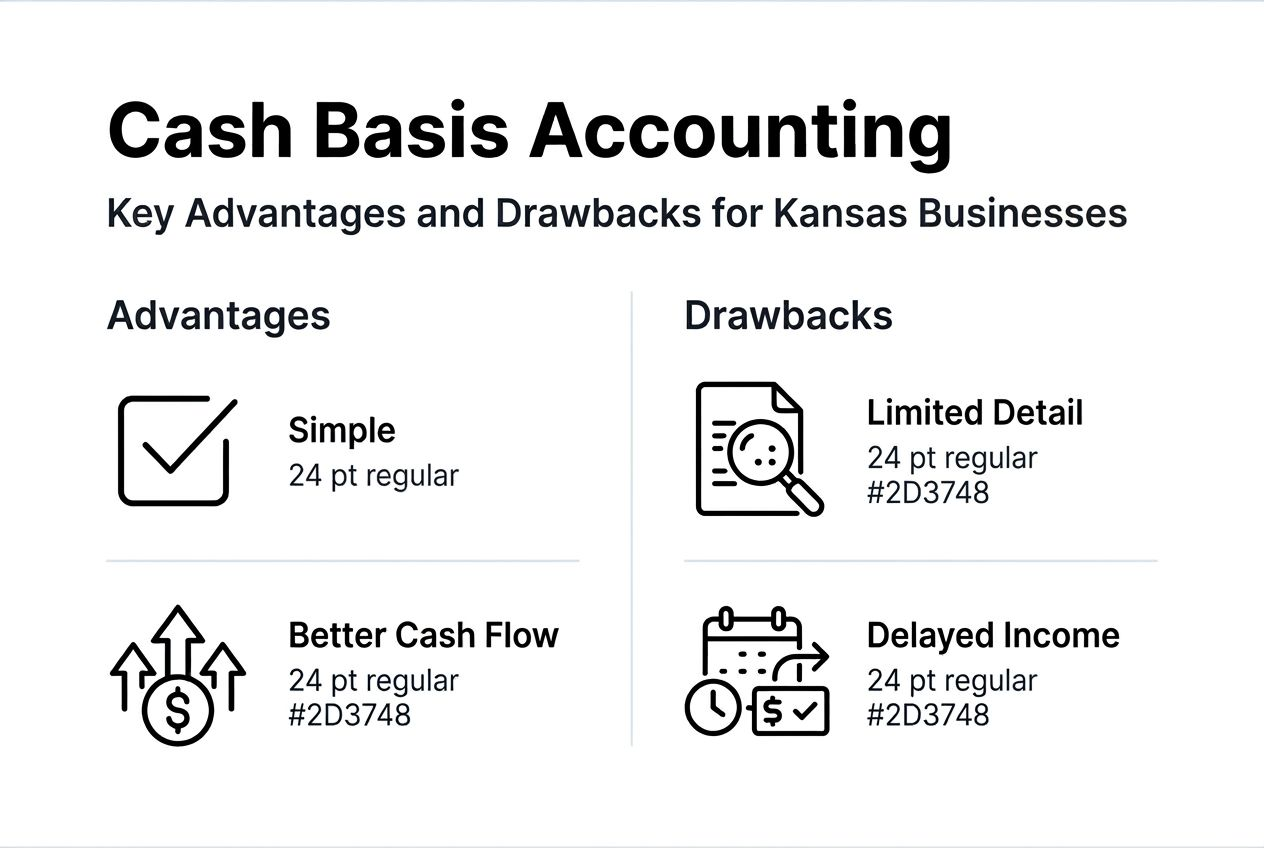
Cash basis accounting delivers significant advantages for Kansas small businesses. The simplicity factor cannot be overstated because you’re only tracking actual money movement. This focus on real cash eliminates the need to calculate complex adjustments or maintain detailed accounts receivable and payable records. Your bookkeeping becomes faster, less expensive, and easier to manage without specialized accounting expertise.
Key benefits include:
- Immediate understanding of available cash for business decisions
- Lower accounting costs due to reduced complexity
- Easier tax planning because you control when to receive or make payments
- Less time spent on bookkeeping tasks, freeing you to focus on operations
- Reduced chance of errors from complex accrual adjustments
However, cash basis accounting simplifies bookkeeping but can lead to inaccurate financial snapshots, especially for businesses with significant inventory or credit transactions. The method’s simplicity creates blind spots that can mislead you about your actual financial position.
Limitations you must consider:
- No visibility into accounts receivable means you can’t see money customers owe
- Unpaid bills don’t appear until you actually pay them, hiding upcoming obligations
- Large purchases in one period can dramatically skew your apparent profitability
- Credit transactions go unrecorded until cash changes hands
- Financial statements may not reflect true business performance during any given period
Imagine you complete $50,000 worth of projects in December but don’t receive payment until January. Cash basis shows zero revenue for December, making that month look terrible even though you did substantial work. Similarly, if you pay annual insurance in January, that month shows a huge expense while the rest of the year shows none, distorting your monthly financial picture.
Kansas tax law aligns with federal regulations requiring the accounting method to be consistent for state and federal income tax. This means you can’t use cash basis for your Kansas return while using accrual for federal taxes. The consistency requirement simplifies compliance but locks you into one method across both returns.
Evaluating if cash basis suits your business:
- Assess your typical transaction patterns and whether you extend credit
- Consider if your business maintains inventory that must be tracked
- Determine whether you need financial statements for loans or investors
- Review IRS gross receipts thresholds that may require accrual accounting
- Evaluate whether the simplicity benefits outweigh the information limitations
Understanding your bookkeeping cycles helps you recognize how cash basis accounting fits into your overall financial management process.
How to implement cash basis accounting effectively in your Kansas small business
Successfully adopting cash basis accounting requires establishing clear processes and maintaining consistency. Cash basis accounting records revenue when you receive payment and expenses when you pay them, making implementation straightforward if you follow systematic steps.
Implementation steps:
- Open separate business bank accounts to clearly distinguish business cash from personal funds, creating a clean foundation for tracking.
- Identify all sources of cash inflows including customer payments, loans, and any other money entering your business accounts.
- Document all cash outflows such as vendor payments, payroll, rent, utilities, and any money leaving your business.
- Establish a recording schedule, whether daily or weekly, to consistently enter transactions while details remain fresh in your memory.
- Reconcile bank statements monthly by comparing your recorded transactions against bank records to catch errors or missing entries.
- Maintain organized receipts and payment documentation to support every transaction you record in your books.
- Consult with a tax professional to ensure your cash basis method complies with federal and Kansas tax requirements for your business type.
Regular bank reconciliation proves essential because it catches discrepancies before they compound into major problems. When your recorded cash balance matches your bank balance, you know your books accurately reflect reality. Any differences signal missing transactions, errors, or potentially fraudulent activity requiring immediate attention.

Cash basis accounting simplifies bookkeeping, making it easier to manage, especially for businesses with immediate payments. This simplicity works best when you maintain discipline around recording transactions promptly and completely.
Tracking your finances effectively requires good habits:
- Record transactions immediately rather than letting them pile up
- Use consistent categories for income and expenses to maintain useful records
- Keep digital copies of receipts and invoices for easy reference
- Review financial reports monthly to spot trends or problems early
- Set calendar reminders for regular bookkeeping tasks to prevent falling behind
Your cash flow tracking becomes significantly easier with cash basis accounting because every transaction directly impacts your available cash. You don’t need to adjust for accounts receivable or payable when reviewing your current financial position.
Consider using accounting software designed for small businesses to automate much of the recording process. Many platforms connect directly to your bank accounts, automatically importing transactions that you simply categorize. This automation reduces manual data entry while maintaining accuracy. Learn more about tracking income and expenses to optimize your financial management.
Pro Tip: Choose accounting software specifically labeled as supporting cash basis accounting to ensure the system handles transactions correctly. Some platforms default to accrual basis or require manual adjustments, defeating the simplicity you’re trying to achieve with this method.
Explore our bookkeeping solutions to simplify your cash basis accounting
Managing cash basis accounting effectively requires consistency and attention to detail that many busy Kansas business owners struggle to maintain. Understanding the method provides a solid foundation, but implementing it correctly while running your business demands time and focus you might not have available.

Kenworthy Bookkeeping provides expert services tailored specifically for Kansas small businesses using cash basis accounting. Our team handles the daily recording, categorization, and reconciliation tasks that keep your books accurate and current. We ensure your financial records remain tax compliant while you focus entirely on growing your business and serving customers. Professional bookkeeping eliminates the stress of managing your own books while providing reliable financial data for better business decisions. Schedule a bookkeeping consultation to discover how our Kansas bookkeeping services can transform your financial management and give you back valuable time.
Frequently asked questions
What is cash basis accounting in simple terms?
Cash basis accounting records revenue only when you actually receive payment and expenses only when you actually pay them. You ignore unpaid invoices or bills until cash changes hands, making this method extremely straightforward for tracking your available money.
Who should use cash basis versus accrual accounting?
Small businesses with annual gross receipts under $25 million, minimal inventory, and immediate payment transactions benefit most from cash basis. Larger companies, those with significant inventory, or businesses needing financing typically require accrual accounting for accurate financial reporting.
How does cash basis accounting affect tax filing in Kansas?
Kansas requires your state tax accounting method to match your federal method, so you must use cash basis consistently across both returns. This alignment simplifies compliance but means you cannot switch methods between state and federal filings.
What is modified cash basis accounting and when is it useful?
Modified cash basis blends cash and accrual methods by using cash basis for most transactions while tracking certain items like equipment or inventory using accrual principles. This hybrid approach suits growing businesses that need more detail than pure cash basis provides without full accrual complexity.
How do I transition from cash basis if my business grows?
Transitioning to accrual accounting requires recording all outstanding receivables and payables as of the change date, creating opening balances for these new accounts. Work with an accountant to ensure the transition follows tax regulations and maintains accurate financial records throughout the switch.
Recommended
- 7 Bookkeeping Best Practices 2025 for Kansas City Owners
- Small Business Accounting: Streamlining Your Kansas City Finances
- Why Bookkeeping Matters for Kansas City Businesses
- Bookkeeping cycles for small business success in Kansas
- Hnry – Accounting for Sole Traders
- Financial Planning for Small Business: Complete Guide – My Mobile Notary