

What is bookkeeping accuracy and why it matters
Accurate bookkeeping is your silent business partner. Small businesses with accurate bookkeeping manage cash flow 25% better than those with frequent errors. Yet many Kansas City home services owners underestimate how precision in financial records directly impacts profitability, tax outcomes, and peace of mind. This guide explains what bookkeeping accuracy truly means, exposes common costly mistakes, and delivers practical steps to master your financial management for better control and results.
Table of Contents
- What Is Bookkeeping Accuracy? Defining The Term
- Why Bookkeeping Accuracy Matters For Your Business
- Common Bookkeeping Errors And Their Financial Consequences
- Bank Reconciliations: The Backbone Of Bookkeeping Accuracy
- Tools And Techniques To Improve Bookkeeping Accuracy
- Common Misconceptions About Bookkeeping Accuracy
- How Bookkeeping Accuracy Supports Tax Season Success
- Practical Steps To Improve Bookkeeping Accuracy
- Improve Your Bookkeeping Accuracy With Expert Help
- Frequently Asked Questions
Key takeaways
| Point | Details |
|---|---|
| Bookkeeping accuracy definition | Recording, classifying, and reconciling every transaction correctly and on time ensures reliable financial statements. |
| Common costly errors | Misclassification, missed entries, and skipped reconciliations inflate tax bills and cloud cash flow visibility. |
| Bank reconciliation impact | Monthly reconciliations reduce errors by 30% and catch discrepancies before they become serious problems. |
| Tools for improvement | QuickBooks Online automation plus manual checklists boost accuracy by 20% and flag anomalies early. |
| Tax season advantage | Accurate records reduce tax liabilities by 15% and support all eligible deductions for maximum savings. |
What is bookkeeping accuracy? Defining the term
Bookkeeping accuracy means more than just keeping receipts. It requires accurate recording, classifying, and reconciling financial transactions essential for reliable financial statements and legal compliance. Think of it as your business’s financial truth system.
Three pillars form the foundation:
- Transaction recording and categorization: Every dollar in and out gets logged immediately with the correct label. Mixing personal and business expenses or recording income in the wrong month creates chaos.
- Bank reconciliations: Matching your books against bank statements monthly catches errors, fraud, or forgotten transactions before they compound.
- Continuous review with automation and checklists: Regular verification using software alerts and manual spot checks ensures nothing slips through cracks.
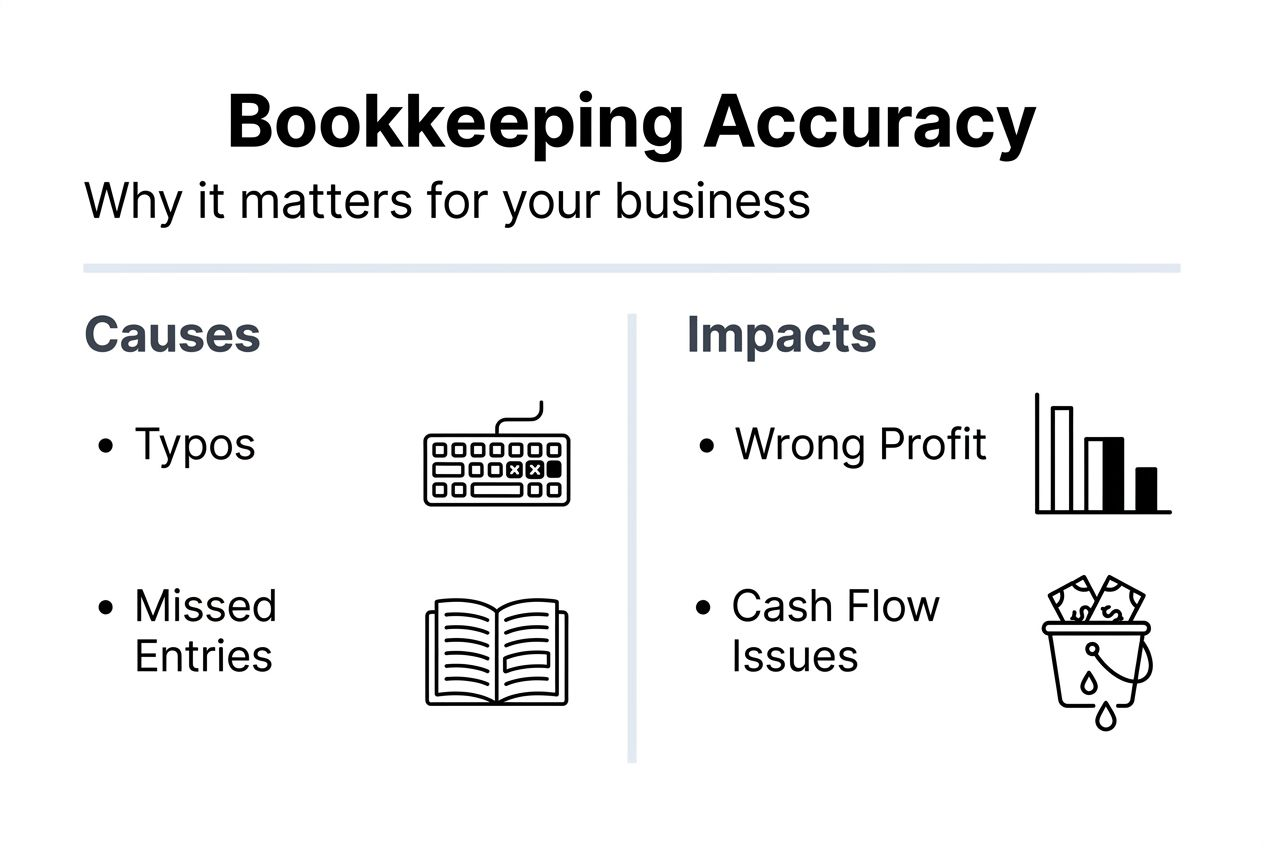
Many owners think bookkeeping accuracy is just about avoiding typos. That misunderstanding creates financial blind spots. You might record the correct amount but assign it to the wrong category, making your profit and loss report misleading. Or you skip reconciling for three months, only to discover a $2,000 discrepancy during tax season.
Precision at every step builds trust in your numbers. When you know your financial statements reflect reality, you make confident decisions about hiring, equipment purchases, or expansion.
Why bookkeeping accuracy matters for your business
Precise bookkeeping delivers real money benefits. Accurate bookkeeping improves cash flow management by 25%, reduces audit risk, and prevents costly decision errors responsible for 60% of business failures. For Kansas City home services businesses juggling jobs, materials, and crews, visibility into actual cash position prevents nasty surprises.
Consider these direct impacts:
- Better cash flow visibility: Know exactly when payments arrive and bills come due. Avoid scrambling for payroll money because you thought you had more available than reality.
- Lower tax audit risk: IRS computers flag inconsistencies. Clean books with proper documentation make audits rare and painless when they happen.
- Smarter business decisions: Should you buy that new truck or hire another technician? Accurate numbers show true profitability per service line, revealing what actually makes money.
- Reduced tax liabilities: Proper categorization captures every deductible expense. Missing write-offs costs you 15 cents per dollar in unnecessary taxes.
Inaccurate books create an expensive illusion. You might think you’re profitable while burning cash, or avoid smart investments because you underestimate available resources. Understanding why bookkeeping matters transforms your relationship with business finances from anxious guessing to confident planning.

Pro Tip: Review your profit and loss statement monthly. If numbers surprise you, that’s a red flag your bookkeeping needs accuracy improvements.
Common bookkeeping errors and their financial consequences
Small mistakes create big problems. Up to 40% of tax filing errors stem from bookkeeping mistakes like mismatched categories, missed transactions, and skipped reconciliations. Kansas City contractors often rush bookkeeping between jobs, creating patterns that cost thousands.
Typical errors include:
- Misclassification: Recording equipment purchases as supplies inflates expenses and reduces asset values on your balance sheet.
- Omissions: Forgetting to log cash payments or small expenses adds up. A $50 weekly error becomes $2,600 annually in missed deductions.
- Late or no reconciliations: Waiting until year end to reconcile means errors multiply. By December, you can’t remember which transactions were legitimate three months ago.
- Personal and business mixing: Using the business account for personal items muddies the water, making tax preparation a nightmare.
Real consequences hit your wallet hard. Misclassified expenses trigger audits. Omitted income raises red flags. Poor records force you to pay taxes on money you never actually made because you can’t prove legitimate deductions.
“Most tax penalties and overpayments trace back to sloppy bookkeeping, not intentional errors. Business owners simply lack systems to maintain accuracy under daily operational pressure.”
Cash flow disruption compounds the damage. Thinking you have $10,000 available when you actually have $6,000 leads to bounced checks and vendor trust issues. Learning to fix bookkeeping mistakes in QuickBooks prevents these cascading failures.
Bank reconciliations: The backbone of bookkeeping accuracy
Bank reconciliation is your early warning system. Monthly reconciliations reduce bookkeeping errors by 30% and prevent costly financial misstatements. This simple monthly habit catches problems while they’re still fixable.
Here’s the reconciliation process:
- Gather statements: Download your bank and credit card statements for the month.
- Compare transactions: Match every bank transaction to your bookkeeping records.
- Identify discrepancies: Flag differences like missing deposits, duplicate entries, or incorrect amounts.
- Investigate and correct: Research each discrepancy, then adjust your books or note bank errors.
- Document resolution: Record how you resolved differences for future reference and audit trails.
The impact shows clearly:
| Metric | Without Monthly Reconciliation | With Monthly Reconciliation |
|---|---|---|
| Error detection time | 3-6 months | Within 30 days |
| Average error cost | $850 per incident | $120 per incident |
| Tax filing confidence | Low (estimates required) | High (verified numbers) |
| Audit preparation time | 40+ hours | 8-12 hours |
Pro Tip: Set a recurring calendar reminder for the 5th of each month to reconcile the previous month. Integrate your bank feeds with QuickBooks Online to automate transaction imports, cutting reconciliation time in half.
Reconciliations support tax compliance and audit preparedness. Understanding the reconciliation process gives you confidence your numbers withstand IRS scrutiny. The role of reconciliation in bookkeeping extends beyond error detection to strategic financial management.
Tools and techniques to improve bookkeeping accuracy
Smart tools multiply your accuracy without multiplying your time. QuickBooks Online automates transaction categorization and flags anomalies, while bookkeeping checklists increase accuracy by 20%. Kansas City home services owners need both technology and process.
QuickBooks Online offers specific advantages:
- Automatic bank feeds: Transactions import daily, reducing manual entry errors and saving hours.
- Smart categorization: Machine learning suggests categories based on vendor history and transaction patterns.
- Anomaly alerts: Unusual transactions like duplicate payments or unexpected amounts trigger notifications.
- Receipt capture: Photo receipts with your phone, and the app extracts amounts and vendors automatically.
Beyond software, daily habits matter:
- Record transactions the same day they occur, while details are fresh.
- Categorize carefully using a consistent chart of accounts, not random guesses.
- Reconcile monthly without exception, treating it like a required business appointment.
- Review reports regularly, comparing actual performance to your expectations and prior months.
Pro Tip: Combine automation with manual review for optimal accuracy. Let software handle routine categorization, then spend 30 minutes weekly spot checking for unusual patterns or obvious errors.
Building a simple checklist ensures consistency. Before closing each month, verify you’ve imported all transactions, categorized everything, attached supporting receipts, and reconciled all accounts. Automating bookkeeping cuts errors and saves time, but human oversight catches what algorithms miss. When issues arise, knowing how to fix mistakes in QuickBooks prevents small problems from becoming disasters.
Common misconceptions about bookkeeping accuracy
False beliefs sabotage accuracy efforts. Understanding what bookkeeping accuracy actually requires prevents wasted effort and costly mistakes.
Misconception realities:
- “Bookkeeping is just record keeping”: Wrong. Recording transactions is step one. Classification determines tax outcomes and decision quality. Timely recognition affects when revenue and expenses hit your books.
- “I can skip reconciliation if I trust my bank”: Banks make mistakes too. More importantly, reconciliation catches your errors, duplicate entries, and fraudulent transactions.
- “Automation guarantees accuracy”: Software reduces errors but can’t interpret unusual situations. A $5,000 equipment purchase might auto categorize as supplies, requiring your correction.
- “Accuracy only means correct numbers”: Timeliness and completeness matter equally. Recording December income in January shifts tax liability to the wrong year.
- “Perfect books require accounting degrees”: Systematic processes and good tools enable accuracy without professional credentials, though complex situations benefit from expert help.
The biggest trap is believing accuracy happens automatically. It requires intentional systems, regular attention, and willingness to fix mistakes promptly. Waiting until tax season to worry about accuracy means playing expensive catch up.
How bookkeeping accuracy supports tax season success
Tax season rewards preparation. Accurate bookkeeping reduces tax liabilities by 15% and enables smooth IRS audits by supporting all eligible deduction claims. For Kansas City home services businesses, that translates to thousands in legitimate savings.
Direct tax benefits include:
- Maximum deductions: Proper categorization captures vehicle expenses, equipment depreciation, home office costs, and supply purchases that sloppy books miss.
- Lower penalty risk: Clean records with supporting documentation eliminate “reasonable cause” for IRS penalties when questions arise.
- Faster, cheaper preparation: CPAs charge less when they receive organized books instead of shoeboxes of receipts requiring reconstruction.
- Audit confidence: If selected for audit, complete records with bank reconciliations demonstrate good faith compliance, often resulting in quick resolution.
“The difference between paying $8,000 and $12,000 in taxes often comes down to documented deductions that accurate bookkeeping preserves. Business owners literally leave money on the table by failing to track deductible expenses properly.”
Accurate books also enable strategic tax planning. Knowing your year to date profit in October allows discussions with your CPA about equipment purchases or retirement contributions that optimize your 2026 tax position. Waiting until January 2027 eliminates those opportunities.
Strong bookkeeping creates an audit story. Each transaction has proper documentation showing business purpose. Your numbers reconcile to bank statements. Categories follow tax code logic. Even aggressive legitimate deductions become defensible with this foundation.
Practical steps to improve bookkeeping accuracy
Implementation beats information. Following these accuracy improvement steps using monthly bank reconciliations, bookkeeping software, and maintenance checklists transforms financial control.
Action plan for Kansas City home services businesses:
- Record promptly: Enter or import transactions within 24 hours while you remember details. Attach digital receipt photos immediately.
- Categorize correctly: Use your chart of accounts consistently. When unsure, research the proper category or mark for CPA review rather than guessing.
- Reconcile monthly: Block time on the 5th of each month to reconcile all accounts from the prior month without fail.
- Use software automation: Set up QuickBooks Online bank feeds and enable smart categorization to reduce manual work and errors.
- Review with checklists: Create a monthly closing checklist covering transaction imports, categorization completion, reconciliations, and report review.
Tailor these to your specific situation. Contractors with equipment might add monthly depreciation entries. Service businesses with recurring customers might automate invoice generation. The goal is systematic habits, not perfect complexity.
Following best practices designed for Kansas City owners addresses local tax considerations. Small business accounting approaches factor in Missouri requirements. Streamlined bookkeeping for home services recognizes industry specific needs like job costing and progress billing.
Start with one improvement. Maybe that’s setting up bank feeds this week. Next month, add reconciliation discipline. Building accuracy happens through consistent small steps, not overnight transformation.
Improve your bookkeeping accuracy with expert help
Mastering bookkeeping accuracy delivers real financial benefits, but implementation challenges persist for busy business owners. Kenworthy Bookkeeping specializes in helping Kansas City home services businesses achieve the precision this guide describes.

Our QuickBooks Online experts handle monthly categorization, bank reconciliations, and accuracy verification so you focus on running jobs and growing revenue. We implement the automation and checklist systems covered here, customized for your specific business needs. Clients typically see improved cash flow visibility within 30 days and reduced tax preparation costs every year.
Whether you need full service bookkeeping or coaching to improve your internal processes, schedule a consultation to discuss your accuracy goals. We’ll assess your current situation and recommend solutions that fit your budget and timeline. Better bookkeeping accuracy means better business decisions and more money in your pocket.
Frequently asked questions
What is bookkeeping accuracy and why is it important?
Bookkeeping accuracy means recording, classifying, and reconciling all financial transactions correctly and on time. It’s crucial because accurate books enable reliable financial decisions, ensure tax compliance, reduce audit risk, and directly improve profitability through better cash flow management.
How often should I perform bank reconciliations for my business?
Perform bank reconciliations monthly to maintain accuracy and catch errors early. Businesses with high transaction volumes or complex cash flow might benefit from weekly reconciliations. Never go longer than one month, as older discrepancies become nearly impossible to resolve accurately.
Can automation replace manual bookkeeping review?
Automation improves accuracy by reducing human data entry errors but cannot fully replace manual review. Software misses context like unusual transactions, duplicate payments, or incorrect categorization. Effective bookkeeping combines automated transaction imports with weekly manual spot checks for completeness and logic.
How does accurate bookkeeping affect my taxes?
Accurate bookkeeping helps claim all eligible deductions, potentially reducing tax liabilities by 15% through proper expense categorization. It also makes tax filing faster and cheaper, reduces penalty risk from documentation gaps, and creates strong audit defense if the IRS requests verification of claimed deductions.