

Bookkeeping vs. Accounting: What Kansas Businesses Need to Know
TL;DR:
- Bookkeeping involves daily recording of financial transactions, providing accurate and organized records.
- Accounting analyzes bookkeeping data to generate financial insights, tax strategies, and growth planning.
- Both roles are essential; automation helps with bookkeeping, but human expertise remains crucial for accounting.
Many Kansas small business owners treat bookkeeping and accounting as the same thing. They are not. Mixing them up can lead to missed tax deductions, compliance issues, and financial blind spots that quietly drain your business. The good news is that understanding the difference is simpler than you think, and acting on that knowledge can change how you manage your money. This guide walks you through clear definitions, a side-by-side comparison, how automation is reshaping both roles, and practical guidance for choosing the right support for your Kansas business.
Table of Contents
- What is bookkeeping? The foundation of business financials
- What is accounting? Turning data into business strategy
- Bookkeeping vs. accounting: Key differences for Kansas small businesses
- How automation is changing bookkeeping and accounting in Kansas
- Which does your business need? Choosing the right support in Kansas
- Why most business owners get this wrong—and how to avoid it
- Get the right financial support for your Kansas business
- Frequently asked questions
Key Takeaways
| Point | Details |
|---|---|
| Bookkeeping vs. accounting | Bookkeeping records daily transactions, while accounting interprets that data for compliance and strategic decision-making. |
| Both are essential | Combining accurate bookkeeping with expert accounting guidance optimizes your business finances. |
| Automation reshapes roles | Automating bookkeeping can cut errors, but human oversight and accounting are still crucial. |
| Kansas business application | Kansas owners should balance technology with local expertise to meet regulations and fuel growth. |
What is bookkeeping? The foundation of business financials
Bookkeeping is exactly what it sounds like: keeping the books. It is the daily practice of recording every financial transaction your business makes. Think of it as the foundation your entire financial picture is built on. Without accurate bookkeeping, everything else falls apart.
Bookkeeping is the process of recording daily financial transactions, including data entry, reconciling bank statements, managing invoices, and processing payroll. It serves as the foundational record-keeping layer for any business, large or small.
Here is what a bookkeeper typically handles on a regular basis:
- Recording income and expenses as they occur
- Managing invoices sent to clients and received from vendors
- Reconciling bank statements to catch discrepancies early
- Processing payroll and tracking employee-related costs
- Maintaining ledgers that organize all financial activity by category
For small business owners in Kansas, accurate bookkeeping is not just a nice-to-have. It is the difference between knowing where your money goes and guessing. Clean records protect you during tax season, support loan applications, and give you a clear picture of your cash flow.
Understanding bookkeeping’s role in small business goes beyond just staying organized. It directly affects your ability to make smart, confident decisions every month.
“Accurate books are not just about compliance. They are about control. When your records are clean, you stop reacting to your finances and start leading your business.”
Pro Tip: Set a weekly time block, even just 30 minutes, to review your transactions. Catching errors early is far less painful than untangling months of mistakes before tax season.
One important thing to keep in mind: bookkeeping is focused on recording and organizing data. It does not interpret that data or tell you what it means for your business strategy. That is where accounting comes in. For more practical guidance, explore these bookkeeping tips for service owners to build strong habits from the start.
What is accounting? Turning data into business strategy
Accounting picks up where bookkeeping ends. While bookkeeping captures the raw numbers, accounting makes sense of them. It transforms your organized financial records into insights you can actually use to grow your business and stay compliant.
Accounting involves analyzing the recorded data from bookkeeping, preparing financial statements, ensuring regulatory compliance, handling tax preparation, conducting audits, and providing strategic financial advice and forecasting. It is a higher-level function that requires analytical skill and regulatory knowledge.
Here is what accounting typically covers:
- Preparing financial statements including income statements, balance sheets, and cash flow reports
- Filing tax returns and identifying legal deductions to reduce your tax burden
- Conducting audits or preparing your records for external review
- Providing financial forecasts to guide hiring, expansion, or investment decisions
- Ensuring compliance with federal, state, and local regulations
For Kansas small businesses, accounting is what turns your monthly numbers into a business health assessment. It answers questions like: Are we profitable? Can we afford to hire? Should we expand this year?
“Bookkeeping tells you what happened. Accounting tells you what it means and what to do next.”
Pro Tip: Even if you handle your own bookkeeping, schedule at least one annual review with a licensed accountant. They can spot tax-saving opportunities and compliance risks you might easily miss.
Understanding your financial statements guide is a smart starting point for any business owner who wants to move from simply tracking numbers to actually using them. Pair that with solid financial planning tips and you have a real strategy for growth.
Bookkeeping vs. accounting: Key differences for Kansas small businesses
Now that you understand each role individually, here is a direct comparison to clarify how they work together and where they differ.
| Feature | Bookkeeping | Accounting |
|---|---|---|
| Primary focus | Recording transactions | Analyzing and interpreting data |
| Key tasks | Ledgers, reconciliations, invoices | Tax prep, audits, forecasting |
| Skillset | Detail-oriented, organized | Analytical, regulatory knowledge |
| Output | Clean, organized records | Financial insights and reports |
| Timing | Ongoing, daily or weekly | Periodic, monthly or annually |
| Business impact | Accuracy and compliance | Strategy and growth |
The core distinction is simple. Bookkeeping provides the raw data foundation, while accounting delivers insights for decision-making, tax optimization, and compliance. Kansas small business owners benefit most when they treat both as essential, not optional.
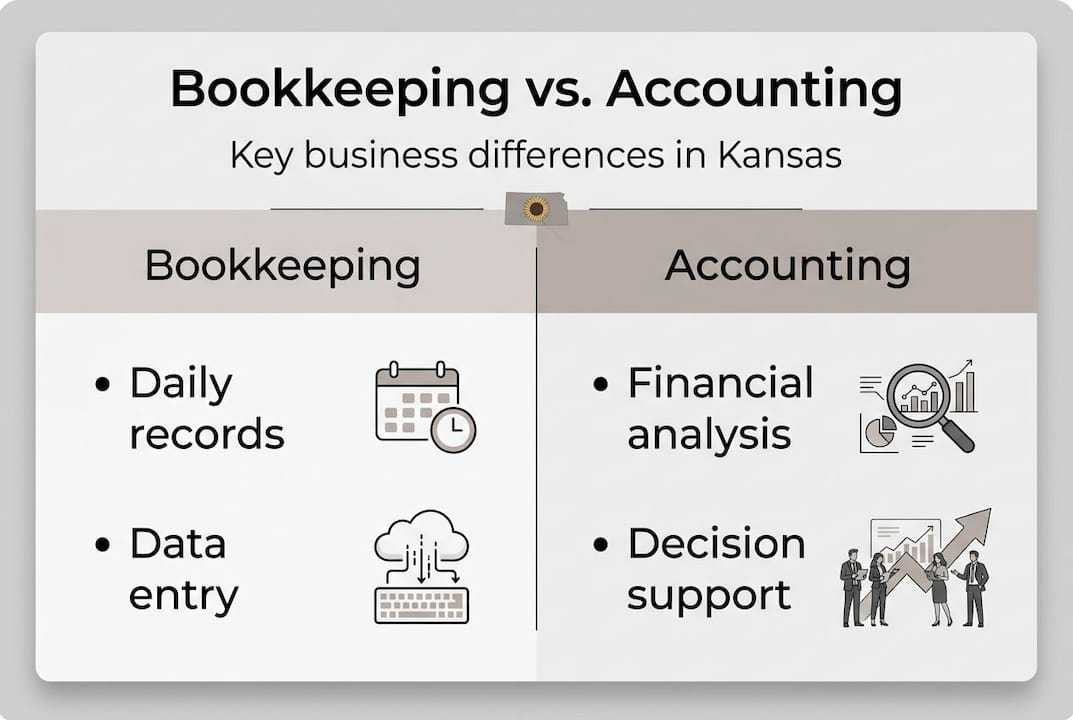
Here is something worth knowing about the labor market. BLS data shows bookkeepers earn a median salary of $47,440 to $49,210, with a projected job decline of 5 to 6 percent through 2034 due to automation. Accountants, by contrast, earn $79,880 to $81,680 with a projected 5 percent growth in demand. This tells you something important: routine bookkeeping tasks are increasingly automated, but the need for expert financial analysis is growing.
For Kansas businesses, this means you can leverage automation tools to handle repetitive bookkeeping tasks while investing in accounting expertise for the decisions that matter most. Understanding why bookkeeping matters is the first step, but combining it with accounting analysis is what drives real results. Regular bookkeeping reviews also help you catch issues before they become expensive problems.
How automation is changing bookkeeping and accounting in Kansas
Technology is reshaping both professions, and Kansas small business owners need to understand what that means for them practically.
Bookkeeping has seen the biggest shift. Software like QuickBooks Online can automatically import bank transactions, categorize expenses, and generate basic reports. This reduces manual errors and saves significant time. However, automation is not foolproof. Miscategorized transactions, duplicate entries, and syncing errors still happen. Human oversight remains essential.
The projected bookkeeper job decline of 5 to 6 percent through 2034 reflects this reality. Automation is handling the repetitive work, but it is not replacing the judgment needed to keep records accurate and meaningful.
Here is a practical breakdown of what automation handles well versus where human expertise is still needed:
| Task | Automation handles | Human expertise needed |
|---|---|---|
| Transaction import | Yes | Reviewing for errors |
| Expense categorization | Mostly | Correcting mismatches |
| Bank reconciliation | Partially | Resolving discrepancies |
| Tax preparation | No | Fully requires expertise |
| Financial forecasting | No | Requires strategic analysis |
For Kansas business owners, here is a practical action plan:
- Set up automated transaction imports through your accounting software to reduce manual data entry.
- Review categorizations weekly to catch errors before they compound.
- Use automated reports for a quick monthly snapshot of your finances.
- Retain a bookkeeping professional to oversee your automated system and ensure accuracy.
- Work with an accountant for tax season, compliance reviews, and growth planning.
Pro Tip: Automation is a tool, not a replacement. Think of it as a capable assistant that still needs a skilled manager. Explore how bookkeeping automation in Kansas is evolving, and learn how to automate bookkeeping without losing the accuracy your business depends on.
Which does your business need? Choosing the right support in Kansas
This is the practical question most Kansas small business owners are really asking. The answer depends on your stage of growth, complexity, and goals.
Here is a straightforward framework to help you decide:
- Just starting out? Focus on clean bookkeeping first. Accurate records from day one prevent headaches later.
- Growing and hiring? Add periodic accounting reviews to stay compliant with payroll taxes and employment regulations in Kansas.
- Filing taxes or seeking funding? You need an accountant. Tax preparation and loan applications require professional analysis.
- Scaling or planning expansion? Integrate both. Accurate bookkeeping feeds your accountant the data they need for strategic forecasting.
- Feeling overwhelmed? Outsourcing bookkeeping is often the fastest way to regain control without hiring full-time staff.
Outsourcing or integrating both bookkeeping and accounting is the recommended approach for most Kansas small businesses. It reduces errors, saves time, and ensures you have both accurate records and expert guidance when you need it.
Kansas has its own regulatory landscape, including state sales tax requirements and specific filing deadlines. Staying compliant means your records need to be accurate and current, not just at year-end but throughout the year.
Pro Tip: Do not wait until tax season to think about your financials. A monthly bookkeeping routine paired with quarterly accounting check-ins keeps you ahead of problems instead of reacting to them. Understanding the bookkeeping role in business planning can help you build a financial routine that supports your goals year-round.
Why most business owners get this wrong—and how to avoid it
Here is something we see consistently: business owners either over-rely on bookkeeping and skip accounting entirely, or they assume their accountant handles everything and neglect their daily records. Both approaches create real problems.
When you treat bookkeeping and accounting as fully interchangeable, you create blind spots. Your books might look organized, but without accounting analysis, you could be missing tax-saving opportunities or heading toward a cash flow crisis without realizing it.
The hard truth is that neither role alone is enough. Bookkeeping without accounting is like having a detailed map but no destination. Accounting without accurate bookkeeping is like trying to navigate with bad data. You need both working together.
Kansas businesses that thrive financially tend to automate routine bookkeeping tasks while retaining local accounting expertise for compliance and growth decisions. They do not cut corners on either end. Understanding why businesses often overlook professional help is the first step toward making a smarter choice for your own business.
Get the right financial support for your Kansas business
You now have a clear picture of what bookkeeping and accounting each bring to your business, and why both matter. The next step is making sure your financial foundation is actually solid.

At Kenworthy Bookkeeping, we handle your books like they are our own business. We specialize in QuickBooks Online bookkeeping for Kansas City area small businesses, including categorization, bank reconciliations, P&L reports, and tax season preparation. Our tailored solutions give you accurate records and the clarity you need to make confident decisions. If you are ready to stop stressing about your finances and start leading your business with confidence, schedule a consultation with our team today.
Frequently asked questions
Do I need both a bookkeeper and an accountant for my Kansas business?
Most Kansas small businesses benefit from both. Bookkeeping keeps your records accurate and current, while accounting provides the compliance oversight and strategic guidance your business needs to grow responsibly.
Can automation fully replace bookkeepers or accountants?
Automation handles repetitive bookkeeping tasks well, but expert oversight is still essential for accuracy. Accountant demand is growing because analysis, compliance, and strategic advice require human judgment that technology cannot replicate.
When should I hire a bookkeeper versus an accountant?
Hire a bookkeeper when you need accurate, organized daily records to manage cash flow and stay audit-ready. Consult an accountant for tax prep and compliance, growth planning, or any situation involving complex financial decisions.
What’s the cost difference between bookkeeping and accounting?
Bookkeeping services generally cost less because the role requires less specialized credentials. Accounting services cost more due to the higher level of expertise involved, with accountant median salaries ranging from $79,880 to $81,680 compared to $47,440 to $49,210 for bookkeepers.